The Language We're Losing
L. M. Sacasas has written something urgent about language at the moment language machines are reshaping what words mean. The piece arrives as large language models turn human speech into training data, and Sacasas treats this not as a technical problem but as a human one. What does language have to do with human flourishing? That question anchors everything.
Words as Human Fabric
Sacasas opens with Iris Murdoch's warning from "The Idea of Perfection": "Words are the most subtle symbols which we possess and our human fabric depends on them. The living and radical nature of language is something which we forget at our peril." This is not nostalgia. Murdoch wrote before chatbots could mimic human conversation, yet her warning cuts deeper now that language has become raw material for machines.
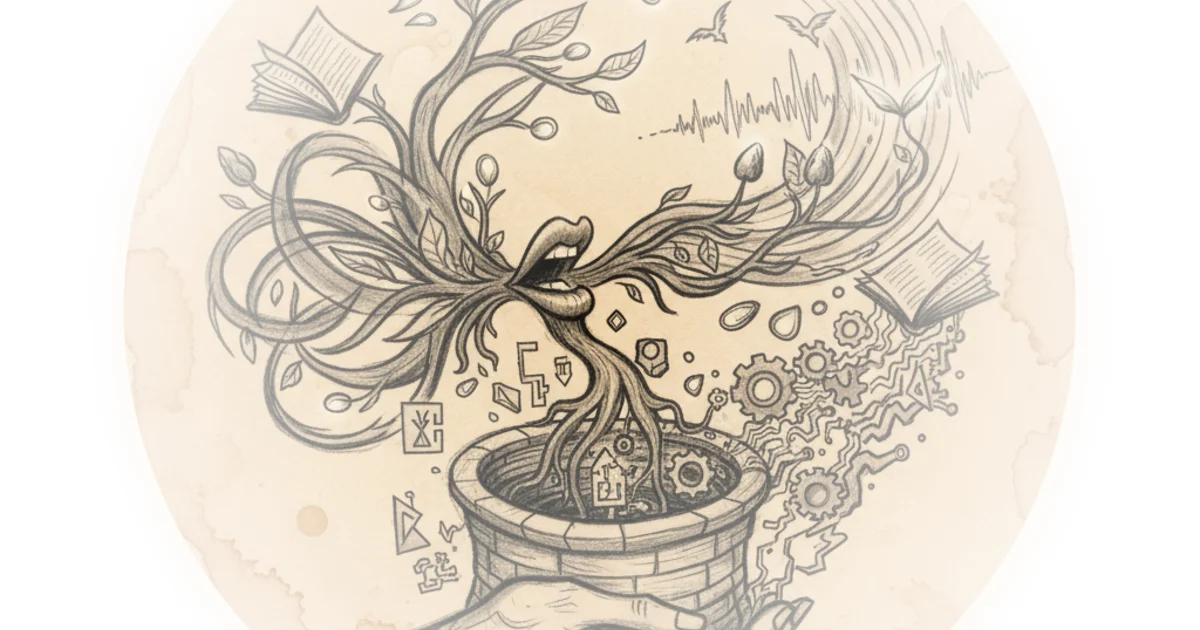
As Sacasas puts it, technology cannot be understood merely as a neutral tool. Language machines operate on words as their input, their interface, and their output. The question becomes whether outsourcing articulation erodes our capacity to judge well.
"Words are the most subtle symbols which we possess and our human fabric depends on them. The living and radical nature of language is something which we forget at our peril."
Stewarding the Gift
Sacasas draws on Marilyn Chandler McIntyre's Caring for Words in a Culture of Lies to argue that language requires active care. McIntyre writes, "if language is to retain its power to nourish and sustain our common life, we have to care for it in something like the way good farmers care for the life of the soil." Three prescriptions follow: deepen reading skills, cultivate precise speaking and listening, practice being makers of words.
Sacasas adds a crucial qualifier: delight in metaphor, but only good metaphor. The piece includes J.R.R. Tolkien's sharp refusal of a bad metaphor—"I don't tick. I am not a machine"—as a model of linguistic self-defense.
Language Disintegration
Wendell Berry's "Standing By Words" provides the heaviest weight. Sacasas quotes Berry on two epidemic illnesses: "the disintegration of communities and the disintegration of persons." Berry connects these to language itself: "My impression is that we have seen, for perhaps a hundred and fifty years, a gradual increase in language that is either meaningless or destructive of meaning."
Critics might note that Berry wrote forty years ago about nuclear regulators and print culture. Yet Sacasas argues the disintegration accelerated with specialized professional language. Berry called it "a cheat and a hiding place; it may, indeed, be an ambush." When experts cannot say what they are talking about to their neighbors, public responsibility becomes public relations.
Corruption of the Word
Josef Pieper's "Abuse of Language—Abuse of Power" links linguistic corruption to political corruption. Sacasas quotes Pieper: "if the word becomes corrupted, human existence itself will not remain unaffected and untainted." The abuse of political power finds fertile soil in the sophistic abuse of words.
George Steiner's observation about German language after the Holocaust sharpens the point. Languages can absorb cheapness and hysteria until a breaking point. Something settles in the marrow. The language no longer performs its functions: conveying humane order and communicating the quick of the human spirit.
Critics might argue this framing is too dark for the current moment. Not every degraded phrase leads to tyranny. Yet Sacasas suggests the almost imperceptible moment when words lose dignity matters precisely because it is imperceptible.
Triadic Worlds
Sacasas closes with Rowan Williams drawing on Walker Percy and Charles Pearce: language transforms experience from stimulus-response into a triadic world where symbols stand between minds and objects. This world includes risk of metaphor, possibility of error, possibility of fiction. The human speaker takes the world as a project.
Sacasas writes that we cannot easily imagine human speaking without these risks. That is the point worth keeping.
Bottom Line
Sacasas has assembled fragments that hang together meaningfully around one claim: language machines threaten not just convenience but human fabric. The piece succeeds by refusing to treat technology as neutral. The verdict: read this when you need to remember why words matter more than efficiency.