Public Notice delivers a searing indictment of the executive branch's latest maneuver, arguing that the administration's half-hearted release of the Jeffrey Epstein files is not a victory for transparency, but a clumsy legal violation that will ultimately fracture the very coalition it seeks to protect. The piece's most striking claim is that the government's refusal to release unredacted documents is a self-inflicted wound that is already turning former allies into vocal critics, proving that stonewalling is a failing strategy even for those who believe they are untouchable.
The Architecture of Defiance
Public Notice opens by dismantling the administration's narrative that the recent document dump satisfies the law. The author points out that the Epstein Files Transparency Act was passed with near-unanimous support and explicitly forbade redactions based on "embarrassment, reputational harm, or political sensitivity." Yet, the Justice Department, under Attorney General Pam Bondi, released files that were "farcically censored," including a 100-page grand jury testimony that was entirely blanked out. Public Notice writes, "The administration's blatant defiance of statute is yet another ugly exercise in lawlessness by a fascist regime which attacks the Constitution on multiple fronts virtually every day."
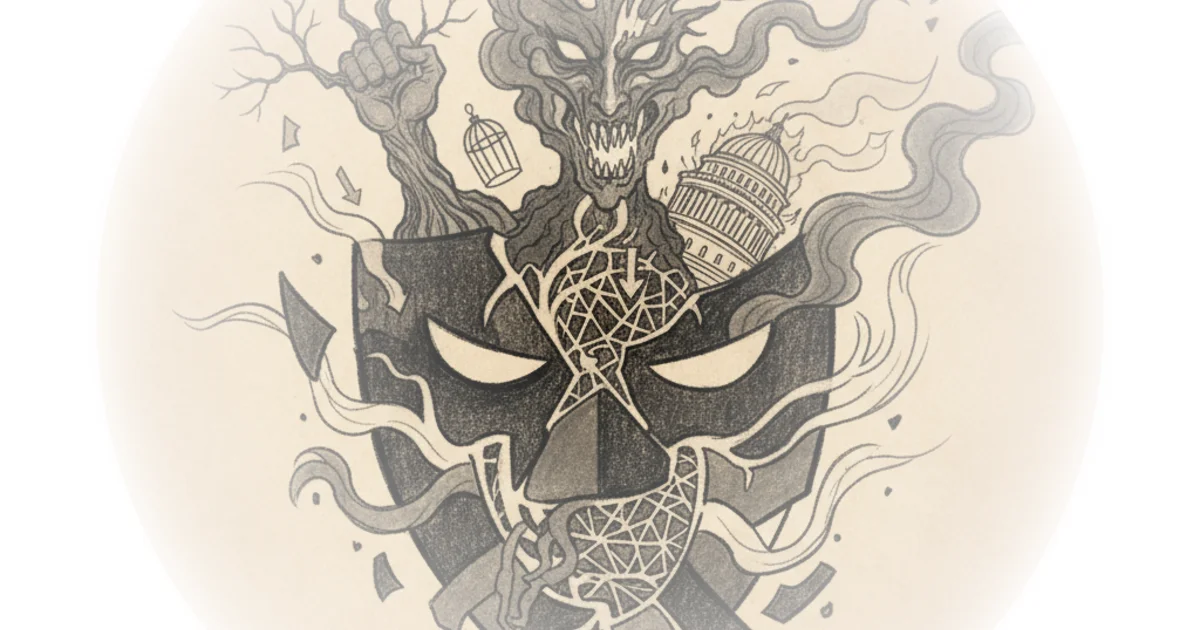
This framing is aggressive, but the evidence presented suggests the legal argument is sound. The statute allowed for redactions only regarding victims and child sexual abuse material, yet the government applied the same standard to "politically exposed individuals." By highlighting that the FBI failed to act on a 1990s complaint from Maria Farmer—a failure that likely allowed further abuse—the author underscores the human cost of this bureaucratic obstruction. The argument here is that the delay isn't just political theater; it is a continuation of the systemic failures that allowed the abuse to persist in the first place.
The material the DOJ released last Friday is farcically censored.
Critics might argue that the administration is simply exercising standard discretion to protect privacy or ongoing investigations, but the author effectively counters this by noting that Deputy Attorney General Todd Blanche admitted more documents would be released "over the next couple of weeks," a timeline that directly contradicts the statutory 30-day mandate. This admission of non-compliance undermines any claim of good faith.
The Royal Silence and the Partisan Double Standard
The commentary then pivots to the specific omissions that reveal the true intent behind the redactions. Public Notice notes the conspicuous absence of Andrew Mountbatten-Windsor, a royal family member accused of collaborating with Epstein, despite the fact that the files are supposed to be comprehensive. The author contrasts this silence with the aggressive inclusion of images of former President Bill Clinton, suggesting a deliberate attempt to distract from the administration's own connections. Public Notice writes, "In contrast with the protection of Trump, the release includes numerous pictures of former Democratic president and Trump enemy Bill Clinton, whose friendship with Epstein was well known."
This observation is crucial because it exposes the partisan weaponization of the files. The administration appears to be using the release to settle old scores while shielding its own leadership. The author points out that even the White House has confirmed the former President is in the files, yet the released materials contain "virtually no images of or mentions" of him. When a photograph of the former President was included, it was quickly removed from the database, a move that Public Notice describes as raising "even more questions" about the nature of the individuals pictured with him.
The historical context provided here is vital. Just as the Epstein scandal has long been tied to questions of royal complicity, the current administration's handling of the files mirrors the cover-up tactics seen in previous decades, where the powerful are insulated while the powerless are exposed. The author argues that this selective transparency is not just a legal failure but a moral one, making a "mockery of the pain of victims and survivors."
The Fracture in the Base
Perhaps the most compelling section of the piece is its analysis of the political fallout. Public Notice argues that the coverup is not uniting the right but tearing it apart. The author cites Republican strategist Brian Darling, who warned that the redactions "added more fuel to the fire of controversy" and created "political risk for all Republicans in swing seats." This is not just speculation; the piece documents real resignations and rifts. Representative Marjorie Taylor Greene, once a fervent supporter of the administration, has resigned from her post, calling the redactions "NOT MAGA" and insisting that "People are raging and walking away."
The author connects this to the broader QAnon movement, noting that Greene's early career was built on conspiracy theories about child abuse, which ironically put her at odds with the administration's current stance. Public Notice writes, "Those fake QAnon theories were connected to the real crimes of Epstein, and Greene has pushed to have the files released, putting her at odds with Trump and leading to a political rupture."
This analysis is sharp because it moves beyond the usual political maneuvering to show how the administration's actions are eroding its own foundation. The resignation of FBI Deputy Director Don Bongino, a podcaster who had pushed Epstein theories, further illustrates this point. Public Notice notes that while Bongino didn't explicitly cite the files, "the timing is hard to ignore."
Trump believes that stonewalling will protect him from political damage. But he's a fool.
A counterargument worth considering is that the administration is simply playing a long game, waiting for the political heat to die down before releasing more information. However, the author effectively dismantles this by pointing out that the damage is already done, with high-profile figures like Joe Rogan and Sean Strickland publicly denouncing the handling of the files. The piece argues that the administration's attempt to control the narrative has backfired, creating a "metastasizing" crisis that cannot be contained.
The Human Cost and the Path Forward
The article concludes by grounding the political drama in the reality of the victims. Public Notice reminds readers that the discussion often centers on whether the files will prove the former President's guilt, but ignores the fact that he has already been found liable for sexual assault and accused by dozens of women. The author writes, "Whatever the Epstein files do or don't disclose, Trump has a long, disgusting history of sexual impropriety which should absolutely disqualify him for office."
This is the piece's moral anchor. While the political infighting is fascinating, the author insists that the primary issue is the justice for the survivors. The failure to release the full files is not just a legal technicality; it is a denial of accountability for those who were harmed. Public Notice writes, "It makes a mockery of the pain of victims and survivors who Jeffrey Epstein assaulted and tortured when they were children."
The author acknowledges that immediate impeachment is unlikely given the current control of Congress, but argues that the erosion of support is a significant victory in itself. The piece suggests that the "fraying of right-wing support" is a sign that the regime of "fascists and abusers" is weakening, even if justice is delayed.
Bottom Line
Public Notice makes a powerful case that the administration's attempt to bury the Epstein files is a strategic blunder that is accelerating its own political decline. The strongest part of the argument is the detailed evidence of the coalition's fracturing, showing that even the most loyal allies are turning against the coverup. The piece's biggest vulnerability is its reliance on the assumption that political damage will inevitably lead to accountability, a leap that history has not always supported. However, the reader should watch for the continued resignations and the potential for legal challenges, as the administration's defiance of the statute may eventually force a confrontation in the courts that it cannot win.