Timothy Snyder transforms the Olympic Games from a spectacle of athletic prowess into a stark mirror of global indifference, arguing that the true competition is not between nations for medals, but between memory and oblivion. Writing from Uzhhorod under the shadow of air raid sirens, Snyder offers a perspective that no broadcast from a neutral venue can provide: the realization that the ability to watch sports is itself a fragile luxury bought with the blood of those defending the right to exist. This is not merely a travelogue; it is a moral intervention that challenges the viewer to recognize the human cost behind every headline and the political stakes of every moment of silence.
The Architecture of Distraction
Snyder begins by dismantling the illusion of a unified global event, noting that "The Olympics look different from different places, depending, for example, on whether your viewing might be interrupted by an air raid siren or your electricity cut by a missile attack." He contrasts the polished, often deceptive production of Russian state media with the chaotic, human reality of Ukrainian coverage. In his view, the "sparkling backdrops and horrifying lies" of the aggressor stand in sharp opposition to the Ukrainian network's "gentle production values" and "actual reporting," where a visible sticker on a laptop becomes a symbol of authenticity. The author suggests that this imperfection is not a flaw but a feature of a society under siege, where "traditional production values" are associated with the propaganda of criminal invasions.
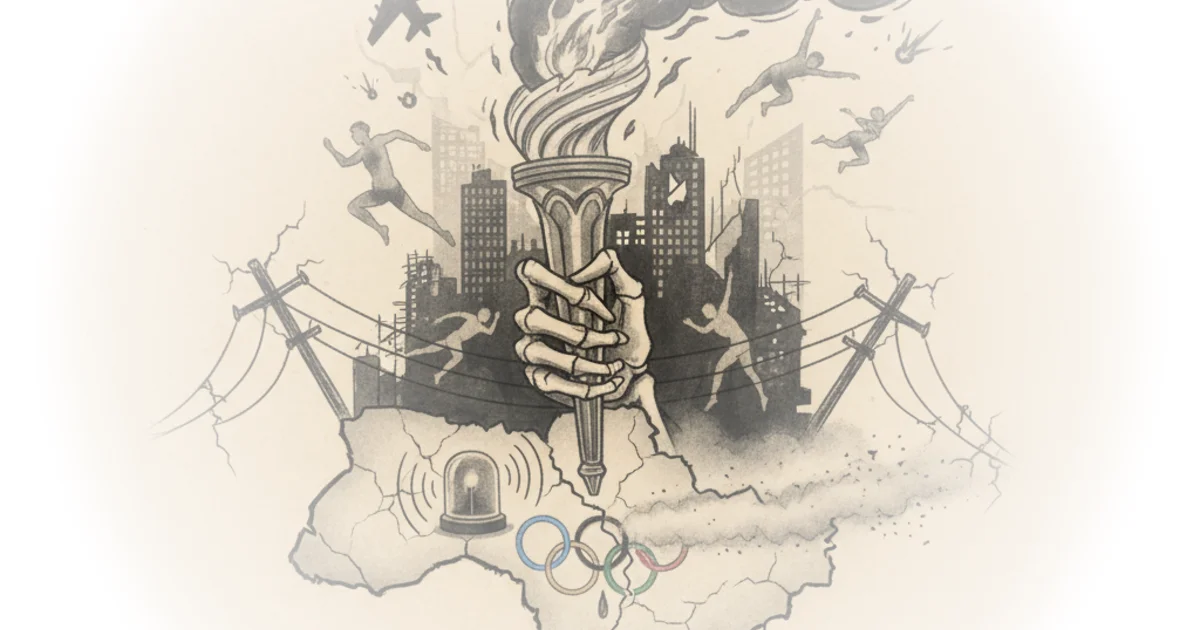
This framing is powerful because it reframes the viewer's relationship with the media. Snyder argues that while other nations focus on the outcome, the Ukrainian coverage allows him to "think about the sports" precisely because it is so grounded in the reality of survival. He observes that the Ukrainian commentators are "unscripted" and "laugh spontaneously," creating a space where the audience can experience a moment of peace. However, this peace is conditional. Snyder reminds us that "many Ukrainians are not" watching because they have no electricity, as Russia continues to target "civilian infrastructure" to leave millions cold during the winter. The argument here is that the distraction of the games is a privilege purchased by the defense of the nation, a point that forces the reader to confront the disparity between their leisure and the reality of the people enabling it.
Empathy is not a moral luxury; it is a precondition of freedom.
The Cost of a Medal
The narrative shifts to the personal tragedies embedded in the competition, specifically the disqualification of Ukrainian skeleton racer Vladyslav Heraskevych. Snyder details how Heraskevych was barred from competing for wearing a helmet adorned with photographs of athletes killed in the war, a decision that underscores the administration's refusal to let the memory of the dead be erased by the rules of sport. The author notes that "Ukrainians have won no medals at these games and are unlikely to do so," yet he finds a deeper victory in the resilience of the athletes who remain. He highlights the story of freestyle skier Kateryna Kotsar, who qualified for the finals and got engaged on Valentine's Day, a moment that Snyder interprets not just as romance, but as an act of defiance against an invading army.
Snyder's analysis of the engagement is particularly nuanced. He acknowledges the potential for such a public stunt to shift focus away from the woman's achievement, yet he argues that in this context, "affirming a future as a couple is a different matter when an invading army... is trying to obliterate your country." The fiancé, Bohdan Fashtryha, is a soldier and medic who had to secure leave to propose, a risk that highlights the precariousness of life in a war zone. Snyder writes, "Before the war he worked here in the southwest of the country as a guide in the Carpathians; he volunteered in summer 2024 and was assigned to a tank battalion where, according to media reports, he serves as a medic." This detail connects the personal narrative to the broader historical context of the region, echoing the deep roots of the conflict in the Carpathian landscape.
Critics might argue that focusing on individual stories risks sentimentalizing a geopolitical crisis, but Snyder uses these narratives to illustrate the human stakes of the war. He contrasts the Ukrainian approach with the American obsession with winning, noting that the U.S. coverage often reduces performance to a "prelude to winning or losing." He critiques the "emphasis on getting gold" as a reflection of a broader cultural indifference, where "if nothing matters but the golden prize, then why not admire the people who cheat, who grift, who blame others?" This comparison serves to highlight the moral bankruptcy of a worldview that prioritizes outcome over human motive.
The Politics of Memory
The piece culminates in a philosophical meditation on the nature of memory and freedom, anchored by the figure of the Ukrainian poet Lesya Ukraïnka. Snyder draws a parallel between her struggle with physical pain and the collective suffering of the Ukrainian people, suggesting that "a free society is built not as a community of grievance but as a community of pain." He uses her example to argue that tyrants fall because of their "indifference to others," and that forgetting the suffering of others invites the return of oppression. The author writes, "We cannot be free without the memory of others who suffer, without recalling the people who are suffering now."
Snyder extends this argument to a global scale, asking the reader to consider how the forgetting of atrocities in places like Sudan, Gaza, or Iran contributes to the current global predicament. He references the 1968 Olympics, noting how "hatred greeted Tommie Smith and John Carlos" for their protest, to illustrate how societies often punish those who demand memory. The core of his argument is that "when we remember others, and they remember us, we have a chance to remember ourselves." This is a call to action that transcends the specific conflict in Ukraine, urging a global reckoning with the cost of indifference.
When we forget others, our oblivion invites indifferent kings to rule us, to envelop us in their bottomless grievance.
Bottom Line
Snyder's most compelling contribution is his redefinition of the Olympic spirit, shifting the focus from the pursuit of gold to the preservation of memory and the defense of human dignity. While the piece risks being seen as overly didactic by those seeking pure sports analysis, its strength lies in its unflinching confrontation with the reality that the ability to watch the games is a direct result of the sacrifices made by the Ukrainian people. The argument's greatest vulnerability is its heavy reliance on the reader's willingness to engage with the moral weight of the conflict, but for those willing to listen, it offers a profound and necessary perspective on the intersection of sport, war, and freedom.