What if you discovered the oldest writing system in Europe — but couldn't read it? That's exactly what happened with one of archaeology's most frustrating mysteries.
Around 400 small clay tablets have been found across Central Europe, dating to the transition between the early and middle Bronze Age. They're called "breadloaf idols" because of their shape: roughly ten centimeters long, resembling a small loaf of bread. They bear simple patterns — sometimes a circle or flower-like indentation, sometimes horizontal lines like a chocolate bar. Some are ornate, but most are strikingly plain.
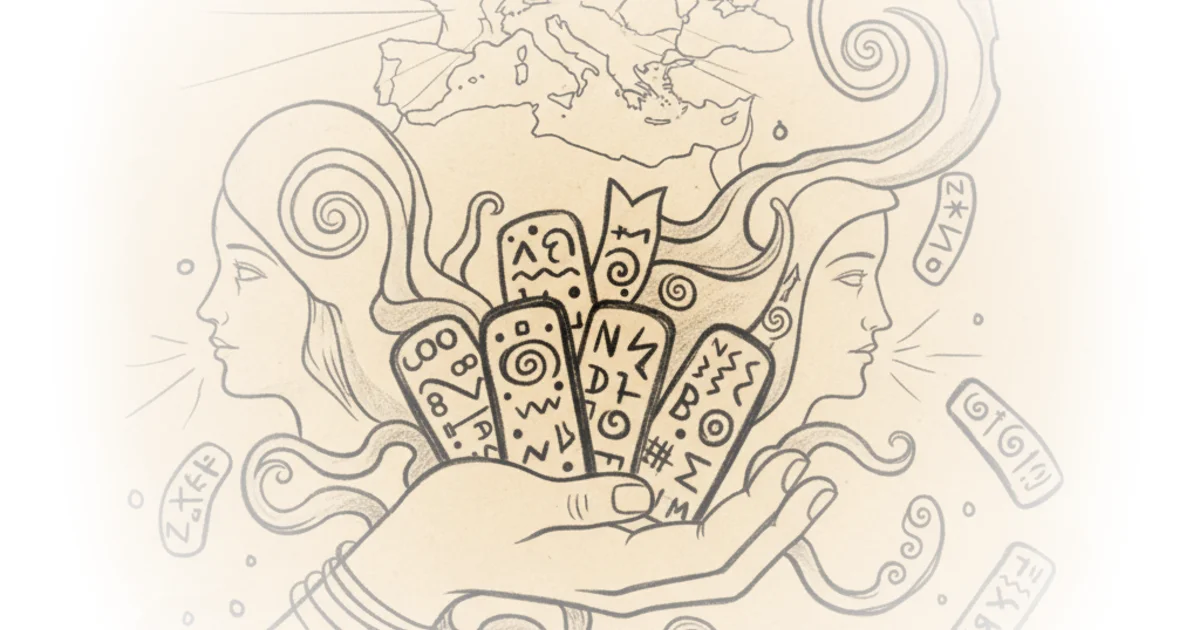
What makes these tablets extraordinary is what we don't know. We can't read the symbols. We don't know who made them or why. And unlike almost any other prehistoric artifact, they appear precisely when Mediterranean civilizations — the Minoans and Hittites — developed writing systems.
They appear along major trade routes at exactly the moment writing emerges in the Mediterranean — yet these tablets remain unreadable.
The distribution tells a story. Clusters follow two great European rivers: the Danube from Romania through Serbia, Hungary, Austria, Slovakia, and Germany; and the Po Valley in Northern Italy. These were the Bronze Age superhighlands of their day — trade arteries connecting cultures that didn't share political unity or common language, but did share these tablets.
Wolfgang David, an archaeologist who has studied these artifacts more than anyone alive, believes they're for communication across cultural boundaries. The problem is figuring out what they communicated — and why so many bear deliberate breaks.
Here's the mystery: hundreds of tablets have been found, yet not a single one has two halves recovered together. They're either fully intact or missing entirely. This suggests something specific about their function. One hypothesis points to message sticks from Australia — simple aids for delivering oral news like declarations of war or death. Perhaps when a messenger delivered news, they snapped the tablet as proof of identity before taking their answer back.
Another possibility: timekeeping. The symbols might represent dates or seasons, with pieces broken off weekly, monthly, or seasonally as events occurred. This could explain why some tablets have more breaks than others — different cycles for different purposes.
Critics might note that assuming any single purpose fits all 400 tablets is optimistic. The tablets come from varied contexts across centuries and cultures. What makes sense in one village might not apply to another.
What we need is more evidence. A Rosetta Stone would be finding these patterns connected to other objects — perhaps trade goods the tablets were wrapped around or accompanied. One promising clue: a bird rattle artifact found near the Danube shares an almost identical pattern with a breadloaf tablet, suggesting some shared cultural meaning between them.
The final question is why this experiment ended. If these tablets were inspired by Mediterranean writing, why didn't the tradition continue? Why did Europe's first attempt at written communication simply stop?
We don't know. But we do know this: they appeared exactly when writing emerged in the Mediterranean world — and they're still waiting to be read.