Wes Cecil offers a reframing of philosophy that's anything but abstract. He argues that philosophy isn't some lofty academic exercise—it's the practical skill of "counting cards" in life. You can't control the cards you're dealt, you can't control what other people are dealt, but how you understand the situation and respond is entirely within your control. This is a surprisingly grounded definition for something often perceived as impractical.
Cecil spends considerable time exploring why we need philosophy at all. The answer lies in freedom: "you need to have a certain amount of freedom before you need philosophy because if you have no choices then you have nothing to think about." This is a crucial distinction. Philosophy isn't needed when you're simply responding to stimuli, doing what you have to do and avoiding what you can't do. It's only when you can begin making choices—which "comes along pretty early"—that you suddenly need reasons for those choices.
You can't control the cards you're going to be dealt... but how you respond to them, how you understand the situation in which you find yourself, is entirely within your control.
The historical section is particularly vivid. Cecil paints a timeline where 2.6 million years ago our ancestors began using stone tools, and for nearly 2.5 million years, "pretty much the same stone tools" persisted with only slight changes. Then around 200,000 years ago came a jump in tool sophistication, followed by art and jewelry around 50,000 years ago. The Agricultural Revolution arrived about 10,000 years ago—"just five minutes" of our evolutionary clock.
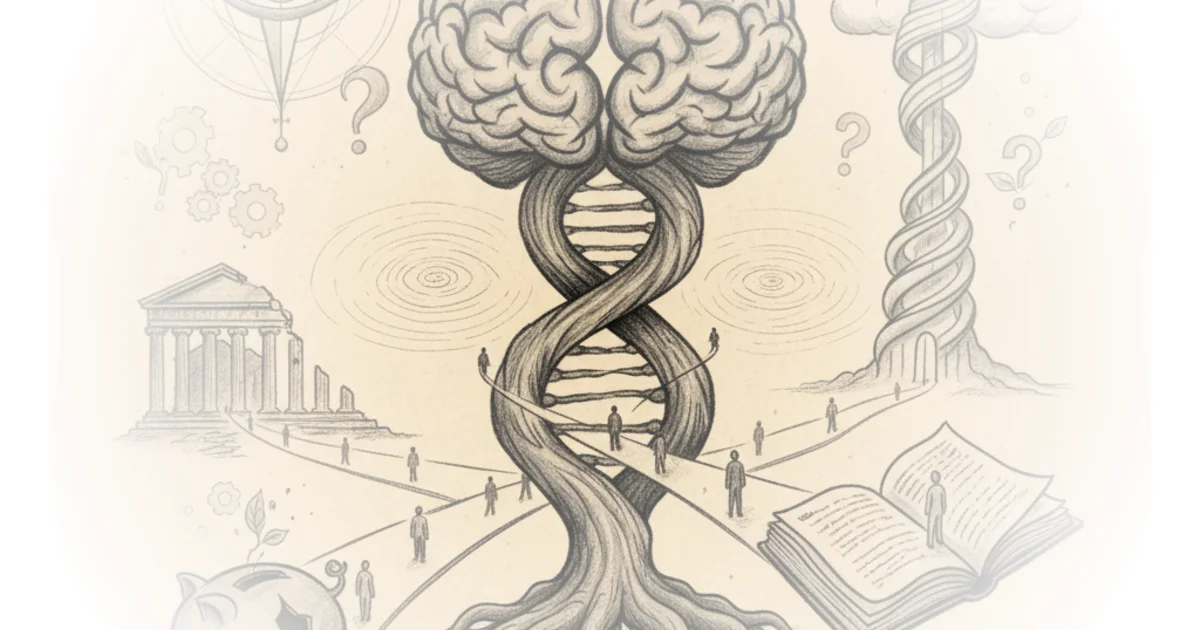
This matters for philosophy because we are still those people who used stone tools for millions of years, now living in "vast expanses of humanity using unbelievably complex and sophisticated tools." We have a fundamental schism: evolved to live in small groups with simple tools, but finding ourselves in million-person cities with smartphones. The human mind can only really recognize and know about "400 people" because that's what our evolutionary capacity was designed for—now we live in cities of millions.
Cecil's discussion of children's development is equally compelling. Babies as young as six to nine months make accurate inferences from experience—they expect objects to keep moving when they disappear behind a screen, and they're shocked when they don't. We're "really good at these kinds of inferences from very little" but terrible at actual reasoning, which develops "very slowly and very incrementally." By around age six to eight, children begin recognizing that others see the world differently—which is what allows rational trade.
The piece's biggest strength is its accessibility. Rather than treating philosophy as an academic preserve, Cecil grounds it in survival: we need philosophy precisely because our minds aren't naturally equipped for the complexity of modern life. The evolutionary history isn't just background—it's the reason we struggle with choices that matter.
Critics might note that the argument conflates two different senses of "philosophy": the practical decision-making framework Cecil advocates versus the academic discipline of philosophy as inquiry into knowledge, ethics, and existence. The historical examples—the Chinese confusion period, the Greeks—are compelling but compressed, leaving readers to fill gaps about what exactly philosophers contributed during those periods.
Bottom Line
Cecil's core argument is that philosophy is a survival tool for complex living—essential precisely because our evolved minds weren't built for cities of millions or choices that actually matter. The strongest element is his concrete framing: not abstract reasoning but practical "card counting" for life decisions. His biggest vulnerability is the leap from historical context to prescriptive philosophy—you can't assume simply having freedom guarantees we'll use reason well. The piece works as a gateway into philosophical thinking, though listeners may want more guidance on actually applying these ideas.