Alex O'Connor and Matthew Cobb dismantle the most persistent intuition in human history: that our thoughts and feelings reside in the chest. This conversation is not a dry lecture on neuroanatomy; it is a forensic excavation of why we still say "heartbroken" when our brains are the ones processing the grief. For the busy reader, the value lies in understanding how deeply embedded biological misconceptions are in our language and culture, and how long it took for the scientific consensus to shift from the heart to the head.
The Intuitive Trap
The discussion opens by anchoring the debate in popular culture, specifically a line from Shakespeare that reveals the 16th-century public was already wrestling with the location of "fancy." O'Connor notes that the groundlings, the commoners standing in the pit, understood the joke about whether imagination lay in the heart or the head. This cultural literacy suggests the shift was already underway, yet the prevailing intuition remained stubbornly cardiac.
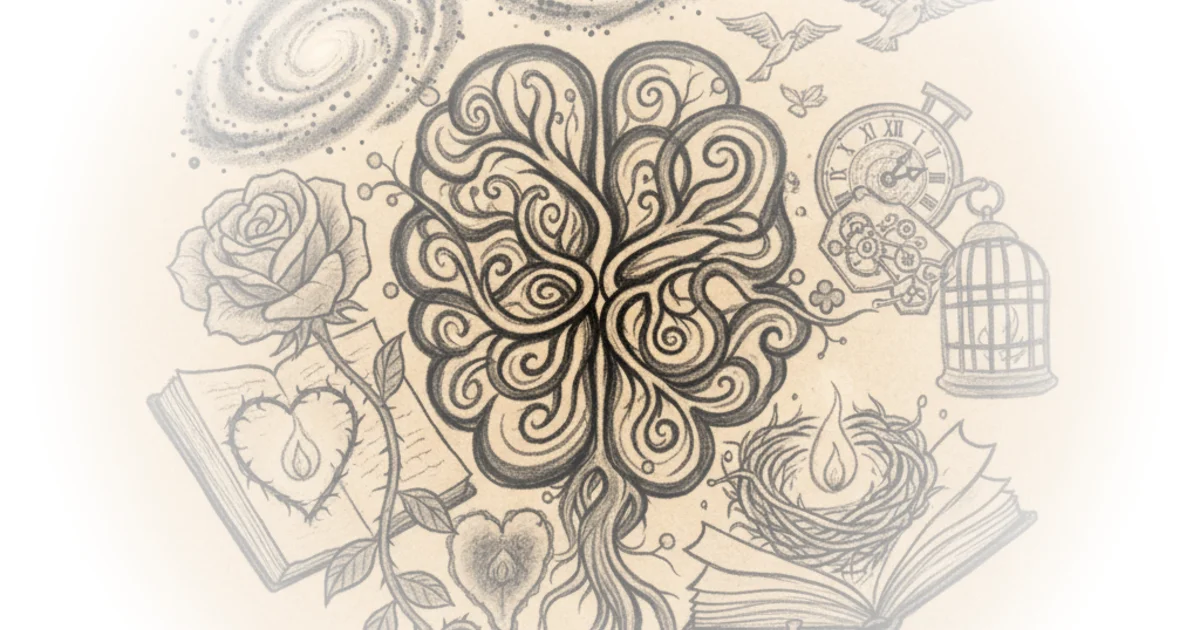
Cobb explains that for most of human history, the heart was the undisputed seat of thought because it aligns with sensory experience. "If you think about what you feel, you don't feel if you feel excited, you're not excited up here. You're excited in your whole body, in your gut," Cobb argues. This reliance on phenomenology—the way things feel to the subject—is a powerful counter-argument to early anatomical findings. Just as the sun appears to move around the earth, the heart appears to be the engine of emotion. The author highlights that this wasn't just a philosophical error but a logical conclusion based on available data: the heart pounds when frightened, while the brain remains a silent, mushy white mass.
"It's a bit like the sun going around the earth. People thought that cuz that's what it looked like. And you'd have to be very very odd or to have made incredibly precise observations to realize that it's the earth that goes around the sun."
This framing is effective because it humanizes the error. It wasn't stupidity; it was a failure of intuition in the face of overwhelming sensory evidence. However, the conversation also touches on the limitations of ancient dissection. While anatomists could see the "threads" (neurons) connecting the eyes to the brain, they lacked the conceptual framework to understand information transfer. Without the concept of electrical signaling, a nerve looked no more significant than a chandelier hanging from a ceiling.
The Gruesome Pivot
The turning point in this historical narrative arrives with Galen, a Greek physician working in Rome during the second century. O'Connor and Cobb detail a demonstration that is as brutal as it is definitive. Galen sought to prove that the brain, not the heart, controlled the voice and consciousness. He did so by chaining a live pig, silencing its squeals by compressing its brain, while leaving its heart beating.
The description of the experiment is stark: "They crack open its skull... and they bear the brain. Pig's still making a noise. And then Galen says to his opponent, 'Right, push down on the brain.' So he pushes down on the brain. And instantly, of course, the poor pig becomes unconscious and no longer makes a noise." This moment serves as the empirical nail in the coffin for the cardiocentric hypothesis, yet the authors note a fascinating historical inertia. Despite this clear evidence, the idea that the heart ruled the mind persisted for another millennium.
Critics might note that relying on animal dissection to prove human consciousness is a fraught methodology, yet in the absence of modern imaging, it was the only tool available. The failure of Galen's experiment to immediately change the cultural narrative highlights a crucial point about scientific progress: data does not always instantly overturn belief systems. As the authors observe, "There never was a brain centric moment. There isn't a moment at which the apple falls from the tree and Newton goes aha gravity."
From Ventricle to Pineal Gland
The transition to a brain-centric view was not a single event but a slow accumulation of evidence over centuries. In the medieval period, the focus shifted to the brain's ventricles, the fluid-filled cavities. Since the solid brain tissue seemed inert, thinkers hypothesized that "spirit" or thought resided in these liquid spaces. This theory persisted until the 17th century, when René Descartes proposed a dualist model where the soul interacted with the physical body through the pineal gland.
Descartes believed the pineal gland was the unique seat of the soul because he thought only humans possessed it. "He thinks that thought is some or the soul is comes into the brain it accesses the physical world through a particular gland uh called the pineal gland," O'Connor summarizes. This was quickly debunked when it was discovered that most mammals have a pineal gland, yet the broader consensus that the brain was the key organ had finally taken hold by the mid-18th century.
The discussion also briefly references the historical context of phrenology and the later, tragic case of patient H.M., illustrating that even after the location of thought was identified, the mechanism remained a mystery. The journey from Aristotle's "radiator" theory to modern neuroscience is a testament to the difficulty of overriding deep-seated intuition.
"There is no experiment that convinces everybody... What they do do is say, 'Hm, that's really interesting, but maybe it's not right,' and then within a few years there's extra evidence and they end up saying okay we change our mind now but that took centuries of work."
This observation serves as a powerful reminder that scientific consensus is often a gradual erosion of old ideas rather than a sudden revelation. The authors effectively use this historical arc to show that our current understanding is fragile and hard-won.
Bottom Line
The strongest element of this piece is its ability to connect ancient biological misconceptions to modern linguistic habits, proving that our intuition is a historical artifact rather than a biological truth. The argument's only vulnerability is the potential for the reader to underestimate the sheer difficulty of the transition; the authors make it seem like a logical progression, but the resistance to abandoning the heart as the seat of the soul was fierce and cultural, not just scientific. Readers should watch for how these deep-seated intuitions continue to shape modern debates on consciousness and artificial intelligence, where the question of "where" thought resides remains as complex as ever.