Noah Smith challenges the very definition of the term that dominates modern economic debate, arguing that "industrial policy" has become too broad to be useful. While the administration and global institutions rush to adopt interventionist strategies, Smith contends that lumping together protectionism, subsidies, and technology promotion under one label obscures what actually works. For the busy reader tracking the shift from free-market orthodoxy to state-led growth, this piece offers a crucial distinction: the difference between picking winners in a developing nation versus seeding a technological revolution in a wealthy one.
The Problem with a Single Buzzword
Smith begins by dismantling the monolithic view of government intervention. He notes that the term has become a catch-all for everything from tariffs to export promotion, making productive conversation nearly impossible. "It's kind of crazy that this huge diversity of policies and goals coexists under one single buzzword," Smith writes. This observation is vital because it explains why policy debates often talk past one another; when critics say industrial policy fails, they may be citing the failures of import substitution, while proponents point to the successes of export-led growth.
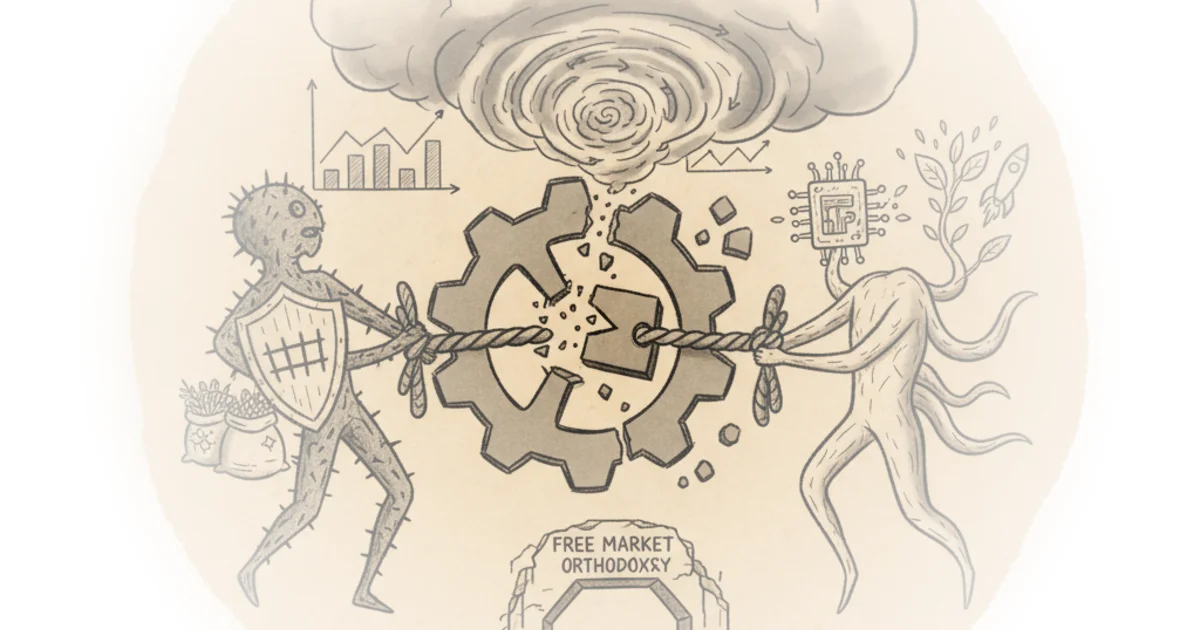
The author highlights a significant shift in the consensus among major international bodies. He points to a 2019 paper by the International Monetary Fund that explicitly distinguishes between successful and failed strategies. "We argue that the success of the Asian Miracles is based on three key principles... state intervention to fix market failures... export orientation... and the pursuit of fierce competition," Smith quotes. This framing is effective because it moves the debate from "government vs. market" to "smart government vs. dumb government." However, critics might note that even with these principles, the execution requires a level of bureaucratic competence that is rare and difficult to replicate in unstable political environments.
"Dismissing the whole idea of industrial policy out of hand... is simply a policy of self-imposed ignorance."
Smith argues that the stigma around these policies is finally fading, allowing researchers to study them seriously rather than dismissing them as heresy. He references the World Bank's new report, which supports industrial parks while casting doubt on direct subsidies. This nuance is critical for understanding current U.S. strategy, where the executive branch is increasingly favoring infrastructure and market-access assistance over blanket cash handouts.
The Developing World: Let the Multinationals In
When addressing developing economies, Smith makes a surprising pivot away from the romanticized idea of building "national champions." Instead, he champions the Foreign Direct Investment (FDI) model used by Poland, Malaysia, and Ireland. "Poland, especially, has succeeded amazingly using the FDI strategy," he observes, noting that the country is on track to surpass Japan's living standards without a single globally recognized domestic brand. This argument is compelling because it prioritizes results over ideology; the goal is wealth creation, not nationalistic industrial self-sufficiency.
He explains that FDI is less risky because it allows the market to discover comparative advantage rather than forcing the government to pick winners. "FDI promotion also requires good institutions," Smith writes, noting that attracting German factories requires the kind of property rights and legal stability those companies expect. This connects to the historical lessons of the Telecommunications Act of 1996, where the U.S. government didn't build the internet but created the regulatory framework for private companies to do so. The parallel suggests that for developing nations, the best "industrial policy" might be simply becoming a reliable place for global capital to operate.
The Developed World: Technology is the New Industry
The piece's most distinct contribution is its reframing of industrial policy for wealthy nations. Smith argues that for the U.S., "industrial policy is technology policy." He points to the current focus on artificial intelligence as a clear example of the government picking a winner. "If you rewrite regulation to allow more construction of data centers, or if you try to recruit top AI researchers... you are picking AI as a winner," he states. This is a powerful reframe because it normalizes intervention in the U.S. context, showing that the country has been doing this all along.
Smith reminds readers that the U.S. government actively seeded the internet, citing the High Performance Computing Act of 1991 and the National Science Foundation's role in the initial buildout. "We picked the internet as a winner, and it was a winner," he writes. This historical context is essential for understanding why the current administration is comfortable with subsidies for semiconductors and green energy. The argument suggests that building a new technology sector shares the same risks and requirements as building a new manufacturing base in a developing country.
"The people trying to figure out how to make America competitive in AI should study the South Korean Heavy and Chemical Industry initiative, or Taiwan's promotion of TSMC."
By urging American policymakers to study the specific successes of East Asian industrializers, Smith bridges the gap between developing and developed world strategies. He acknowledges that the problems are not identical but argues that the fundamental challenge of creating something that has never existed before is shared. A counterargument worth considering is that the geopolitical context for the U.S. is vastly different from the Cold War-era dynamics that fueled the Asian Tigers, potentially limiting the applicability of those specific models.
The China Experiment and Its Pitfalls
Finally, Smith turns a critical eye toward China's unprecedented subsidy experiment. He acknowledges the boom in high-tech manufacturing but warns of the inevitable downsides of subsidizing everyone. "Paying dozens of companies to all make the same products ends up creating brutal price wars that compete profit margins toward zero," he writes. This is a stark warning about the limits of state power; when the government prevents market selection, it creates a bubble of inefficiency.
He notes that China is now facing the consequences, with deflation and bad debts threatening the financial system. "Cutting industrial subsidies will be politically difficult," Smith observes, as the government attempts to phase out support for industries like electric vehicles. This aligns with the "export discipline" playbook endorsed by the IMF, which dictates that inferior manufacturers must be allowed to fail. However, Smith points out a unique danger in the Chinese context: "the bulk of China's unprecedented industrial subsidies are actually in the form of artificially cheap bank loans." This creates a massive debt overhang that could destabilize the global economy if a wave of bankruptcies is forced.
Bottom Line
Smith's strongest argument is his insistence on precision: we must stop treating "industrial policy" as a single tool and start distinguishing between the FDI strategies that lift developing nations and the technology policies that sustain developed ones. The piece's greatest vulnerability lies in its optimism about institutional competence; while the theory of "smart intervention" is sound, the history of government failure in picking winners remains a formidable obstacle. As the administration continues to deploy these tools, the real test will be whether they can replicate the discipline of the Asian Tigers without triggering the debt crises that now plague China.