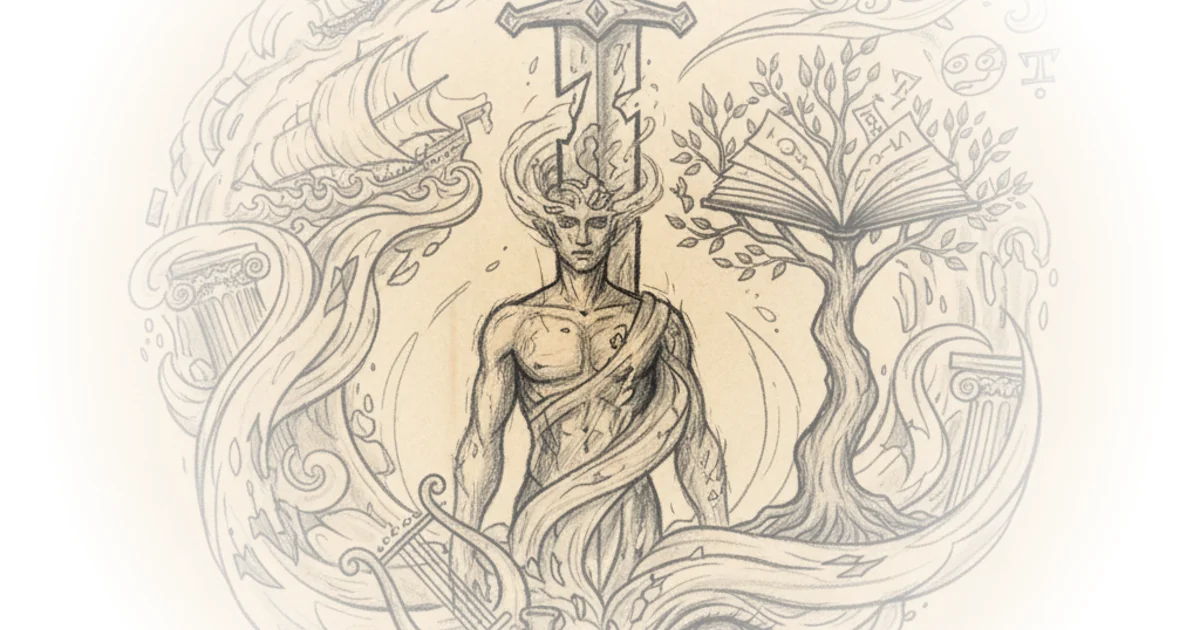
The Iliad is one of the oldest stories still being told — a poem nearly 3,000 years old that somehow feels urgently contemporary. It is brutal, unrelenting, and obsessed with death. But beneath all the gore lies something unexpectedly tender: a meditation on what it means to lose a city, and what that loss tells us about civilization itself.", "This is a lecture designed for readers who have never encountered Homer in any meaningful way — those who might dismiss the Iliad as 'just guys killing each other' without understanding its deeper architecture. The author argues that reading this ancient poem on its own terms reveals it as a lesson in living fully and meaningfully, even in a short and difficult life.", "The Iliad was composed sometime between 760 and 700 BCE, though scholars believe it draws on an oral tradition dating back to around 1200 BCE — meaning the poem existed for centuries before anyone wrote it down. This creates a remarkable gap of roughly 3,000 years between today's readers and the original composition.", "## The Mystery of Homer", "One of the most tantalizing questions about these poems is simply: who was Homer? Ancient scholars treated him as a real person — a blind bard whose birth cities various Greek communities still claim. But modern scholarship has complicated that picture considerably.", "The scholar Milman Perry demonstrated that Greek epic poetry was composed through an oral tradition using formulas and epithets — phrases like "swift-footed Achilles" or "the wine-dark sea" that helped poets remember the poem's architecture. Under this view, Homer wasn't a single author but rather a cumulative tradition spanning generations of traveling bards who modified and preserved fragments of the story.", "But Oliver Topplan has pushback against this extreme view. He argues that Perry's oral tradition theory leaves little room for the originality and unified greatness of the work. The poem is undeniably cohesive — formulas call back to each other across the text, suggesting a genius mind pulling it all together rather than a haphazard compilation. Something unified the tradition into what we now read.", "The debate matters less than the mystery: there is clearly some inspired voice behind these verses, whether one poet or many generations.", "## What the Iliad Is About", "Simone Vy once summed up the Iliad in a single word: force. Not the story of Troy or any particular hero — but force itself. Force employed by man, force that enslaves man, force before which human flesh simply shrinks away.", "The poem turns anyone subjected to it into a thing. Exercised to its limit, it makes a corpse out of people who were here and now are nowhere. One passage from Book Five describes a spear piercing the bladder, death swirling around a man as he screams. This is the Iliad's true subject: not heroism in any noble sense, but the horrifying precision of death.", "Ezra Pound noted that the wound descriptions are so anatomically accurate they could fit a coroner's inquest — leading one writer to propose Homer must have been a physician. Yet alongside this brutal force exists profound humanity. The characters draw us close despite ourselves.", "## The Fall of the City", "If the Iliad is about death and war, it is also about the destruction of a city — Troy, or Ilium. This is where the poem becomes most relevant to modern readers.", "The siege took place around the late thirteenth or early twelfth century BCE. The tactics reflect Bronze Age warfare. But consider what a city represents: for the Greeks, the city was the very condition that humanized and civilized people. It was social harmony itself — a high symbol so potent that Hebrew poets likened God's dwelling place to a city.", "As Steiner wrote, at the core of these poems lies the remembrance of one of the greatest disasters that can befall a man: the destruction of a city. A city is the outward sum of human nobility. When it is destroyed, humans are compelled to wander the earth or dwell in the open fields — a partial return to beastliness.", "This realization resounds through the epic, now in stifled delusion, now in strident lament: that an ancient and splendid city has perished by the edge of the sea.", "> The Iliad does not narrate the fiery death of Troy. Perhaps there is poetic tact in this reticence — the Trojan horse isn't even in the book. The poem stops before the fall of Troy, though it is intimated through Hector's death.", "This is where many readers set by movies like Troy are disappointed: the fall itself is not contained in the text. But consider instead what that absence teaches us about narration and storytelling styles radically different from modern epic conventions."]