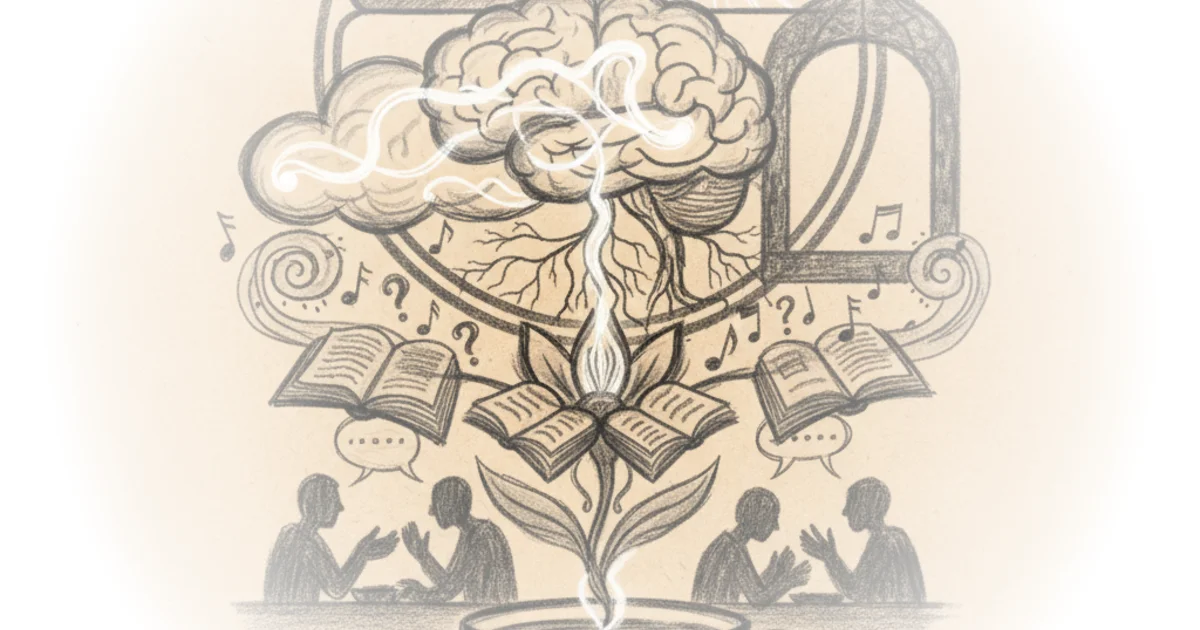
Wes Cecil makes a case that's been strangely absent from our understanding of intellectual history: conversation itself is an art form worth studying. Not just as content exchanged between people, but as a shared creative act — something that produces "something outside of themselves greater than what they would be able to produce by themselves." This framing reframes every coffee shop and salon as a collaborative workshop for ideas.
The Persian Origin Story
Cecil opens with a striking historical detail from JeeneShardan, a French ambassador to Isfahan in the 1670s. "One of the remarkable things he saw people engage in conversation is that news is communicated and where those interested in politics criticize the government and all freedom and without being fearful since the government does not heed what the people say." This is remarkable because it describes a coffee shop in Persia that functions exactly like a modern café — political discussion, literary circles, chess games, and storytelling in verse. The irony? "The coffee shop became sort of the universal answer to the wine bar" in Islamic society precisely because alcohol was outlawed. Coffee shops weren't just substitutes; they were the only public space for intellectual exchange.
Cecil then pivots to 2007 Tehran, where bookstores opening coffee shops inside their premises had become fashionable until "a general clamp down on social and intellectual freedom." Four bookshops in Tehran received a 72-hour ultimatum from a state body governing retail trade. The closure order cited "an illegal mixing of trades" — but critics suspected the real target was "restricting the gathering of intellectuals and educated young people."
Coffee shops constitute an illegal mixing of trades. Critics suspect the move is aimed at restricting the gathering of intellectuals.
This parallel between 1670s Persia and 2007 Iran is the piece's strongest thread: "huge shift in government attitude towards the coffee shop no shift in what's going on in the coffee shop right it is the same they were criticizing the government complaining about things arguing debating discussing in 1670s 350 years later doing the same thing."
The Public-Private Spectrum
Cecil's central argument involves a spectrum between "public space, private space, and court space" where "café is the most public but notice it's not quite an entirely public space" while "salons are famous but they're a more private space they're not exclusively associated with the courts." This distinction matters because it explains why intellectuals throughout history have gravitated toward these intermediate spaces — they offer enough privacy to speak freely, enough publicness to spread ideas.
The historical sweep is impressive: English coffee houses in the 17th and 18th centuries as "fomenters of intellectual and political revolution," Paris cafés that birthed the Impressionist movement, existentialism "born and raised in café society." But the piece never lets us forget the Persian thread — it's the through-line that makes the comparison meaningful rather than just a survey of European coffee culture.
The Original Salon: Plato's Symposium
Cecil's treatment of Plato's Symposium is where the argument becomes most vivid. He frames it as "the beginning" — the model copied for "whatever the last 24500 years." His explanation of the word itself is wonderfully playful: "Symposium one of my favorite words because it sounds good it means drinking party so the next time you see someone say oh there's going to be a symposium on this show up with a keg and if they say why' you bring a keg say you don't read Greek."
The social context matters enormously. In ancient Greece, "private gatherings of numerous individuals were almost always prescribed by law" — meaning normal people couldn't legally gather without official sanction. "This is not actually a breach of law the other thing you need not only is a governing system that says that's okay which again historically is often quite rare." The salon required both legal permission AND private space, two things rarely combined in ancient societies.
Private gatherings of numerous individuals were almost always prescribed by law if you're having a wedding okay major feast days ooh those are public those are held in the temples the courts palaces something like that if you were not gathering in the court or for some other official sanction space it was basically illegal.
Cecil walks through the famous opening of the Symposium — Socrates arriving at someone else's home, "not so a private Gathering" because he wasn't invited. "Rule one for the salon you're not allowed to show up randomly this is important this again is back to the Privacy thing different from a coffee shop essentially you get to walk into a coffee shop."
The Social Dimension
What emerges from this historical reconstruction is that salons were never purely intellectual spaces. "Salons are invariably also social friends connections business sexual relations are all played out within the context of this semi-private setting." The famous debate about love at the Symposium isn't abstract philosophy — it's simultaneously about seduction, positioning, and power.
Cecil describes how "the subject on which they're speaking is the nature of love and so all this great double and triple levels to these conversations when they're talking about who should be loving whom under what circumstances" while everyone is also "attempting to seduce other people who are at the Symposium."
Aristophanes' Defense
The piece's climax is Aristophanes' speech — which Cecil calls "the first ever recorded defense of sexual freedom and license." He paraphrases it: "some men are only attracted to women they should only be with women some men are only attracted to men they should only be with men some women are only attracted to women they should only be with women people who are contracted in marriage they should probably stay faithful to each other that's for the best but if women do not want to contracted marriage they shouldn't have to they should be as free as men should be free."
He makes this plea for human sexual liberty and equality which is like I said you know it's 2500 years ago we're still arguing this stuff out.
This is where the historical argument becomes most contemporary. The debate about sexual freedom hasn't changed in structure since 400 BCE — only the specific topics have shifted.
Counterpoints
Critics might note that Cecil's sweep through Persian, Greek, English, and French history assumes these spaces are fundamentally similar across radically different contexts. The Persian coffee house of 1670s Isfahan operated under very different political logics than existentialist Paris — both may be called "café," but one was a workaround for prohibition while the other was an aesthetic movement. The comparison works, but it flattens important distinctions about what these spaces meant to their participants.
Bottom Line
The strongest part of this argument is tracing 350 years of intellectual history through actual physical spaces — not just the ideas themselves, but where they were exchanged. The vulnerability is that "café" and "salon" serve as metaphors for many things (freedom, sexuality, revolution), and sometimes the historical specificity gets stretched to cover too much ground. Still, the thread connecting Persia to modern Tehran is the piece's most compelling evidence: conversation has always found spaces, and authorities have always struggled to stop it.