Cory Doctorow delivers a startling geopolitical thesis: that Canada's only path to sovereignty lies not in appeasement, but in weaponizing its own digital dependency to dismantle the very American tech monopolies that hold it hostage. In a landscape of standard trade-war rhetoric, this piece cuts through the noise by arguing that the administration's erratic tariff policies have inadvertently created a vacuum that Canadian innovation can fill—if only the nation stops legislating against its own tech sector.
The Myth of the Technocratic Fix
Doctorow opens by dismantling the hope that a "safe pair of hands" could manage the current crisis. He describes Prime Minister Mark Carney's initial response to the administration's aggressive tariffs as a performative display of national unity. "True Carneyism has never been tried," Doctorow writes, noting the Prime Minister's fiery speech at Davos where he declared a "rupture" in the old world order. The author frames this as a moment of high-stakes theater, where Carney promised to go "elbows up" against the United States, encouraging Canadians to boycott American goods and embrace a symbolic war of consumption.
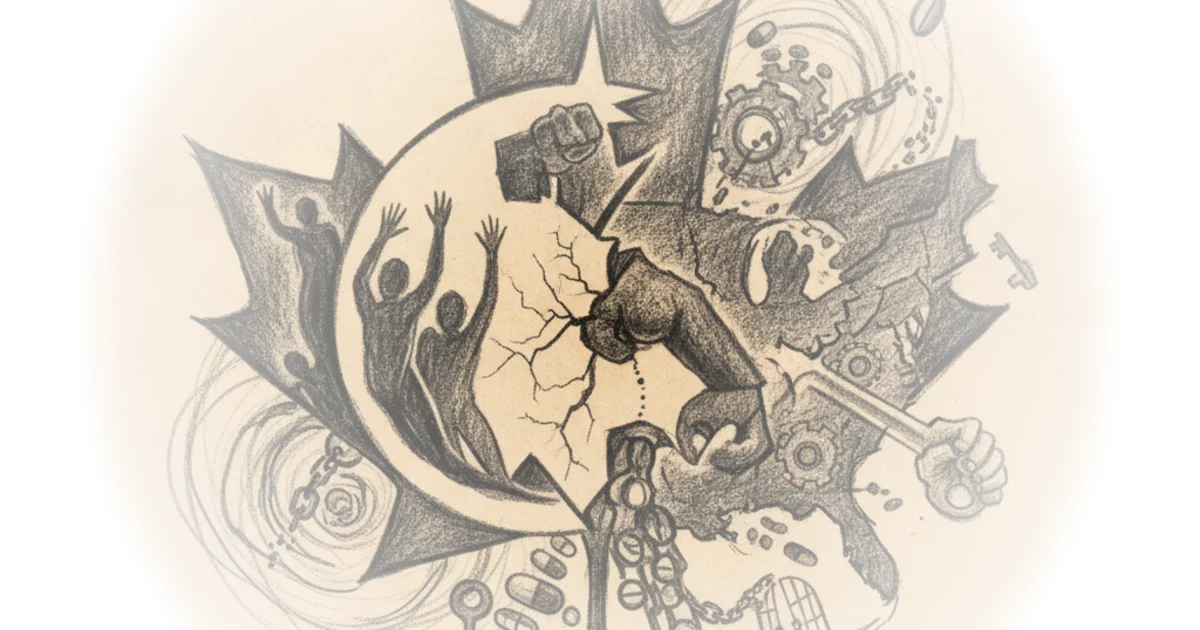
This framing is effective because it highlights the disconnect between public posturing and private capitulation. While the Prime Minister championed the idea of sacrificing for the country, Doctorow points out that "outside the realm of symbols, Carney's elbows wilted." The commentary suggests that the administration's pressure tactics worked precisely because the Canadian government remained tethered to American corporate interests. When the administration threatened further tariffs, Carney abandoned the Digital Services tax, a levy designed to make American tech giants pay their fair share. "Trump repaid his tech giants by threatening Carney with still more tariffs unless he canceled the Digital Service Act, and Carney capitulated," Doctorow observes. This sequence reveals a critical vulnerability: the Canadian state has prioritized maintaining access to American markets over building independent economic resilience.
Carney's symbolic gestures—memorable speeches and minor changes to consumption habits—are second to none. But when it comes to building a strong country that is resilient against the attacks we can all foresee, Carney himself becomes Carneyism's fiercest opponent.
The Digital Kill Switch
The piece takes a darker turn as it details the extent of Canada's digital subjugation. Doctorow argues that the administration has turned American software into a geopolitical weapon, capable of shutting down foreign governments that defy its will. He notes that Canadian ministries are entirely dependent on American cloud software, a dependency the Prime Minister exacerbated by handing over key military digital back-ends to Palantir, a firm deeply aligned with the administration. "Trump's tech companies don't have to hack into Canada's digital infrastructure to shut it down: they already control it," Doctorow writes. This is a chilling assessment of the current reality, suggesting that the threat of cyberwarfare is not a future possibility but a present-day leverage point.
Critics might argue that decoupling from American technology is economically suicidal in the short term, given the sheer scale of integration. However, Doctorow counters that the cost of inaction is total subjugation. He draws a parallel to the administration's obsession with William McKinley-era tariffs, noting that the administration's inability to learn from mistakes creates a unique opening for novel tactics. "Trump's inability to learn or reason means that if Canada engages in novel retaliatory tactics, it stands a good chance of flummoxing the Mad King," he argues. The logic here is that the administration's unpredictability is a weakness that a nimble, sovereign competitor could exploit.
The Path to Sovereignty
Doctorow identifies the root cause of this vulnerability not as a lack of talent, but as a self-inflicted legal wound. He points to Canada's 2012 Copyright Modernization Act, which criminalized the modification of digital devices without manufacturer consent. This law, passed under a previous administration to secure trade access, effectively barred Canadian entrepreneurs from building the tools necessary to compete with American monopolies. "In 2012, Canada passed a law that lets American companies use Canada's courts to destroy Canadian companies that help Canadian technology users get more out of their own property," Doctorow states. He argues that this legislation was a "bad bargain" that has now come due.
The proposed solution is radical: repeal the restrictive laws and legalize "adversarial interoperability." By allowing users to jailbreak devices, install independent app stores, and modify firmware, Canada could unlock a wave of innovation. Doctorow envisions a scenario where the administration's crackdown on Silicon Valley talent creates a "reverse brain-drain," with skilled technologists fleeing to Canada. "Thanks to Trump, Canada has all three [innovative ideas, skilled technologists, and capital]," he asserts. The argument is that the administration's own policies are sowing the seeds of its own technological defeat, provided Canada is willing to seize the moment.
By repealing Bill C-11 and legalizing reverse-engineering and modification of digital technology with consent of its users and in accordance with privacy, consumer and labour rights, Canada will gain a devastating counter to Trump's tariffs.
Bottom Line
Doctorow's most compelling contribution is the reframing of digital sovereignty not as a defensive shield, but as an offensive economic strategy that leverages the administration's own anti-competitive excesses. The argument's greatest vulnerability lies in the political feasibility of dismantling entrenched corporate interests and the risk of immediate retaliation from Washington. However, the piece succeeds in demonstrating that the status quo is a slow surrender, and that the only viable path forward requires a fundamental restructuring of Canada's relationship with American technology. Readers should watch for whether the Canadian government moves beyond symbolic resistance to enact the legal changes Doctorow proposes, as this will determine if the nation can truly "defeat America" by out-innovating its own dependencies.