Matt O'Dowd dismantles the decades-old cynicism surrounding fusion energy with a startling premise: the technology isn't stuck in a perpetual '50 years away' limbo, but is actually being driven forward by an unlikely ally—the artificial intelligence sector. While the public narrative often fixates on the impossibility of containing a star, O'Dowd argues that the real bottleneck has shifted from theoretical physics to the engineering of the vessel itself, a challenge now being solved with unprecedented speed.
The Physics of Containment
O'Dowd begins by reframing the Sun not as a distant miracle, but as a blueprint we are finally learning to reverse-engineer. He notes that while the Sun relies on crushing gravity, we must compensate with extreme heat, creating a scenario where "there is no material in the universe that wouldn't be instantly vaporized at the temperatures needed for Fusion." This sets the stage for his central thesis: the problem isn't creating the reaction, but building a container that can survive it.
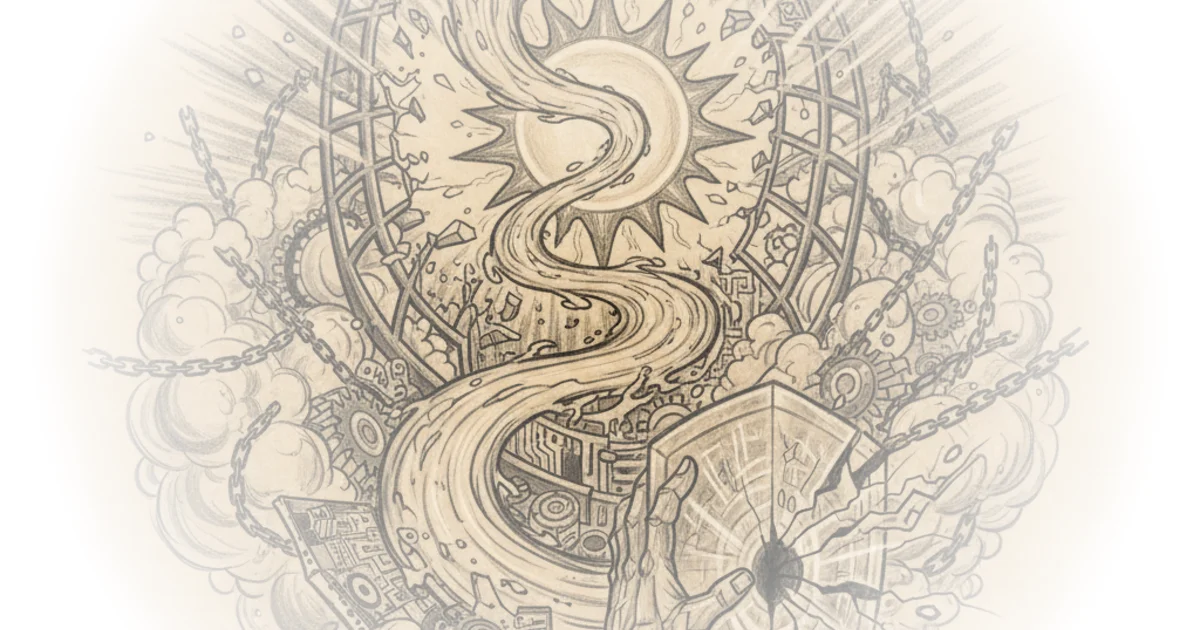
The author distinguishes between two main approaches, noting that while inertial confinement (using lasers) recently achieved a historic net energy gain, it remains "rather bursty" and ill-suited for steady power generation. Instead, the focus is on magnetic confinement, where superconducting magnets create a vacuum of sorts to hold the plasma. O'Dowd highlights the sheer absurdity of the engineering challenge, describing the need to "create the largest temperature gradient in the known universe," with plasma millions of degrees hot sitting mere meters from magnets cooled to near absolute zero.
"Why build a cage around the star if you can instead build a star inside a cage?"
This rhetorical pivot is the piece's strongest hook. It moves the conversation from abstract astrophysics to tangible engineering. However, O'Dowd is careful to temper optimism; he acknowledges that while the magnetic fields are a "relatively solved problem," the physical wall holding the plasma remains the "final barrier."
The Wall That Must Do Everything
The commentary shifts to the most critical, yet overlooked, component: the first wall. O'Dowd explains that this surface must simultaneously withstand intense heat, capture neutrons to generate electricity, and breed new fuel, all while preventing the plasma from cooling down. He details the brutal environment where "energetic gamma rays and very fast moving neutrons" bombard the chamber, causing erosion and radioactivity.
The most compelling part of O'Dowd's analysis is his deep dive into material science, specifically the trade-off between tungsten and beryllium. He explains that tungsten, despite its high melting point, is dangerous because if it erodes into the plasma, its heavy atoms cause "line emission cooling," which drains energy from the reaction. "Even a little bit of a heavy element like tungsten in the plasma can make it very difficult to keep it hot enough to sustain Fusion," he writes. This is a crucial insight that moves beyond generic "it's hard" statements into specific atomic physics.
Conversely, the European fusion experiment (ITER) is opting for beryllium. O'Dowd notes that while beryllium erodes faster and is "extremely toxic," it has a unique advantage: it acts as a neutron multiplier, helping to breed the scarce tritium fuel needed for the reaction. He describes this as a high-stakes gamble: "The wall needs to create new fuel for Fusion... the trick is to place a layer of lithium behind the First wall."
Critics might note that O'Dowd glosses over the immense difficulty of managing the toxic beryllium dust and the frequent need to replace the wall, which could make commercial viability a logistical nightmare even if the physics works. The toxicity issue alone poses a massive operational hurdle for any future power plant.
"The wall is the first point of contact between the plasma and the outside world... and it still has to do a lot."
The Fuel Cycle and the Path Forward
The piece concludes by addressing the fuel supply, a common point of skepticism. O'Dowd clarifies that while deuterium is abundant in seawater, tritium is nearly non-existent in nature. The reactor must be self-sufficient, breeding its own fuel via a lithium blanket. He points out a critical gap in current designs: "the fusion reaction doesn't produce enough neutrons to breed a sustainable amount of tritium," necessitating a neutron multiplier to amplify the flux.
This section underscores that the path to "nearly infinite energy" is not a single breakthrough but a complex system of interlocking engineering solutions. The author's framing is effective because it treats the reactor not as a magic box, but as a machine with specific, solvable, yet difficult constraints. The involvement of private startups and the push from AI companies for clean power provides the capital needed to iterate on these material choices rapidly.
Bottom Line
O'Dowd's strongest argument is the shift from theoretical impossibility to material engineering, specifically the nuanced trade-off between tungsten and beryllium for the reactor wall. His biggest vulnerability is the underestimation of the operational risks associated with toxic beryllium and the complexity of the tritium breeding cycle. The reader should watch for the results of ITER's first plasma, which will serve as the ultimate stress test for these material choices.
"Why build a cage around the star if you can instead build a star inside a cage?"