Devin Stone delivers a rare legal dissection of a political earthquake, cutting through the spectacle of a sitting dictator in a New York courtroom to ask the one question most commentators are too afraid to ask: does the law actually work this way? While the world fixates on the optics of a captured leader, Stone zeroes in on the surprising admission that the US government has quietly conceded its own narrative about a specific cartel may be fiction. This is not just a recap of charges; it is a forensic look at how the Department of Justice is rewriting its own playbook to ensure a conviction.
The Cartel That Wasn't
Stone begins by dismantling the most dramatic element of the prosecution's case: the existence of "Cartel de los Soles." He notes that the government originally indicted Maduro as the head of this specific organization, designating it a foreign terrorist group with a propaganda poster to match. "Then in 2025, the US government doubled down on its assertion that cartel deosles was a big bad drug cartel," Stone writes. "There's just one tiny little problem with that. Experts in Latin American crime and narcotics say the phrase cartel deles is just slang coined by the Venezuelan media for corrupt officials who wear Venezuela's national emblem, the sun, on their uniforms."
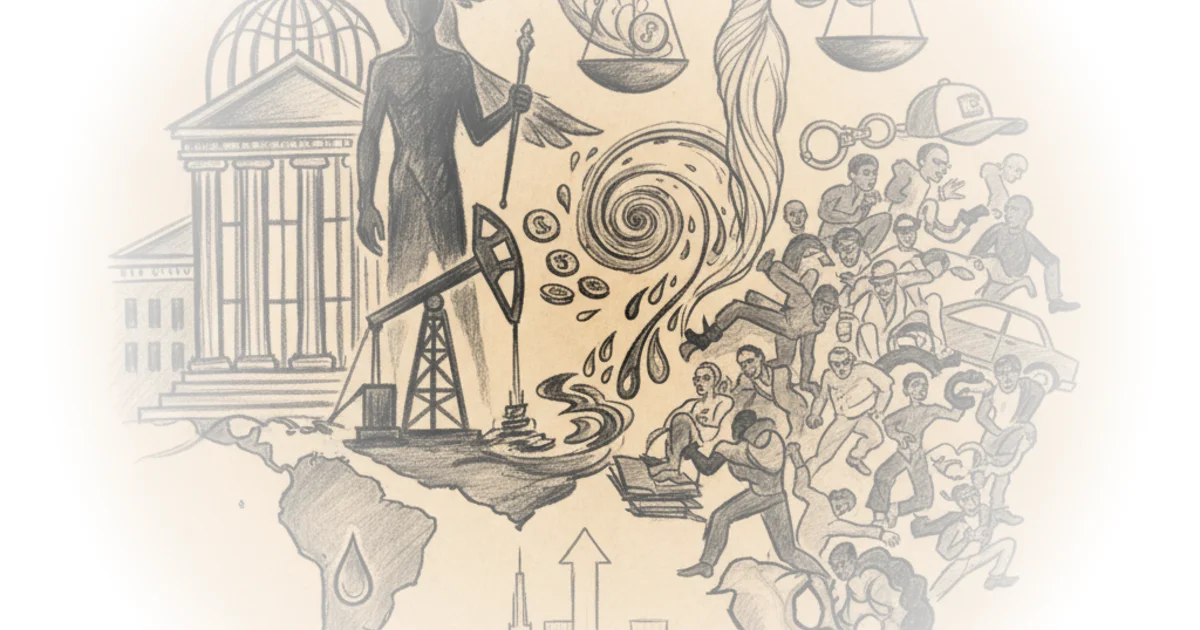
This pivot is the article's most critical insight. The Justice Department, in a superseding indictment, essentially admitted the cartel was a myth, reframing it as a "patronage system" rather than a formal criminal enterprise. Stone observes, "The Justice Department has finally acknowledged that cartel deosles isn't a real cartel. Hey, it's a low bar, but Pamela Joe Bondi cleared it. I believe in positive reinforcement." By simplifying the charge to a patronage system, prosecutors avoid the impossible task of proving the existence of a non-existent organization, though this creates a new hurdle: proving that a loose network of officials constitutes a conspiracy under federal law.
Critics might argue that this semantic shift weakens the moral clarity of the prosecution, turning a clear-cut case of organized crime into a murky debate over the definition of government corruption. However, Stone suggests this is a tactical masterstroke that makes the government's job "easier narratively and factually."
The Weaponization of Conspiracy Law
The commentary then shifts to the mechanics of the charges, particularly the gun offenses that seem disconnected from a drug trial. Stone explains that possession of machine guns and destructive devices is not about Maduro holding a rifle in an action movie, but about the legal doctrine of conspiracy. "If guns are a foreseeable part of the drug trafficking scheme, and any co-conspirator used or controlled them to protect that operation, the government can try to pin that on everyone, even if the guns never entered the United States," he writes.
This is where the legal strategy becomes ruthless. The defense will likely argue that weapons used in Venezuela were not part of an agreed-upon plan to traffic drugs into the US. Yet, Stone points out the stakes: "Gun charges carry long mandatory minimum sentences, and they can stack on top of whatever drug charges a defendant is facing. In other words, if he's convicted, Maduro could serve those sentences consecutively, and that means he's staring down the barrel of a potentially decadesl long sentence." The inclusion of these charges is less about the specific weapons and more about the mathematical certainty of a life sentence.
Gun charges carry long mandatory minimum sentences, and they can stack on top of whatever drug charges a defendant is facing.
The Jurisdictional Gamble
Perhaps the most surprising element of Stone's analysis is the location of the trial. Why New York? Stone clarifies that the choice is procedural, not political, rooted in the 2020 indictment and the routing of drugs through New York ports. "New York has jurisdiction because the drugs were allegedly routed to New York and smuggled through its ports. That's enough to put the case in New York," he notes. The case has landed before Judge Alvin Hellerstein, a 92-year-old Clinton appointee known for his independence.
Stone describes the judge with a mix of reverence and caution: "See, Judge Hellerstein is a Clinton appointee who lawyers openly describe as quote old and old school and does things his own way and doesn't give a what anyone thinks about him." This is a significant variable; a judge who moves at a "brisk pace" and ignores political pressure could streamline a trial that the defense is desperate to drag out. While the defense may argue that a jury of "bloodthirsty dictators" is the only fair peer group, Stone dismisses this as legally baseless, noting that the standard is simply a fair group from the local community.
The Capture and the Law
Finally, Stone addresses the elephant in the room: the legality of the raid itself. The defense will likely claim immunity or argue that the forcible abduction violates international law. Stone cuts through this with the Ker-Frisbie doctrine, a Supreme Court precedent stating that the method of capture does not strip a court of jurisdiction. "Under Supreme Court president known as the Kur Frisbee doctrine, courts have jurisdiction over criminal defendants regardless of how they were brought into American custody as long as they're physically present in the US," Stone writes.
He acknowledges the narrow exception for torture but notes that reports of 80 deaths during the capture do not qualify unless the abuse was directed specifically at Maduro. "It doesn't appear that Maduro was tortured. He was brought to the US, given lawyers, and is now in jail with Diddy," Stone quips, adding that even the psychological torture of listening to Diddy "is not a get out of jail free card." This section effectively neutralizes the most potent political defense Maduro's team could mount, grounding the trial in cold, hard procedure rather than international relations.
Bottom Line
Devin Stone's strongest move is exposing the government's strategic retreat on the "Cartel de los Soles" narrative, revealing a prosecution that is more pragmatic than the headlines suggest. The argument's biggest vulnerability lies in the sheer complexity of proving a "patronage system" conspiracy across international borders, a task that may prove harder than the original cartel theory. Readers should watch closely how Judge Hellerstein manages the pre-trial phase, as his "old school" approach could either seal Maduro's fate or expose the cracks in the government's evolving case.