Matt O'Dowd challenges the most fundamental assumption of modern cosmology: that the universe had a singular, irreversible beginning. In a field dominated by the theory of inflation, O'Dowd argues that the evidence for a "Big Bang" might actually point toward an eternal, repeating cycle of cosmic birth and death, a concept that eliminates the need for a singularity and potentially saves us from an "eternally inflating Multiverse."
The Flaws in the Standard Model
O'Dowd begins by dismantling the comfort of the standard Big Bang model, which posits that space and time originated from an infinite, dense point. While this model explains the expansion of galaxies and the cosmic microwave background, O'Dowd notes that it leaves critical questions unanswered. "Some observations aren't so easily explained," he writes, pointing to the "Horizon problem" where distant regions of the universe are too uniform to have ever been in contact, and the "flatness problem" which requires an uncannily perfect balance of forces.
The mainstream solution, cosmic inflation, proposes a period of extreme exponential expansion that smoothed out these irregularities. However, O'Dowd highlights a significant downside: "modern versions of the idea predict that if inflation happened then it never ended." This leads to a chaotic "eternally inflating universe" constantly spawning bubble universes, a concept many find "a little extravagant." Furthermore, inflation does not actually remove the initial singularity; it merely pushes it further back. As O'Dowd puts it, "any theory that predicts a singularity is automatically suspect."
The original Big Bang model has all of space originating from an infinite testal point at the beginning of time and expanding from there, but this fits a lot of observations of our universe.
This framing is effective because it exposes the fragility of the current consensus. By admitting that the leading theory relies on an unproven mechanism (inflation) that creates even stranger problems (the multiverse), O'Dowd creates a vacuum for alternative theories to fill. Critics might note that inflation is still the only model that successfully predicts the specific "lumpiness" of the cosmic microwave background, a feat O'Dowd admits is impressive.
The Ekpyrotic Alternative
To solve the singularity problem, O'Dowd introduces the "ekpyrotic universe," a cyclic model where the Big Bang is not a beginning but a transition. He explains that this model uses a scalar field, similar to the one driving inflation, but tweaked to allow the universe to contract and bounce. "The extreme accelerating expansion of inflation is driven by the same type of quantum field as we now think drives the relatively chill acceleration we attribute to Dark Energy," O'Dowd writes.
In this scenario, the universe expands, slows, and eventually collapses. However, instead of crushing into a singularity, the kinetic energy of the collapsing field converts into radiation, sparking a new expansion phase. "The field potential bottoms out in a minimum and then Rises back to zero," O'Dowd explains. This process smooths out the universe and solves the horizon and flatness problems without requiring a singularity. The model suggests that the universe could have been cycling forever, with no first moment in time.
The universe does not reach arbitrarily high temperatures so no magnetic monopoles ever need to be created there's no Singularity and there's no significant difference between one cycle and the next so this model is consistent with Cycles extending back in time forever.
This is the piece's most compelling argument: a mechanism that preserves the predictive power of inflation while removing its most philosophically troubling aspect—the need for a "first cause." However, the mechanism relies on M-Theory, a complex framework involving higher dimensions. O'Dowd acknowledges this by describing our universe as a "brane" (membrane) floating in a higher-dimensional space called the "bulk."
Colliding Branes and the Physics of Bounces
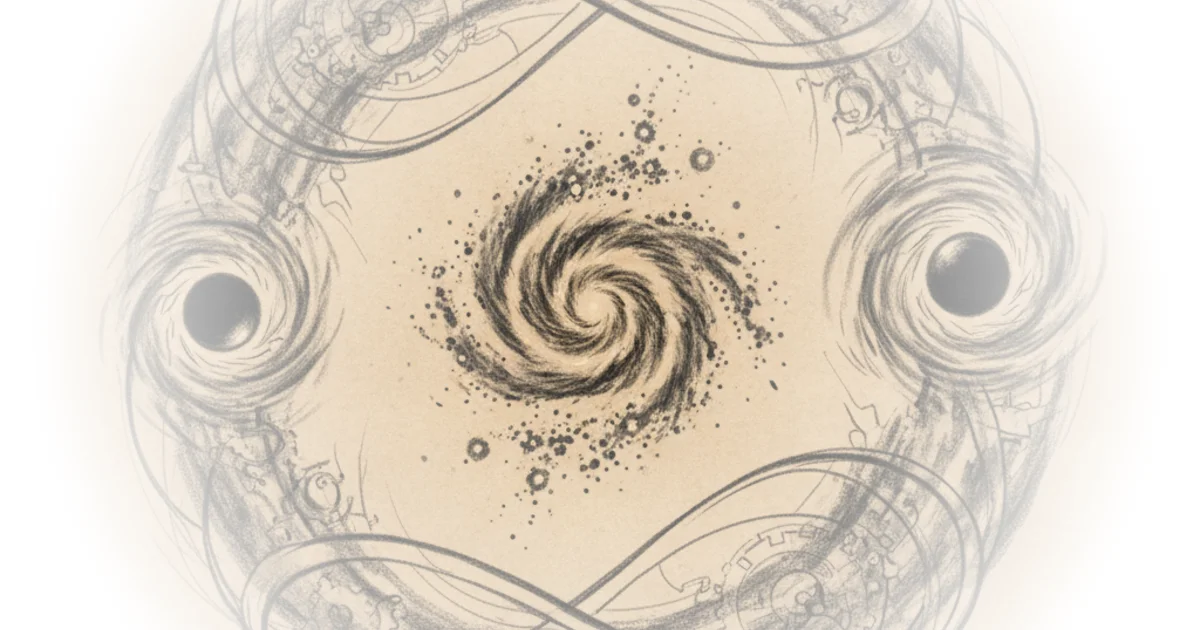
The most vivid imagery in the piece comes from the brane collision theory. O'Dowd describes our universe as a "visible brain" (brane) and suggests that a "hidden brain" periodically crashes into it. "This Collision dumps a bunch of energy into the visual brain sparking a big bang," he writes. In this view, the Big Bang is simply the energy release from two universes colliding and then recoiling.
The quantum fluctuations that seed galaxies are interpreted as "Wiggles in the incoming hidden brain," which cause different parts of our universe to start expanding at slightly different times. This elegantly explains the scale invariance observed in the cosmic microwave background. "Both the visible and hidden brains exist long before the collision and so they could reach thermal equilibrium over a large enough region to explain the smoothness of the CMB," O'Dowd argues.
This connects to the description of the scalar field because we can interpret the value of that field as just the distance between the visible brain and this incoming hidden brain.
While imaginative, this section relies heavily on M-Theory, which remains unproven. A counterargument worth considering is that invoking six extra dimensions and colliding membranes is arguably just as "extravagant" as the eternal inflation it seeks to replace. O'Dowd admits this, noting that if the behavior is due to colliding branes, "that's hardly less extravagant than Eternal inflation."
So did we just manage to say the universe from ever ending or save it from ever starting for that matter and at the same time did we save ourselves from having to be part of an eternally inflating Multiverse let's not get ahead of ourselves.
The Path to Verification
O'Dowd concludes by grounding the speculation in testable physics. He argues that while the ekpyrotic model and inflation predict similar density fluctuations, they differ in their production of gravitational waves. Inflation predicts a specific spectrum of high-frequency waves, whereas the ekpyrotic bounce would produce waves "weighted towards lower frequency." Unfortunately, O'Dowd notes that "no currently planned detector will be able to see these," leaving the theory in a state of elegant but untestable speculation for the foreseeable future.
Although the E parodic model predicts almost exactly the same observables as inflation there are potential differences there may be slight differences in the spectrum of density fluctuations but more concretely we would expect differences in the gravitational waves produced.
Bottom Line
O'Dowd's strongest contribution is reframing the Big Bang not as a unique event but as a phase in an eternal cycle, offering a mathematically viable escape from the singularity problem. However, the theory's biggest vulnerability is its dependence on unproven higher-dimensional physics, making it currently indistinguishable from the inflationary model it challenges. Readers should watch for future advancements in gravitational wave detection, which may finally provide the data needed to distinguish between a bouncing universe and an inflating one.