Vuk Bačanović delivers a startling reframing of the Balkans: what is often sold as a necessary security adjustment is actually a geopolitical prosthesis designed to turn a living society into a border cordon. The piece's most distinctive claim is that the push for a "third entity" in Bosnia and Herzegovina is not a democratic repair, but a "security engineering" project that reduces human beings to collateral damage in a new redistribution of power. For busy observers tracking the shift from post-war reconstruction to frontier management, this analysis exposes the hidden logic behind recent constitutional proposals.
The Security Cordon
Bačanović argues that the prevailing narrative has shifted from viewing Bosnia as a society needing renewal to seeing it as a "sanitary cordon" for the European Union and North Atlantic Treaty Organization. He writes, "Dayton didn't build a shared political community so much as it administered a ceasefire in legal form, turning everyday life (jobs, schools, hospitals, housing) into collateral damage of permanent ethnic bargaining." This observation is crucial because it reminds us that the 1995 Dayton Agreement, while stopping the bloodshed, froze the country into a constitutional maze that prioritizes stability over coexistence. The author suggests that current calls for reform are merely tuning this maze to serve external border patrol needs rather than the internal needs of the three constituent peoples.
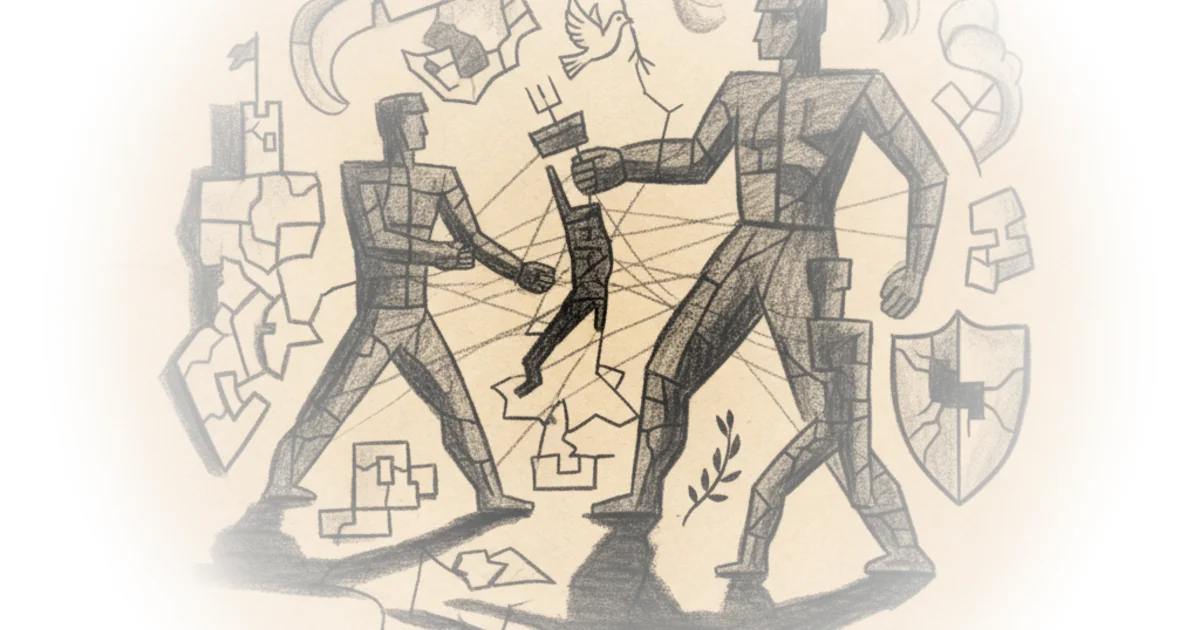
The catalyst for this shift, according to Bačanović, is a specific strand of conservative American geopolitical thought that has gained traction in the region. He highlights Max Primorac, a policy analyst at the Heritage Foundation, who articulates a view that translates demographic anxiety into border security. Primorac is quoted as saying: "The last thing Croatia needs right now—or NATO, or the EU, because it's the same border—is for (the Croatian people in BiH, author's note) to be left with yet another pro-Kremlin-oriented Serb entity and a radicalized Muslim entity." Bačanović dissects this statement to reveal its underlying racism, noting that it essentializes the Serb political space as a "Moscow fifth column" and the Muslim space as "naturally prone to extremism."
In that framing, a "third entity" does not appear as a remedy for any concrete, lived problem, but as a geopolitical prosthesis within a new redistribution of power.
This framing is effective because it strips away the humanitarian rhetoric often used to justify territorial changes. By reducing the country to a "guardhouse," the argument makes the partition of Bosnia seem like a logical necessity for European security rather than a political choice. However, critics might note that the author risks underestimating the genuine grievances of the Croat political leadership regarding their lack of representation, even if the proposed solution is flawed. The piece acknowledges this tension but argues that the solution offered is a trap.
The Theater of Submission
The commentary then turns to the local political elites who, despite their public feuds, collectively perform a "theatrical, almost pathetic submission" to external arbiters. Bačanović points to the recent visit of Croatian Prime Minister Andrej Plenković to Banja Luka, where local Serb politicians, including Milorad Dodik and Draško Stanivuković, suspended their internal conflicts to welcome him. He observes, "In TV studios they call each other traitors, foreign mercenaries, and grave-diggers of the nation; but when the Croatian prime minister arrives... everyone leaps to the feet: 'Welcome, please, just tell us where to stand so it shows up on the evening news.'"
This dynamic mirrors the historical pattern of the 1990s, where local actors used one another to break the whole, but now with a new script. Bačanović writes, "Just as Croatian policy in the early phase of Yugoslavia's disintegration primarily capitalized on Bosniak interests... today, under new circumstances, it is capitalizing on the Serb factor as a lever for reengineering the Dayton protectorate." The author connects this to the recurring controversy surrounding Željko Komšić, whose election by Bosniak voters to the Croat presidency seat has been used as proof of the need for a separate Croat entity. By backing obscure candidates or reinforcing the "Komšić case" narrative, local elites inadvertently validate the external demand for a third entity.
The piece also extends this analysis to Montenegro, where Zagreb uses its EU veto power to discipline Podgorica, framing the country as the antithesis of the "Serb World." Bačanović notes that this allows anti-Serb nationalists in Montenegro to find a patron in Croatia, effectively converting ideological labels into "geopolitical cheerleading." This creates a paradox where enemies on the ground—Montenegrin nationalists and Bosnian Serb leaders—end up serving the same external template of pressure and reengineering.
The Imperial Script
Ultimately, Bačanović concludes that the way out of this "nightmare labyrinth" is not another entity or more accusations, but a break with the racist imposition that reduces complex societies to security threats. He argues that this is a classic imperial strategy: "the center produces caricatures, local elites accept them as a currency of legitimacy, and politics is reduced to who can play their assigned role more skillfully in someone else's script." The author warns that as long as regional leaders accept this borrowed frame, they are working toward the same outcome: the abdication of real politics.
As long as Serbian, Bosniak, and Montenegrin politics accept that language and that borrowed frame—and then quarrel inside it—they work together toward the same outcome: the abdication of real politics and the preparation of terrain for "solutions" that, when needed, will be delivered from outside.
The strength of this argument lies in its ability to connect disparate political maneuvers—from the Heritage Foundation's think tank reports to the local elections in Banja Luka—into a single, coherent strategy of external control. It forces the reader to question whether the current push for constitutional reform is truly about democracy or about creating a manageable border zone. A counterargument worth considering is whether the author gives too much credit to the coherence of this "Trumpist" agenda, potentially overlooking the chaotic and opportunistic nature of Balkan politics. Yet, the evidence of coordinated rhetoric and the suspension of local rivalries for external validation suggests a disturbing level of alignment.
Bottom Line
Bačanović's strongest contribution is exposing how the language of "security" and "border protection" is being weaponized to dismantle the fragile social fabric of Bosnia and Herzegovina. The piece's biggest vulnerability is its heavy reliance on the coherence of an external ideological project, which may overstate the strategic intent behind what could be opportunistic chaos. Readers should watch for whether local elites continue to perform this "theatrical submission" or if they eventually reject the script that reduces their nations to mere guardhouses for a larger geopolitical game.