The idea that any two people on Earth are connected by six degrees or fewer sounds like a party trick. But the mathematics behind it is surprisingly robust — and the implications for how diseases spread, information travels, and even how criminals trace evidence are anything but trivial.
The Falafel Connection
In 1999, the German newspaper Dzite ran an experiment. They asked a falafel salesman named Salabani who in the world he would most like to be connected to. He chose his favorite actor: Marlon Brando.
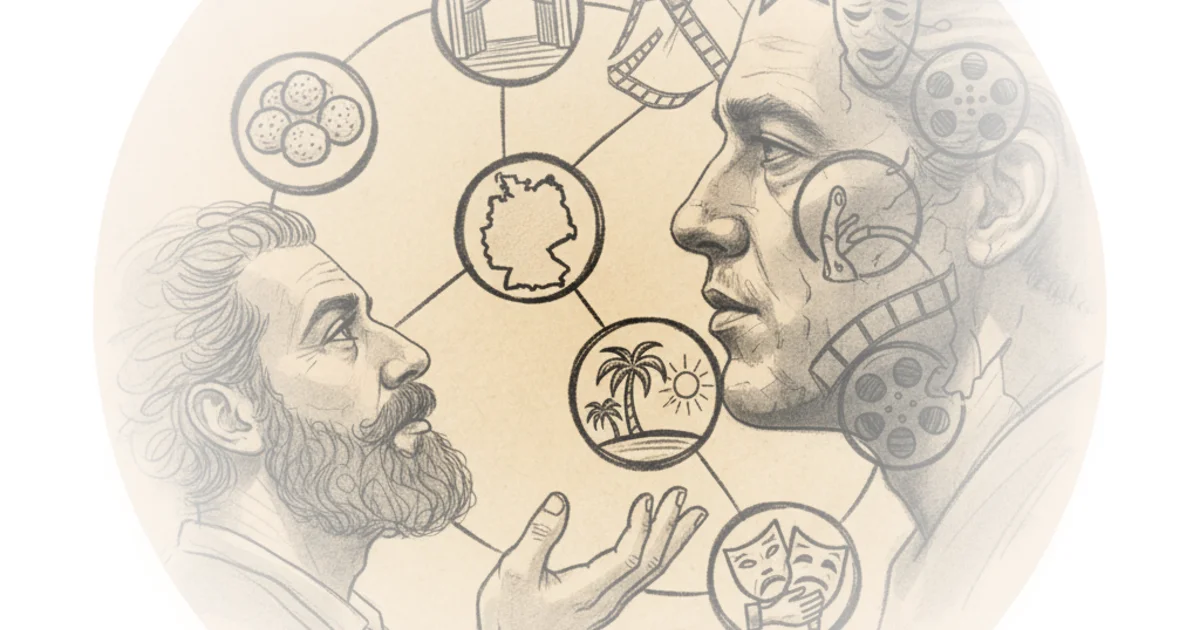
The reporters then searched for a chain of friends, family, or acquaintances — people who knew each other on a first-name basis who could connect Salabani to Brando. Remarkably, they found it took just six steps. The chain involved a friend in California who worked alongside the boyfriend of a woman who was the sorority sister of the daughter of the producer of the film Don Juan Demarco starring Marlon Brando.
The claim: any two people on Earth could be connected in six steps or fewer. But is it really true?
The Mathematics Behind Six Steps
If we were all connected to everyone else on the planet completely at random, it would be almost a mathematical certainty that any two of us would be connected through fewer than six steps.
Suppose you have 100 friends out of eight billion people. Each of them knows 100 people. Two steps away from you would encompass 100 times 100 — that's 10,000 people. Three steps away would reach one million people. Four steps away: 100 million. And five steps away: 10 billion — more than the entire Earth's population.
If your friends each have a hundred friends, five degrees of separation gives you ten billion potential paths. There are only eight billion people on Earth.
The math is simple. The world has roughly eight billion people. Five hops through networks of 100 connections each produces more than enough pathways to connect any two strangers.
But here's the shocking part: this calculation assumes your friends' friends are completely random — and we know that's not how humans work.
Why This Shouldn't Work
The crude calculation above is absurd for a simple reason: the world is very far from random. People naturally cluster geographically. Most of the people you know live close to you, and they also have a higher probability of knowing each other.
Imagine all eight billion people arranged in a circle, with each person knowing only the 100 people closest to them — 50 to the left and 50 to the right. In that scenario, the furthest person you can connect to is just 50 people away. To reach someone on the other side of the planet through a chain of acquaintances would take roughly 80 million steps. Connecting any two people would average 40 million steps.
Six degrees of separation should be mathematically impossible in a clustered world. Yet it works.
The Small World Problem
Ten years ago, Derek Muller conducted his own experiment and found that the average Veritasium viewer was only 2.7 degrees of separation from him — remarkably close.
In social science, this is known as the small world problem. It refers to the phenomenon where you're on holiday somewhere and you bump into a stranger who somehow knows your best friend. You say, "Wow, it's such a small world."
In the mid-1990s, two mathematicians — Duncan Watts and Steven Strogatz — set out to solve this puzzle.
The Middle Ground
Up until then, physicists had studied networks that were ordered and regular like crystal lattices. Mathematicians like Paul Erdős had done work on totally random networks. But no one had studied what happens in between.
There must be some enormous middle ground. And that's what Watts and Strogatz began to explore.
To study this middle ground, they imagined a simple regular network of people dotted around a circle, each connected to a few of their nearest neighbors. They then turned the knob toward randomness by introducing shortcuts — connections that link to someone outside your normal circle.
Watts and Strogatz had a concrete example: one of them belonged to an internet chess club and became very friendly with a guy in Holland. That connection makes the world small because now, even though their friends don't realize it, they're only one step away from a person in Holland.
They began disconnecting some links and reconnecting them at random to different nodes in the network. And as they did that, they watched what happened to the average number of steps it took to get from any one node to another — essentially, the degree of separation.
The Big Reveal
As Watts turned the knob in computer simulations, something remarkable happened. As soon as they introduced a few shortcuts, the world immediately gets as small as a random graph. When they rewired just 1% of the links to shortcuts, the average degree of separation dropped from 50 in the original fully ordered network to 10.
But they also tracked how clustered the network remained — the fraction of a node's connections that are also connected to each other. What they found is that clustering stayed high even as the world shrank. You could simultaneously have the clustering we know is real and the small world we know is real.
In their model with a thousand nodes, if you apply this to the eight billion people on Earth, you'd only need three out of every ten thousand friendships to be a shortcut. The average degree of separation drops to six.
Testing the Theory
Excited about their breakthrough, Watts and Strogatz wanted to test their small world model on real data. But this was 1996 — before Google existed and before vast networks were mapped.
They turned to an unusual source: the nervous system of a worm. C. elegans is a tiny worm, like a millimeter long, that can be found in dirt. It's a favorite of neurobiologists because they know every cell in its body from the time it's a single cell until it becomes a whole organism.
They had the total wiring diagram of that organism.
The worm has precisely 282 neurons, and on average they're connected to 14 others. If you lay that out in a line along the worm's body, the neurons at the ends would be separated by around 40 steps, and the average degree of separation would be around 14.
But when Watts and Strogatz ran calculations, they found the average degrees of separation between any two neurons was just 2.65 — remarkably close, comparable to a random graph.
They reasoned that if nature had done this for worms, it should be true of many networks. They looked at Hollywood actors and power grids across the United States. Sure enough, both were small world networks. In a database of over 200,000 Hollywood actors, the average degree of separation was less than four — meaning any two actors are connected through fewer than four co-stars.
What This Means for Disease
The real payoff was understanding how diseases spread and information travels.
Derek wanted to know how a few shortcuts would affect disease spreading through a network. They ran simulations starting with a completely regular world where it's entirely clustered. The result: if every step was a day, it would take 73 days for an infection to take over the entire world.
Then they introduced a few shortcuts and made it a small world — just 10% of connections. The spread became dramatically faster. After 26 days, the whole world was infected. It looks exponential at the beginning, then almost linear as you can't go any faster.
When they tested with a completely random network, the result was essentially identical: 25 days to infect everyone. In the random case, all links are random. In the small world case, it's just 10% — one out of ten friends being a shortcut. For some people that might be a bit much, but for most, it's about right.
But here's the crazy part: in this simulation, they only used 100 nodes. If you apply the same model to eight billion people on Earth, you'd actually need less than 1% of all links to be shortcuts.
The Paper's Impact
In 1998, Watts and Strogatz published their findings in a three-page article in Nature. The paper took off. Within a few years, it already had hundreds of citations. By 2014, it was ranked the 63rd most cited paper of all time. Today, it's got around 58,000 citations — higher than Peter Higgs's paper on the Higgs Boson and almost three times as many as Watson and Crick's Nobel Prize-winning paper on DNA.
The paper has been cited by people in far-flung fields from neuroscience to sociology to graph theory to computer science. Some drew networks between words.
The FBI Connection
Then things got strange. Derek started getting calls from the FBI. He was a little scared.
He called back, and the person who picked up worked in the hair and fiber network at the FBI — people who do criminology based on telltale hairs or fibers left on a victim's clothes after they've been murdered.
The FBI wanted to know: if police have a suspect and say you have fibers on your sweater matching the hair of the victim, what's the probability that those fibers came from secondary transfer? Maybe the victim was on a bus and left her fibers there, and then the suspect sat in the same seat — a secondary transfer. That doesn't prove anything.
The FBI wanted to know the probability of secondary transfers compared to primary transfers from actually killing the person.
Critics might note this connection seems tenuous — applying network theory to criminal forensics is quite different from social networks or disease spread. The analogy works metaphorically, but the practical application remains unclear.
Bottom Line
Watts and Strogatz discovered something profound: even with local clustering, a small number of random shortcuts creates a world where any two points connect in just six steps. Their paper became one of the most cited scientific papers ever.
The strongest part of this argument is the mathematical elegance — their model explains both why we're connected and why we stay clustered. The biggest vulnerability is that while the theory explains networks beautifully, applying it to real-world problems like disease spread or criminal investigation requires much more nuance than a simple simulation provides.