The question has haunted anthropologists for decades: why did we end up as the only human species on Earth?
For most of human history, this wasn't the case. Fifty thousand years ago, multiple human species walked the planet. Our ancestors, Homo sapiens, were spreading from Africa across the globe. Neanderthals roamed Eurasia from Britain to Siberia, reaching as far south as the Middle East. In Asia, distinct groups like the Denisovans and Homo floresiensis—tiny people nicknamed "the hobbits"—occupied their own ecological niches.
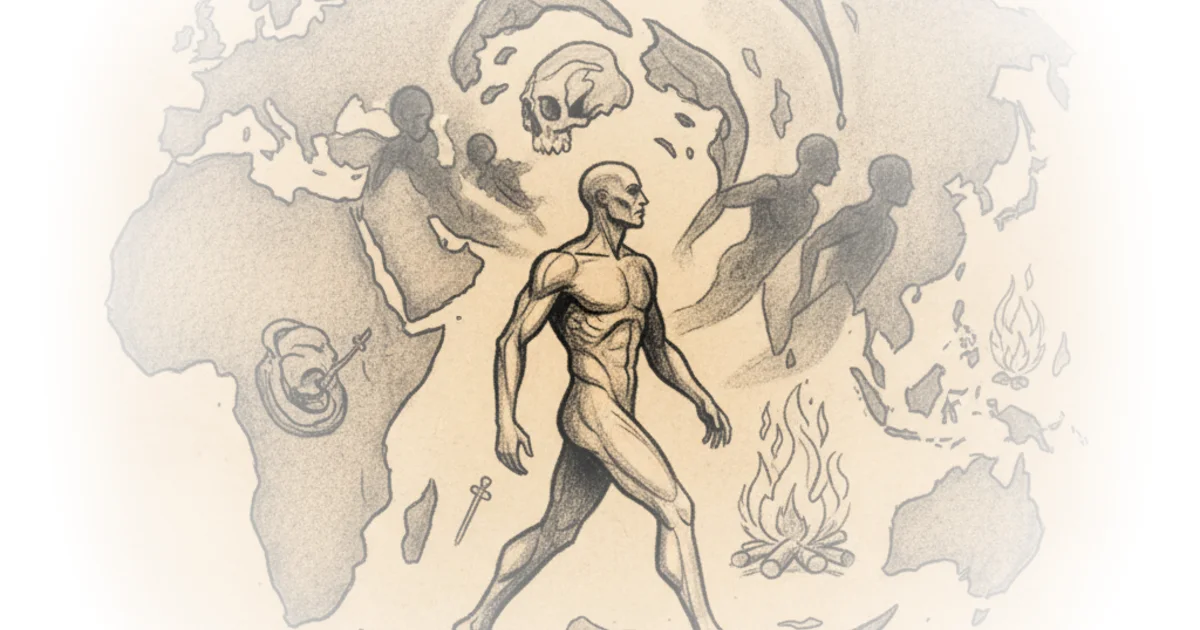
By thirty thousand years ago, they were all gone. We remained alone.
The Biological Advantage
What happened? Scientists don't know for certain, but several hypotheses offer clues.
The first theory centers on biology. Modern humans may have possessed subtle advantages over Neanderthals—advantages rooted in our bodies and brains.
Neanderthals were not the brutish creatures earlier generations imagined. They made sophisticated tools bonded with birch resin. They painted cave walls. They constructed elaborate structures deep underground, complete with carefully arranged fires. And we know from genetics that they interbred with us—they were truly human like us.
Yet our brains evolved alongside our bodies, and there may have been differences in how Neanderthal and Homo sapiens brains developed. Both species evolved large brains, but their shapes differed. The Neanderthal brain was more rugby-shaped—elongated—while ours is rounder.
Clothing and Survival
Beyond biology, technology may have played a role. Archaeologists have found bone needles across European and Asian sites—but always in layers connected to Homo sapiens. This isn't evidence that Neanderthals lacked clothing or couldn't work hides; they must have used them. But the presence of needles with eyes shows something more sophisticated: fitted, tailored garments designed for specific bodies.
The ability to create thin threads transformed survival. Clothing that actually fit meant protection from cold. Nets caught prey and fish. Bows let us hunt from safe distances. Sewing technology ranked among the most significant Paleolithic developments—alongside fire itself—and it appears only in Homo sapiens contexts.
The Calorie Calculus
Physical differences also matter. Neanderthals were chunkier, more robust. Modern humans are taller and slimmer. Did this mean Neanderthals needed more calories?
Estimates vary dramatically—from roughly double the daily intake to just five hundred extra calories—but they did need more. This is a fundamental disadvantage. The easier access to calories, the greater survival chance. In evolutionary terms: consume calories, reproduce, survive.
If Homo sapiens accessed calories marginally faster—even over tens of thousands of years—that edge compounded. More free time meant more learning, more culture, more knowledge passed between generations.
The Cultural Advantage
Around the world, archaeologists have found thousands of Paleolithic art pieces. Some were made by Neanderthals. But the volume created by Homo sapiens is simply not comparable—we made far more.
This matters because each artwork represents storytelling, cultural transmission, generational knowledge. These aren't decorations—they're evidence of accumulated wisdom passed down. When times get hard, that shared culture becomes survival cushioning.
The Violence Question
The second hypothesis is more controversial: did we eliminate them through violence?
Evidence exists in the archaeological record. This rib bone belonged to a Neanderthal from Shanidar Cave—a nasty stabbing wound. The problem: we cannot determine whether this represented conflict between species or within Neanderthal communities.
What we do know is that megafauna—large animals like woolly mammoths, giant kangaroos, enormous deer—faced extinction between thirty-two and seventy-six thousand years ago. According to one study, large animal populations dropped by ninety-two to ninety-five percent.
Climate change may have played a role—this period saw unstable climate. But these animals' ancestors had survived climate shifts before without such mass die-offs. The simplest explanation: humans hunted them.
The most famous examples are massive piles of mammoth bones at Costeni—evidence of systematic hunting.
The Hobbit Case
Consider Homo florensis. Tiny people, often called "the hobbits," they were likely Homo erectus trapped on Flores island experiencing island dwarfism. Evidence suggests they'd lived there for one million years—surviving climate change, disasters, shrinking bodies due to fewer resources.
They survived everything until Homo sapiens arrived in the region.
We have no evidence of violence—no weapons embedded in their bones. But that seems like too large a coincidence. Our intolerance toward any challenging life form may have extended to our own cousins.
Climate and Geography
Both hypotheses center human agency, but nature doesn't care about our plans. Climate could have played a role—volcanic activity, for example. The Flegrian Fields in Italy—one of Europe's super volcanoes—represent forces that could devastate ecosystems.
The honest answer: we don't know why these species vanished. Perhaps it was biology, technology, violence, climate, or some combination. What remains is the oldest cold case in humanity—and the evidence we're still analyzing today.
Counterpoints
Critics might note that assuming biological superiority risks repeating colonialist narratives about "advanced" versus "primitive" peoples. The extinction record for megafauna coincides with our arrival everywhere—we hunted them aggressively—yet we cannot prove violence against other humans specifically.
Another consideration: the archaeological record is biased toward Homo sapiens sites. We simply have more evidence from our own contexts, which may skew conclusions about cultural or technological superiority.
Pull Quote
"If you can access all the calories you need quicker, that also gives you more free time. Free time which can be devoted to learning and developing and passing on culture."
Bottom Line
Milo's strongest argument is that survival isn't just biology—it's cultural transmission accumulated over generations. The biggest vulnerability: we cannot prove any single cause. We may never know why Neanderthals, Denisovans, and the hobbits of Flores vanished while we remained.
What makes this investigation compelling isn't definitive answers but the mystery itself—and the uncomfortable possibility that we might not want to know what we did to our cousins.