Adam Tooze reframes the current anxiety over surging bond yields not as a novel crisis, but as a haunting recurrence of a specific, terrifying mechanism from March 2020. The piece's most striking claim is that the "safe haven" status of US Treasuries can evaporate in days, turning the world's most important financial market into a source of systemic panic rather than stability. For busy readers tracking the 2026 market turbulence, this historical parallel offers a critical diagnostic tool: the problem isn't just economic fundamentals, but a broken plumbing system where liquidity dries up precisely when it is needed most.
The "Un-hedge-able" Paradox
Tooze anchors his argument in the disorienting reality of March 2020, where the traditional rule that bonds rise when stocks fall completely inverted. He highlights the testimony of Daleep Singh, who described the moment when investors, desperate for cash, began selling the very assets they held for safety. "There was nowhere to hide. There was no safe haven," Singh told journalist Nick Timiraos, noting that "Treasury yields were spiking higher at the time that equity markets were plummeting. This was an un-hedge-able risk from a market perspective."
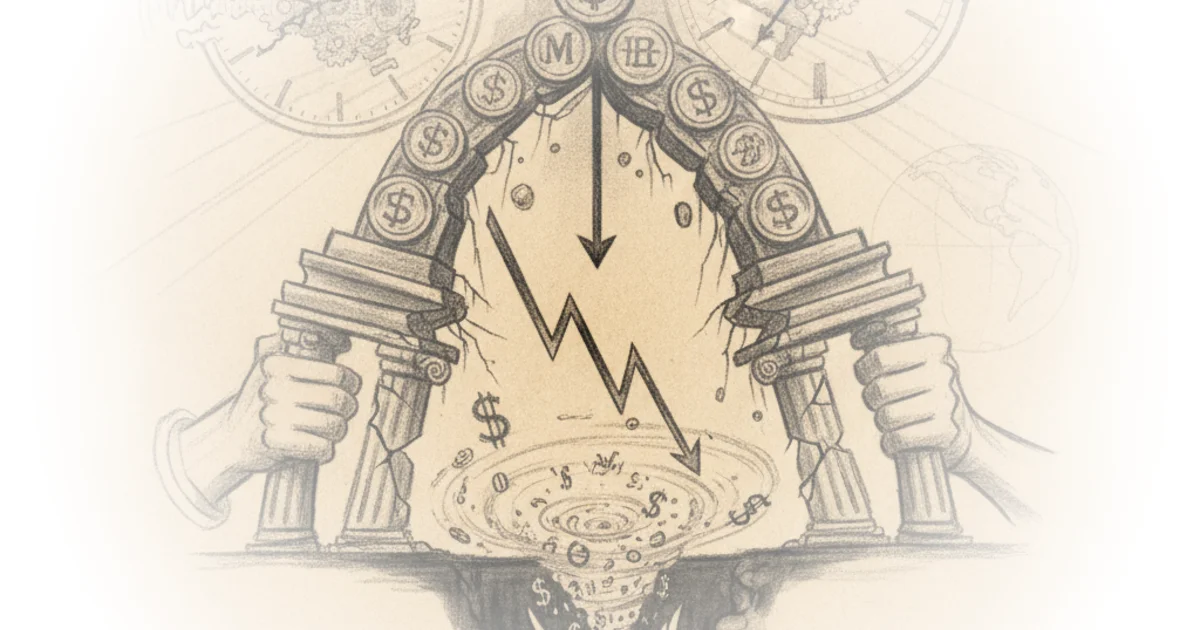
This observation is the core of Tooze's warning for 2026. He argues that the current market structure has failed to learn from this event, leaving the system vulnerable to a self-reinforcing cycle of selling. The author emphasizes that this wasn't a minor glitch; it was a fundamental breakdown of the financial system's "cornerstones." As New York Fed President John Williams stated at the time, "It is really about — to me, the primary focus for us is the fact that the U.S. Treasury securities market, which is, quite honestly, the most important market in the world, has shown a rapid deterioration in liquidity."
"The near collapse of the US Treasury market, the most important financial market in the world, is something we have already lived through, in March 2020."
Tooze effectively uses this historical moment to strip away the complacency that often surrounds bond markets. By detailing how even "safe" assets were dumped to raise cash, he illustrates a scenario where the market's own mechanics become the enemy. Critics might argue that the 2020 shock was unique to a global pandemic lockdown, a one-off event that doesn't translate to a normal economic cycle. However, Tooze counters this by pointing to the structural vulnerabilities in nonbank finance that remain unaddressed, suggesting the mechanism of the crash is permanent even if the trigger changes.
The "Apocalypse Now" Meeting
The narrative shifts to the frantic response from the Federal Reserve, specifically the emergency Sunday meeting of the Federal Open Market Committee on March 15, 2020. Tooze paints a vivid picture of the deliberations, where officials realized that standard tools were insufficient. He quotes New York Fed President Lori Logan, who laid out a "long list of bad, terrible, no-good developments," including airline bonds trading as if in default and commercial paper liquidity becoming "nearly nonexistent."
The most critical debate in that room, according to Tooze, centered on the scale of the intervention. While some officials hesitated, Minneapolis Fed President Neel Kashkari pushed for an aggressive, unlimited commitment. Drawing on his experience with the 2008 TARP bailout, Kashkari argued that "it is much better for the Fed to overreact than underreact." He warned that the mistake of the past was being "always slow, always too little, and always timid," and insisted that "the right policy response is to overreact, because you want to clip that very deep — maybe it's small, but very deep — hole."
This section highlights a crucial lesson for current policymakers: in a liquidity crisis, hesitation is more dangerous than overreach. The Fed's eventual decision to buy bonds at a staggering rate of $75 billion a day, a move that could be read as a form of Modern Monetary Theory in action, successfully stabilized the market by April. Yet, Tooze notes that this "spectacular" response came at a cost, creating a dependency where the market now expects the central bank to be the "buyer of last resort" for everything.
"The basic theory of our regulatory reforms coming after '08 is that institutions should be self-insuring. And yet we've already demonstrated that that's failed."
The author uses Kashkari's reflection to question the entire architecture of modern finance. The reliance on overnight funding markets, which allow institutions to maximize short-term profits while relying on the Fed to clean up the mess, is identified as a fundamental flaw. A counterargument worth considering is that such massive intervention distorts asset prices and encourages excessive risk-taking in the long run. Tooze acknowledges this tension but suggests that the alternative—a functioning market collapse—is an unacceptable price to pay.
The Unresolved Legacy
Looking toward the present day, Tooze connects the dots between the 2020 trauma and the current 2026 environment. He references Robin Wigglesworth's recent oral history, which exposed the "toxic codependency" between the Treasury market and hedge funds. The author argues that despite years of supposed reform, the "nightmare vision" of 2020 remains the primary threat. He quotes Singh again, who recalled the event as "sheer, unadulterated panic, of a magnitude that was far worse than in 2008 and 2009."
The piece concludes with a sobering reflection on the nature of history itself, invoking Benedetto Croce's idea that "all history worthy of its name is contemporary history." Tooze suggests that the current administration and the Federal Reserve are adding new layers to this history, but the underlying code of the financial system remains unchanged. The danger is not just a market correction, but a loss of faith in the Treasury market as a functioning institution.
"If it is true that all true history is contemporary history, then it is also true that any serious engagement with current moment, with contemporary reality, must necessarily be historical."
This framing is powerful because it forces the reader to stop viewing current yield spikes as isolated data points and instead see them as symptoms of a deeper, unresolved structural rot. The article avoids the trap of focusing on individual political figures, instead concentrating on the institutional dynamics of the Federal Reserve and the Treasury Department. The historical context of the 2008 crisis and the specific mechanics of the 2020 "flight-to-quality" failure provide a robust foundation for this analysis.
Bottom Line
Tooze's strongest argument is the identification of the Treasury market's liquidity fragility as a permanent, structural vulnerability rather than a temporary anomaly. The piece's biggest vulnerability lies in its assumption that the "unlimited" Fed intervention of 2020 is a repeatable solution, given the potential long-term inflationary and balance-sheet consequences. Readers should watch for whether the current administration's policy responses prioritize short-term market stabilization over the long-term regulatory reforms that Kashkari and others called for a decade ago.