Steve Vladeck exposes a disturbing pattern in the Supreme Court's emergency docket: the systematic erasure of human suffering to preserve executive overreach. In his analysis of the Court's ruling in Orr, he argues that the justices are not merely applying legal standards, but are actively rewriting the rules of equity to favor the administration's agenda while ignoring the tangible, life-threatening risks faced by transgender travelers. This is not a dry procedural critique; it is an indictment of a judicial body that has decided some harms matter and others do not.
The Illusion of Neutrality
Vladeck begins by dismantling the Court's superficial reasoning regarding passport markers. The majority order attempts to equate the display of biological sex with the display of a country of birth, claiming both are merely "attesting to a historical fact." Vladeck identifies this as a fundamental failure to grasp the reality of how these documents function in the real world. He writes, "Displaying passport holders' sex at birth no more offends equal protection principles than displaying their country of birth—in both cases, the Government is merely attesting to a historical fact without subjecting anyone to differential treatment." This sentence, according to Vladeck, is not just legally flawed; it is "preposterously dismissive."
The author's critique here is sharp because it highlights the disconnect between abstract legal theory and the lived experience of the plaintiffs. While a country of birth rarely triggers immediate physical danger for a traveler, a mismatched gender marker can lead to harassment, detention, or violence abroad. Vladeck notes that the district court made specific factual findings regarding "a greater risk of experiencing harassment and violence" for these individuals, findings the Supreme Court simply chose to ignore. By treating the passport as a passive record rather than a potential weapon against the bearer, the majority sidesteps the core constitutional question of equal protection.
The documented real-world harms to these plaintiffs obviously outweigh the Government's unexplained (and inexplicable) interest in immediate implementation of the Passport Policy.
The Broken Scale of Equity
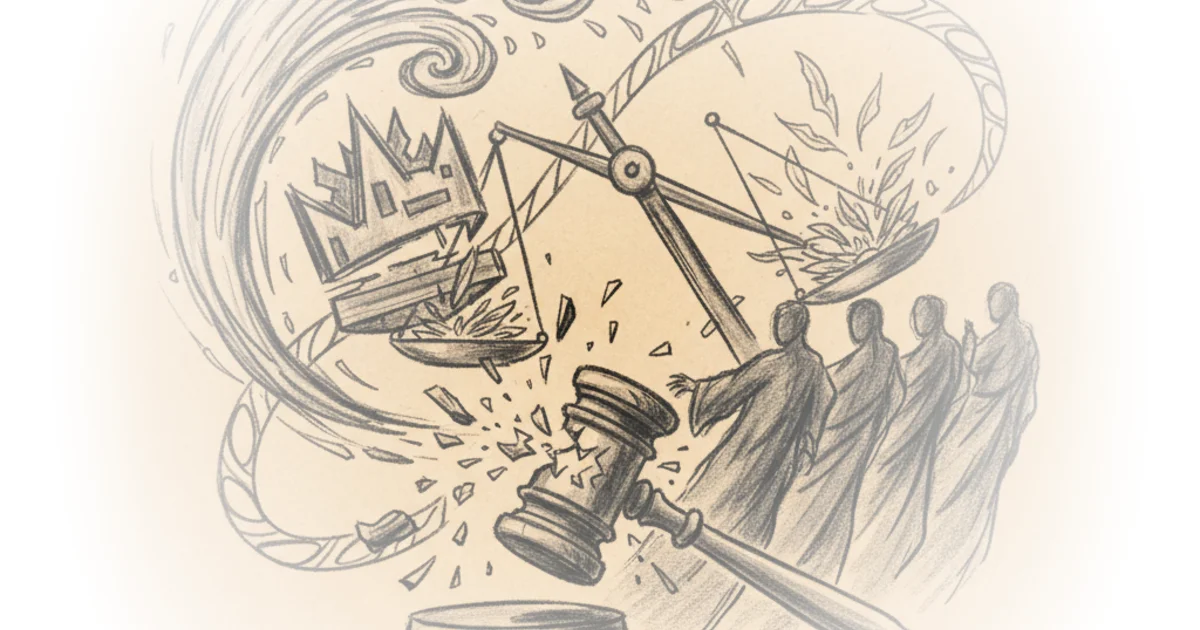
The most damning aspect of the ruling, as Vladeck frames it, is the complete absence of a balancing test. In emergency applications, courts are supposed to weigh the harm to the government against the harm to the individual. Here, the Court allegedly found "irreparable harm" to the executive branch without offering a single piece of evidence to support the claim. Vladeck points out that the order asserts the injunction harms the government because it involves "foreign affairs implications," yet provides no explanation of what those implications are or why they are irreparable.
This move echoes the troubling trends seen in the "shadow docket," where the Court has increasingly granted emergency relief to the executive branch without the rigorous scrutiny applied to other litigants. Vladeck argues that the Court has conflated the blocking of a statute with the blocking of a policy, treating the latter as an existential threat to the government. He writes, "The former idea can be traced back to the 'presumption of constitutionality,' the prosaic idea that statutes come to court on the assumption that they are valid. Not only is there no such presumption for executive branch action, but even the presumption of constitutionality gives way in the face of a colorable constitutional claim."
Critics might argue that the executive branch has a legitimate interest in enforcing its own policies uniformly, especially those with foreign policy dimensions. However, Vladeck counters that this interest cannot override the specific, documented dangers faced by the plaintiffs. The imbalance is stark: the government faces a delay in implementing a policy, while the plaintiffs face a return to a 33-year-old regime that the lower courts found likely unconstitutional and deeply harmful. The Court's refusal to acknowledge this disparity suggests a bias in how "harm" is defined.
The Abdication of Duty
Vladeck reserves his harshest criticism for the Court's failure to engage with the merits of the case. Instead of addressing the plaintiffs' arguments about animus or procedural violations, the majority places the burden on the respondents to prove the policy was motivated by a "bare desire to harm a politically unpopular group." Vladeck finds this inversion of burden of proof to be "unbecomingly mean." He notes that the administration's own executive order, which described transgender identity as "false" and "corrosive," should have been sufficient to raise the specter of animus, yet the Court demanded the plaintiffs do the heavy lifting.
The dissent by Justice Jackson, joined fully by Justices Sotomayor and Kagan, serves as the moral anchor of Vladeck's analysis. He highlights Jackson's observation that the Court "misunderstands the assignment" in these emergency cases. Jackson's closing argument, which Vladeck quotes in full, asserts that equity cannot justify intervention when the government's interest is "little advantage" compared to the "needlessly and significantly burdening" of the plaintiffs. Vladeck emphasizes that this is not a disagreement over policy, but a failure of judicial duty. "The Court's failure to acknowledge the basic norms of equity jurisdiction is more than merely regrettable," Vladeck writes. "It is an abdication of the Court's duty to ensure that equitable standards apply equally to all litigants—to transgender people and the Government alike."
This framing is particularly powerful because it connects the specific case to a broader institutional crisis. It suggests that the Court is no longer a neutral arbiter but an active participant in the erosion of rights for marginalized groups. The consistency of the three Democratic appointees in their dissent, Vladeck notes, serves as a rebuttal to media narratives suggesting deep divisions among them. They are united in their view that the majority has abandoned the rule of law.
Bottom Line
Vladeck's analysis is a masterclass in exposing the procedural subterfuge used to mask substantive injustice. His strongest point is the revelation that the Court's "irreparable harm" finding is a legal fiction, constructed without evidence to justify a politically convenient outcome. The argument's vulnerability lies in its reliance on the assumption that the Court will eventually be held accountable for these procedural deviations, a hope that may be fading as the shadow docket expands. Readers should watch for whether this ruling sets a precedent for future emergency applications, potentially cementing a two-tiered system of justice where the government is shielded from the very equity standards it demands of others.