The strangest physics story you've never heard: how Einstein proved that the universe allows something faster than light—and why we still don't know what it means.
The Paradox That Started Everything
In 1905, Einstein revolutionized physics by showing that gravity isn't an instant force acting across distance. Instead, spacetime itself bends, and changes in that bending propagate like ripples outward at exactly the speed of light. This theory fixed a devastating logical flaw: if gravity were truly instant, observers moving at different speeds would disagree on whether cause preceded effect—and that would break the laws of physics entirely.
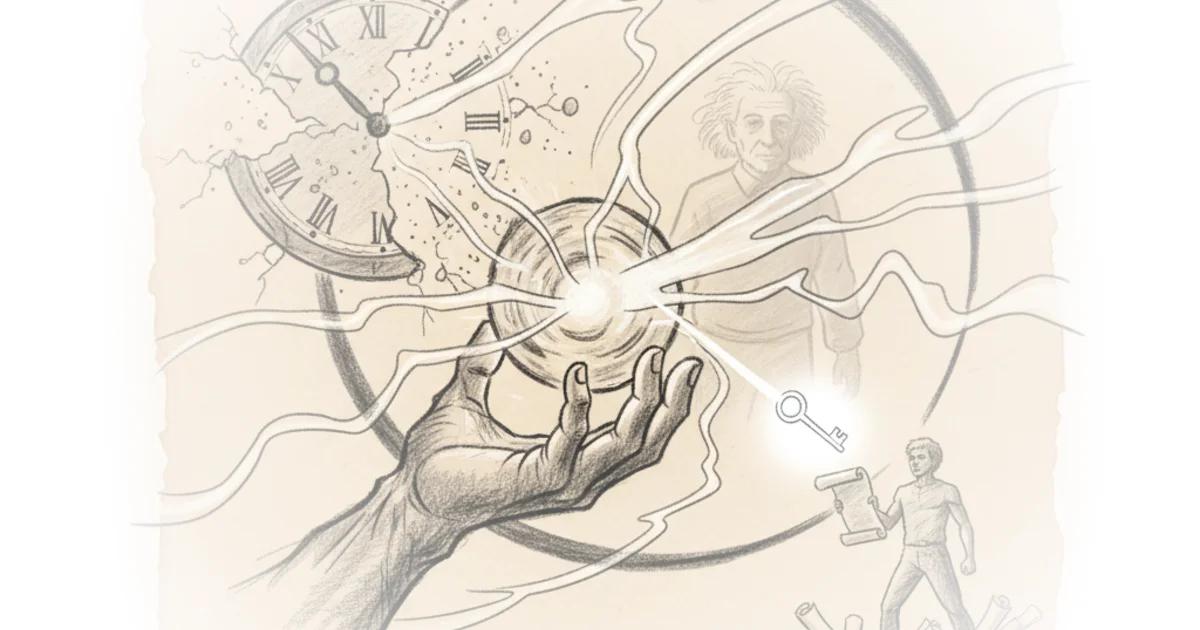
Einstein spent ten years working through this problem. The result was general relativity—our best theory of gravity—and it came with an ironclad rule: nothing carrying information can travel faster than light. Causality must be preserved for all observers.
Then in 1927, Einstein turned his attention to the brand new quantum mechanics.
The Showdown at Copenhagen
In 1927, the world's leading physicists gathered at the Scripps Institution of Oceanography conference in La Jolla, California—a gathering that would later be called "the Nobel Prize bar graph" because roughly sixty percent of attendees would eventually win the prize. The quantum revolution was being discussed.
Einstein took the stage with a simple thought experiment. Imagine firing a single electron through a narrow slit toward a detection screen. Quantum mechanics says this electron behaves like a wave—a probability wave that spreads out through space. When it hits the screen, you detect it at one specific point. The electron seems to choose its location randomly.
The audience followed closely. But then Einstein asked something surprising: why doesn't the electron also show up somewhere else a moment later? There's only one electron—we can't detect it twice.
The answer was that quantum mechanics requires what physicists call "wave function collapse." When the electron is detected at one point, its wave function collapses to zero everywhere else—immediately. The probability of finding it elsewhere becomes zero. But here's the problem: this collapse isn't local. It happens instantly across any distance.
Einstein pointed directly at the heart of quantum theory's strange prediction. A measurement here must instantly affect a wave function over there—no matter how far apart these locations are. This was non-locality in action.
"This is an entirely peculiar mechanism of action at a distance," Einstein concluded. "It implies a contradiction with the postulate of relativity."
The audience didn't know what to make of it. One attendee admitted afterward that he didn't understand precisely what Einstein was trying to prove. That man happened to be Niels Bohr—the most influential figure in quantum physics at the time.
Bohr's institute in Copenhagen had become the hub of the new field. Young scientists like Werner Heisenberg came to learn from him. Rather than writing the mathematical rules himself, Bohr told everyone what they meant. His philosophy became known as the Copenhagen interpretation—essentially a rulebook for making predictions without asking what particles are actually doing when no one is watching.
Einstein couldn't stand this interpretation. He called it "a tranquilizing religion" in a letter to his ally Erwin Schrödinger.
The EPR Paper
But Einstein hadn't convinced anyone. So in 1935, he made one final attempt—working with two younger colleagues Boris Podolski and Nathan Rosen—to prove that quantum mechanics contradicts relativity. They published what became known as the EPR paper.
Here is their simplified thought experiment: Imagine a single high-energy photon suddenly splits into two particles—one electron and one positron. Since one is negative and the other positive, they cancel out electrically. But both particles carry something called "spin"—and like electric charge, this must be conserved.
If the original photon had zero total spin, then the two particles together must have zero total spin as well. If the electron has positive spin in one direction, the positron must have negative spin to perfectly cancel it out. But here's the strange part: quantum mechanics says both possibilities exist simultaneously until a measurement is made.
The only way to conserve spin is if when the electron is measured and its state is determined, the positron's state is also determined instantly—regardless of how far apart they are.
To visualize this, imagine each particle carries an envelope representing its quantum state. Both particles are in what physicists call a "superposition"—meaning plus and minus spin simultaneously. Now move one particle far away. Opening one envelope to measure the electron's spin seems to instantly collapse the other envelope's state. Otherwise, conservation of spin would be violated.
But how does the distant particle know which state to collapse into? It must receive information from the measured particle—information that travels faster than light.
This is non-locality: measurements here can instantly affect particles far away. The EPR paper proved this mathematically.
What This Means
Einstein's argument was simple and his talk so short that people didn't know what to make of it. But the implications were enormous. Just as Newton's gravity led to general relativity—a local theory—Einstein believed quantum mechanics must also be incomplete. There should exist a deeper, local theory that replaces it.
The debate between Einstein and Bohr would last decades. Bohr never fully accepted that quantum mechanics is genuinely non-local. When he recounted Einstein's thought experiment in later years, he drew diagrams—but those diagrams just didn't have the crucial elements Einstein originally included. The physics community took this as a victory for Bohr.
History is written by the victors.
But here's what makes this story so strange: experiments have proven that quantum mechanics really does allow faster-than-light effects. Not information traveling faster than light—but influences that are non-local. We measure one particle, and far away particles instantly respond. This has been confirmed repeatedly in laboratories.
The Unresolved Debate
Critics might note that not all physicists agree about what this means. Some argue that quantum mechanics is complete—that there's no need for a deeper local theory. Others maintain that Einstein was right: there must be something more fundamental underneath quantum mechanics—a reality where cause and effect proceed in an orderly fashion.
The debate continues today, with real experiments testing whether the universe allows faster-than-light influences. Some physicists believe this points toward one of the most profound discoveries about nature: that we live in many worlds.
"This is an entirely peculiar mechanism of action at a distance." — Einstein, describing how quantum mechanics must instantly affect particles far away
Bottom Line
Einstein's strongest claim—that quantum mechanics requires non-local influences—has been experimentally confirmed. His deepest worry about physics was right: something in quantum theory does allow effects to travel faster than light. The biggest vulnerability is that we still don't fully understand what this means. Some physicists think it points to parallel universes; others think it's simply a limitation of our instruments. But Einstein's original concern—that instant influences contradict relativity—has been proven true in the strangest way possible.