Stefan Milo makes an argument that's been strangely absent from paleoanthropology: the story of Lucy isn't just about bones—it's about how she became us. Drawing on recent fossil discoveries and updated dietary evidence, Milo builds a case that 3 million years ago wasn't just another era, but the moment humanity's ancestors started becoming truly human.
The World That Shaped Lucy
Around 3.5 million years ago, one of the most important fossils ever found wandered the African savannah. Her name is Lucy—Australopithecus afarensis—and today scientists are reconstructing her life and death in unprecedented detail.
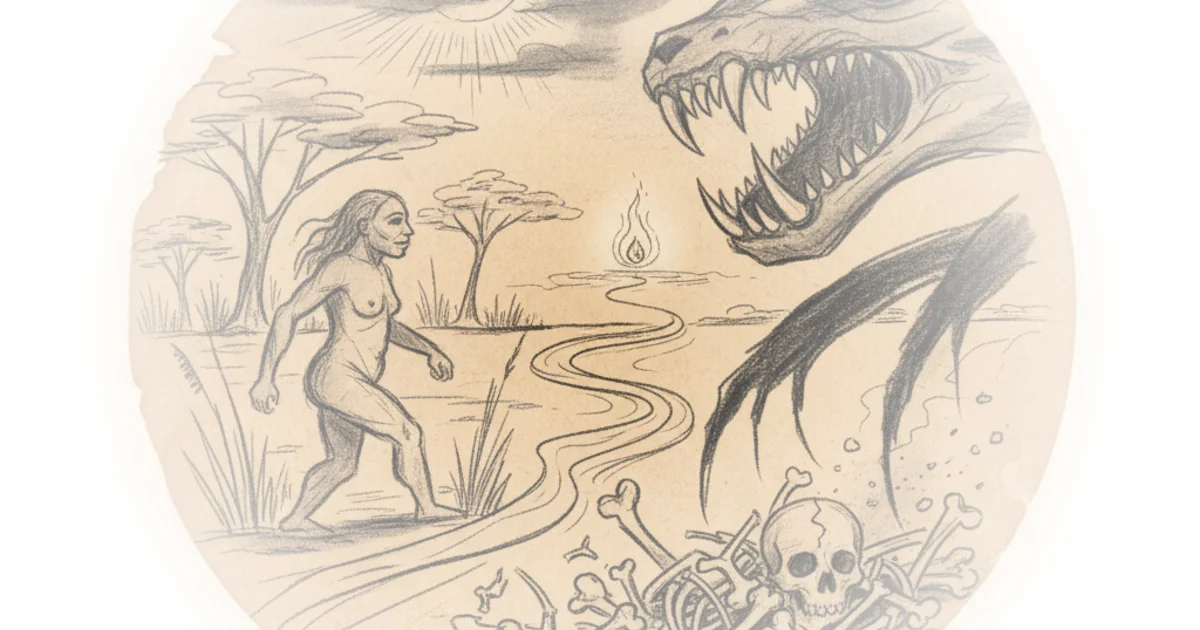
Lucy's world was wild in ways that would feel foreign to modern eyes. The planet bore no scars from human hands. Some animals would look familiar as ancestors of today's species, but others were radically different. Theriodon broomy—a relative of the galada twice its size, weighing up to 50 kilograms—preferred plants, but nobody would have dared stand in its way. Meganterodon, a saber-toothed cat built like a leopard on steroids with massive teeth and powerful jaws, could take down the largest prey. Crocodiles lurked in greater numbers than we see today.
For a young Australopithecus, survival was far from guaranteed. The archaeological record is littered with examples of ancient ancestors becoming lunch. A Paranthropus robust skull shows two puncture marks likely caused by a leopard dragging it across the savannah by its skull. The bones of Australopithecus afarensis are peppered with crocodile tooth marks—victims probably caught off guard at the water's edge and ripped from safety by crocodiles lying in wait. Saddest of all: a roughly 3-year-old Australopithecus africanis that lived around 2.8 million years ago, judging by puncture marks inside its eye sockets, was plucked from the savannah by a predatory bird—probably an African crowned eagle—and carried to a grisly end.
Yet Lucy survived. Scientists believe she spent significant time in trees, though her anatomy already showed she was bipedal. Her short and wide hip, fully extendable knee, and many other features confirm upright walking. But her upper body retained more ape-like characteristics than modern humans.
In 2012, anthropologists found the intact shoulder blade of a young Australopithecus afarensis—named Salam. This was crucial because even though Lucy is 40% complete, her shoulder blades were missing, denying scientists a vital piece of the anatomical puzzle. Salam's shoulder blades were much more similar to modern juvenile gorillas than modern humans, suggesting these hominins still spent time in trees.
A Childhood in the Trees
Lucy's childhood was probably similar to that of modern great apes—playing with others, rolling in grass, jumping on siblings, watching adults, learning survival skills. But her greatest challenge was finding food.
Analysis of teeth from twenty different Australopithecus afarensis specimens reveals a diet involving significant C4 plants: grasses, sedges, and succulents that thrive in dry, open savannah environments. They could have eaten the grasses and seeds themselves or dug for roots and tubers much higher in caloric value. Because these buried foods were hard to access, competition was rare—and they provided decent meals for an Australopithecus smart enough to dig for them.
These foods are almost entirely avoided by chimpanzees and gorillas, our closest relatives. This dietary shift marks a significant moment in human evolution—away from forest resources toward the varied resources of open landscapes.
But this food source didn't mean life was easy. Teeth from Australopithecus that lived one million years after Lucy show seasonal stress in their diets. Lucy likely spent long periods roaming the savannah searching for food.
The Footprints That Prove We Walked
Absolutely stunning are footprints from Lucy's era preserved in earth—the Laeit footprints. What's fascinating is recent discoveries from the same location suggest different walking styles, different gaits used by hominins. How Australopithecus could walk and run has been a major debate in anthropology, and these footprints will certainly be analyzed for clues to the evolution of bipedalism.
These footprints aren't just incredible relics of ancient human life—they are humanity's literal footsteps from roughly 3 million years ago when we were very much in our infancy. There were probably many distinct groups, each subtly different, with specific quirks, survival strategies, and biological adaptations.
The Tool That Changed Everything
When Lucy wandered the earth trying not to starve, she was almost certainly not just looking for plants. She probably had a taste for something sweeter—and possessed a secret weapon to get it.
Many monkeys and apes use tools to acquire food. So it's likely there has never been a point in hominin evolution where some form of primitive tools weren't being used. But what separates our lineage from other cousins is the ability to modify and improve these tools—particularly stone tools.
For a long time, it was believed that the first modified stone tools were Oldowan tools created by our genus Homo—specifically Homo habilis around one million years after Lucy died. However, recently stone tools were unearthed dating to 3.3 million years ago, right in Lucy's era. These have been dubbed the Lomeki assemblage and are currently the oldest deliberately modified stone tools ever found.
Bones of animals, likely antelopes and bovids, have also been unearthed bearing cut marks from an astonishing 3.4 million years ago. This evidence suggests Lucy's diet could have included significant meat—and that she was creating tools to access it.
How Did Lucy Get Her Meat?
This raises fascinating questions. First: how did they acquire this meat? Lucy was only about one meter tall and unlikely to be a great sprinter, so hunting large, fast animals was probably not easy for her. Could troops of Australopithecus have bullied faster predators off their kills? It's possible.
Troops of other primates can be highly aggressive. So if Lucy's life was anything like a chimpanzee's, then another major challenge was probably avoiding other Australopithecus. Lucy could have also been scavenging meat from carcasses of abandoned prey. Lions often leave much meat on the bones—including bone marrow inside. Perhaps Australopithecus like Lucy were developing stone tools to strip bones of small slivers of meat or smash through long bones to reach the marrow. Instead of competing with top predators, Lucy was probably fending off other scavengers like vultures.
The second important question involves what was going on in Lucy's brain. If our interpretation is correct—hominins like Lucy were making modified stone tools—then it suggests something dramatic had shifted in Australopithecus brains compared to other apes.
Lucy's brain would have been similar to a modern chimpanzee's, just marginally bigger on average. Yet chimpanzees in studies have so far been unable or unwilling to produce modified stone tools and even seem unable to use a sharp flake to open a box containing food.
So although the change between the two skulls is small, something dramatic was going on underneath. The brains of Australopithecus were perhaps being rewired.
The Rock That Suggests Her Brain Was Changing
Another incredible artifact that lets us glimpse inside Lucy's brain is the intriguing Makakanscat cobble. This rock was found in a South African cave in layers dated to 2.95 million years ago that also contained remains of Australopithecus. Curiously, this rock is several kilometers from where it would occur naturally—perhaps as far as 32 kilometers away. It's probably too large to be carried by birds. And the cave showed no evidence of flooding that could have brought it in.
No one can really deny this rock triggers pareidolia—that sense within us that likes to find faces. This ability is not unique to humans. Chimpanzees process faces similarly to humans. Many animals have evolved this sense out of simple self-preservation—spotting faces ultimately reduces chances of being bitten.
It is possible this rock stood out to an Australopithecus and something about it said, "Take me home." Again, this suggests something was really changing in their brains. This is especially interesting because so far endocasts of Australopithecus brains and chimpanzee brains have shown little difference in organization. So the change must have been incredibly subtle but very significant.
Perhaps all artistic expression and creativity ultimately has roots in a simple moment of curiosity by an Australopithecus like Lucy.
The First Steps Toward Humanity
Lucy was not simply an upright walking ape. She was taking the first tentative steps toward becoming human.
One of the major events in Lucy's life might have been giving birth. This was probably quite difficult. The combination of upright walking—which narrowed our hips—and slowly increasing brain size was probably starting to put strain on pregnant women. Baby Australopithecus would have had to rotate slightly to pass through the birth canal, meaning giving birth was certainly harder than earlier in our evolution and therefore might have become more collaborative.
Instead of Lucy giving birth alone like a chimpanzee typically does, she could have been surrounded by other women—perhaps her own mother—assisting her in bringing new life into the world. Who knows what effect this increased collaboration had on our evolution?
Usually when we imagine increased cooperation in prehistoric ancestors, we picture them hunting together. But that's just one way we cooperate. And the increasing difficulty of giving birth could have been an extremely significant factor in the evolution of our complex social systems.
The Debate Over Lucy's Family
How much of a role did Lucy's baby daddy play in raising children? This is subject to huge debate. The issue revolves around size differences between males and females called sexual dimorphism.
In primates, species with high degree of sexual dimorphism tend to live in societies where one massive male tries to have all the sex with all the women and plays little role in raising children. Silverback gorillas and mandrills are perfect examples—absolute beasts.
Compared to other apes, humans don't have high degree of sexual dimorphism and males tend to be very involved in raising children. Some studies of Australopithecus afarensis have concluded there was a high degree of dimorphism. Others argue the degree is similar to humans—that therefore males were more involved in family life.
In support of this idea, Australopithecus seems to have developed slower and had longer childhoods than our modern ape cousins—probably because they might have had to learn how to produce stone tools and live slightly more complex lives. So more investment was required from somebody, and that could have been the male. But it's hard to say for sure because we don't have perfectly preserved male and female Australopithecus.
All these estimates are based on reconstructions. The specimens we do have are not only incomplete but also separated by hundreds of thousands of years—plenty of time for a species to change.
How Lucy Died
Whatever happened in the twists and turns of Lucy's life, at some point she died. Judging from fractures on her bones, some have suggested she died from falling. Others contend these fractures could have been caused by large animals. Either way, her death was probably sincerely mourned by her family.
Humans grieve for our dead. Even chimpanzees grief for their infants—staying by their side for days. As evidence suggests Australopithecus might have formed even closer bonds, we can only imagine the pain they would have felt watching over her body.
Little would they know—we are still watching over Lucy more than 3 million years later, captivated by the story she can tell. Not just of herself but of the origins of everyone alive today.
The Neanderthal Question
Around 50,000 years ago in what is now Iraq, another human ancestor walked the earth. This is Neanderal Shannidar 1—Nandi. Using the latest scientific evidence, what can we say about his life and death? His childhood, diet, society, life-threatening injuries.
For all great apes—whether human or non-human—childhood is a time of learning and exploration but also vulnerability. This was undoubtedly the same for Neanderthals. But sadly so many details are now obscured by the mists of time.
For some Neanderthals, childhood was undoubtedly hard. Living as nomadic hunter-gatherers during a period when Earth was colder than it is now was probably not easy. Food, warmth, and safety were not guaranteed.
Stress lines in teeth of this Neanderthal child from western France suggest that for certain periods of their childhood they were under a lot of physical stress—either from illness or malnutrition—possibly a result of having to struggle through a particularly hard winter.
The owner of their tooth was luckier than others. At Mulagi, the remains of at least two adults, two teenagers, and two children were found dating to around 100,000 years ago. Sadly for these people, it seems they came to a grisly end. Every bone from this cave is shattered, butchered, cut up—clear signs of cannibalism.
Bottom Line
Milo's strongest argument is that Lucy wasn't just a fossil—she was the first version of us. The evidence about modified stone tools dating to 3.3 million years ago and possible meat consumption suggests something dramatic shifted in hominin brains compared to other apes, even though brain size hadn't substantially changed. His weakest point: the sexual dimorphism debate remains unresolved, and without more complete specimens, estimates are based on reconstructions separated by hundreds of thousands of years.
The biggest vulnerability is that this piece covers two distinct topics—Lucy and Neanderthals—as if they were one continuous story when they're actually separate snapshots separated by 3 million years. Readers should watch for the gap: the transition from Australopithecus to Homo erectus and beyond.