Erik Hoel challenges a deeply entrenched assumption in modern education: that waiting until age seven to teach reading is biologically necessary. Instead, he argues that this delay creates a "literacy lag," a window where screens inevitably dominate a child's attention, forming habits that are nearly impossible to break later. This is not just a pedagogical debate; it is an analysis of how the current educational timeline cedes the formative years of a child's brain to short-form video algorithms.
The Tyranny of the Delay
Hoel frames the current dynamic as a "tyrannical asymmetry" where children are exposed to screens from infancy but are denied the skill to read until much later. He writes, "So the competition between screens vs. reading for the mind of the American child is fundamentally unfair. This is literacy lag." The argument is compelling because it shifts the blame from individual parents to a systemic timing failure. By the time schools deem a child "ready" for independent reading, the child has already spent thousands of hours consuming media designed to be addictive.
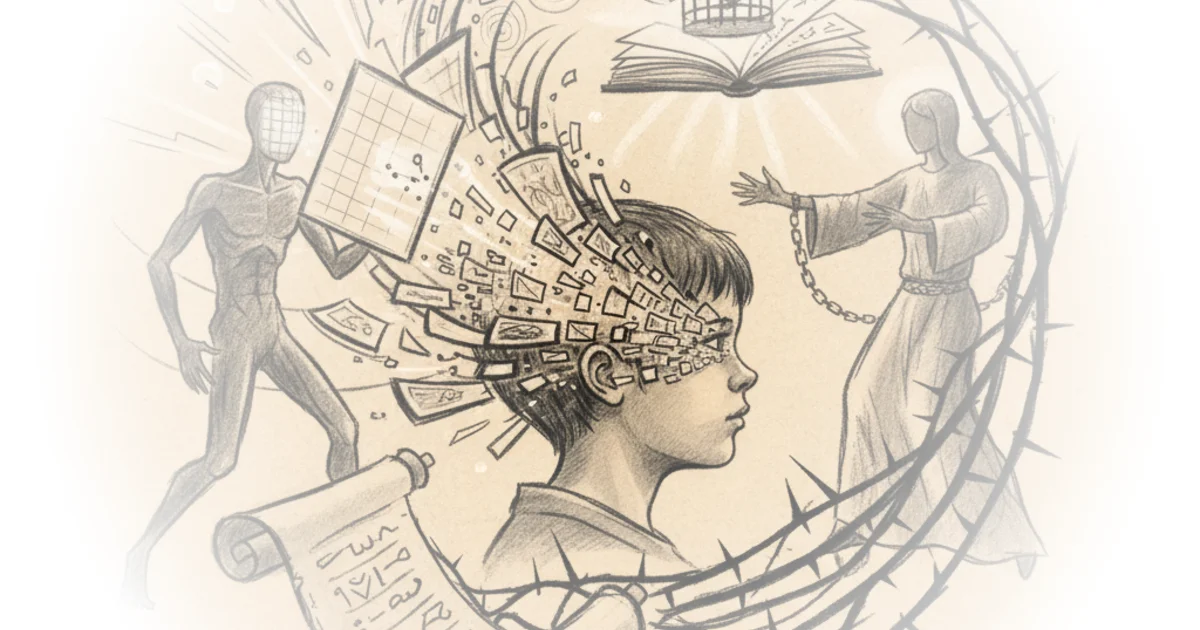
The data supports Hoel's observation of a steep drop-off in reading engagement. He notes that "by the age of 6, about 62% of children in the US have a personal tablet of their own," while screen time in the 5-8 range averages 3.5 hours daily. The consequence is a generation that views reading as a chore rather than a refuge. Hoel observes a personal transformation in his own child, noting, "Even as a rowdy 'threenager,' he got noticeably easier as literacy kicked in." This suggests that reading offers a unique cognitive calm that screens cannot replicate, yet we wait too long to provide it.
Critics might argue that pushing reading too early could cause burnout or frustration, but Hoel contends that the real burnout comes from the lack of alternative engagement. The cultural reliance on screens, he argues, is not a failure of parenting but a structural inevitability: "The category of 'not playing, and not doing a directed or already set up activity, but just quietly consuming media' is simply too large and deep for parents to fill just by reading books aloud."
Once lost, reading often doesn't recover. Even when surveyed from a skeptical perspective, reading is, almost everywhere, in decline.
The Myth of Biological Readiness
The core of Hoel's critique targets the "neuromyths" used by education experts to justify delaying literacy instruction. He dismantles the argument that the brain is not physically capable of reading before age five or six. He cites Maryanne Wolf, a prominent cognitive neuroscientist, who claims, "For the vast majority of children, research suggests that ages 5 to 7 are the prime time to teach reading... I even think that it's really wrong for parents to ever try to push reading before 5." Hoel scrutinizes the historical basis of this claim, tracing it back to a 60-year-old paper by Norman Geschwind that he describes as "highly dense, notoriously difficult to read, and ultimately contains mere anatomical observations and speculations."
Hoel's analysis of modern neuroscience suggests the opposite of the experts' consensus. He points out that "myelination, since it's an anatomical expression of brain development, is responsive to learning itself." In other words, the brain does not wait to be ready; it becomes ready through the act of learning. The argument that a child's brain is "not developed" enough to read is, according to Hoel, a self-fulfilling prophecy created by a lack of instruction.
He further deconstructs the cross-linguistic studies often cited to support delayed reading. While experts claim that children in countries starting school later (like Finland) perform better, Hoel reveals that the real variable is language complexity, not age. He writes, "it is the spelling system and not the child that causes the learning problem." English is simply harder to decode than Finnish or German, making the delay in English-speaking countries a reaction to linguistic difficulty rather than a biological necessity.
A Historical Precedent for Early Literacy
Perhaps the most striking part of Hoel's coverage is his historical excavation. He argues that the idea of waiting until age seven is a modern invention, not a timeless truth. He points to 17th-century educator Charles Hoole, who observed that "betwixt three and four years of age a childe hath great propensity to peep into a book, and then is the most seasonable time... for him to begin to learn." This historical context reframes the current "expert" consensus as an anomaly rather than a standard.
Hoel highlights the work of Anna Laetitia Barbauld, whose primers in the late 18th century were explicitly titled "Lessons for Children of 2 to 3 Years Old." These books were immensely successful and widely used for over a century. "Their effect on nineteenth- and early twentieth-century middle-class people, who learned to read from them, is incalculable," Hoel writes. The fact that these methods worked for centuries suggests that the modern hesitation is rooted in fear or institutional inertia, not biological limits.
The implication is that we are actively depriving children of a tool that could liberate them from screen dependency. By adhering to an outdated timeline, the education system ensures that the "4th grade slump"—where students must switch from learning to read to reading to learn—becomes a crisis rather than a smooth transition. Hoel argues that the "supersensorium" of modern life makes this delay even more dangerous, as literature is "fighting for attention and relevancy with one hand tied behind its back for the first 8 years of life."
We increasingly live in a supersensorium, so it matters that literature is fighting for attention and relevancy with one hand tied behind its back for the first 8 years of life.
Bottom Line
Hoel's argument is a powerful indictment of an educational status quo that prioritizes caution over opportunity, inadvertently handing the developing mind over to algorithmic feeds. The strongest part of his case is the historical and scientific evidence that early reading is not only possible but was once the norm. His biggest vulnerability lies in the practical logistics of implementation; while he proves children can learn early, he offers less detail on how to retrain a teacher workforce and curriculum system built around the "wait until seven" model. The takeaway is clear: the window for literacy is open far earlier than we admit, and closing it for too long comes at a steep cost to a child's attention span and future autonomy.