Tim Mak uncovers a startling cultural symmetry: that a single syllable—'Oi!'—serves as the rebellious heartbeat of both British working-class punk and Ukrainian national identity, bridging decades of geopolitical divides through sound alone. In an era where global attention is fixated on missile trajectories and border crossings, this piece offers a rare, human-scale lens into how resistance is encoded in language and melody, proving that culture often outlasts the empires trying to suppress it.
The Sound of Resistance
Mak anchors his narrative not in abstract theory, but in the lived experience of Yuriy 'Utyug' Demydenko, a punk veteran whose life spans the collapse of the Soviet Union and the current war. The author skillfully juxtaposes Western pop culture influences with deep local roots. "It literally starts with Schwarzenegger's character taking clothes from two punks... and it just looked cool," Mak quotes Demydenko recalling his youth, illustrating how global media seeped through the Iron Curtain to shape a generation. Yet, Mak quickly pivots to show that this was never mere imitation; it was an act of survival.
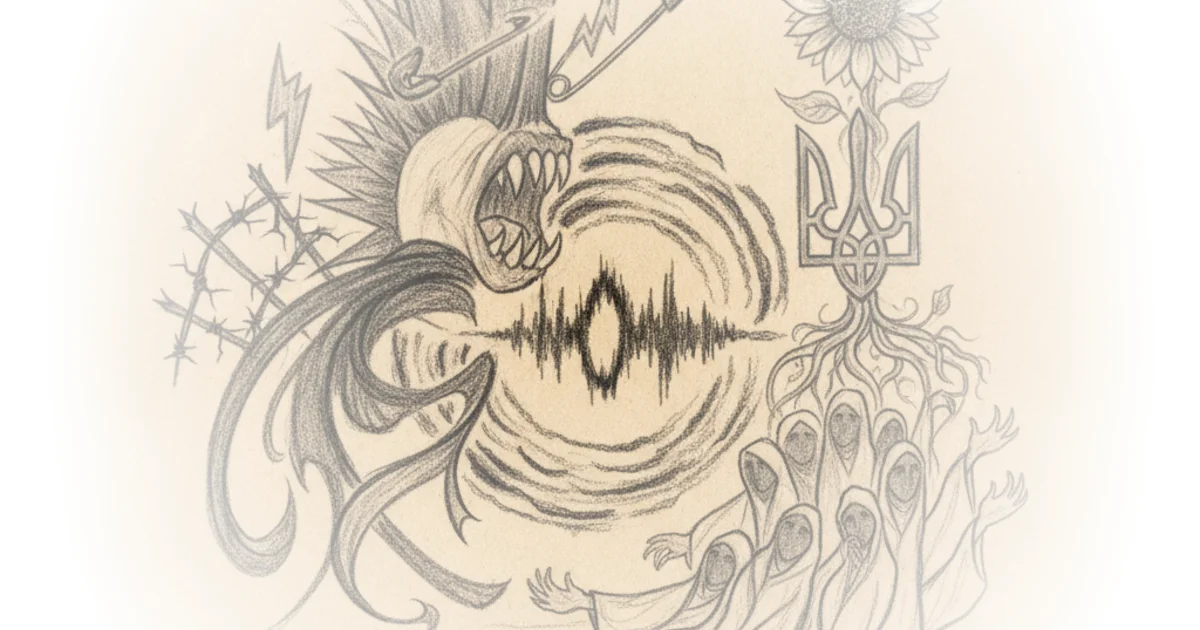
The piece argues that while Western punks rebelled against consumerism, Ukrainian punks faced a far starker threat: imprisonment for the very act of non-conformity. "Underground bands faced censorship, police harassment, or even imprisonment just for playing songs that didn't align with state ideology," Mak writes, grounding the cultural analysis in historical peril. This framing is crucial; it elevates the music from a hobby to a political statement where silence was compliance.
The image factor was very important to us, punks... I've been dressing punk since 13 years old.
Mak draws a sharp parallel between the British 'Oi!' movement of the 1970s and the Ukrainian experience. He notes that while the English term originated in East London as a class-based call to attention, it found an uncanny resonance in Ukraine. "The story of 'oi' is the story of how one phonetically similar expression came to mean different things in two cultures," Mak observes. This linguistic coincidence becomes the article's central thesis: that the spirit of rebellion is universal, even if the specific grievances differ.
Critics might argue that equating British street punk with Ukrainian national resistance risks oversimplifying the unique severity of Soviet repression or the current existential war. However, Mak navigates this by emphasizing that for Demydenko, the connection isn't about musical theory but "authenticity." The author writes, "I think the music itself is secondary in this movement. What really matters is that sense of street culture and working-class background; those are the core elements for them." This distinction saves the argument from becoming a shallow comparison, focusing instead on the shared ethos of the marginalized.
From Folklore to Frontlines
The commentary deepens as Mak traces the word 'oi' back centuries before punk existed. He reveals that in Ukrainian, the exclamation is a versatile vessel for human emotion—surprise, pain, admiration, exhaustion—that survived bans on the language itself. "As a natural sound of emotion, 'oi' in Ukrainian continued to be used because it fulfilled the need for emotional expression," explains Roman Veretenyk, a professor quoted by Mak. This historical context is vital; it shows that the punk movement didn't invent this spirit but rather tapped into a pre-existing cultural code.
Mak connects this linguistic resilience to the Cossack traditions of the 16th and 17th centuries, suggesting that modern Ukrainian punk is merely the latest iteration of an ancient struggle for autonomy. "For example, our song 'Punk Rock Is Alive' sounds almost like a folk song in its melody — it could easily have become traditional music if it had been written 200 years ago," Demydenko tells Mak. This observation reframes the genre not as a foreign import, but as an organic evolution of Ukrainian identity.
The piece also touches on the brutal reality of the current conflict without losing its cultural focus. While the article centers on music, it acknowledges that for many in Chernihiv and Kyiv, the 'anti-establishment' spirit is now a matter of life and death against a foreign invader. The author notes that despite the chaos, Demydenko continues to teach young bands, passing on the "punk rock torch." This persistence serves as a quiet rebuke to the idea that war erases culture; instead, it often sharpens it.
There's a punk band in Ukraine that has existed for 20 years, with five full albums and five EPs. That proves it wasn't for nothing.
This sentiment is particularly poignant given the surrounding news of massive drone attacks on Moscow oil refineries and the desperate need for air defense interceptors mentioned in the same publication's updates. While Mak does not dwell on the military logistics, the backdrop of a city under constant threat makes Demydenko's insistence on "authenticity" feel less like a subcultural preference and more like an act of defiance.
Bottom Line
Tim Mak's most compelling achievement is reframing punk from a niche musical genre into a lens for understanding Ukrainian resilience, successfully arguing that the 'Oi!' of London and Kyiv share a DNA of working-class resistance. The piece's greatest strength lies in its humanization of history through Demydenko's voice, though it occasionally glosses over how the current war has fundamentally altered the stakes of this subculture from political dissent to physical survival. Readers should watch for how these underground cultural movements evolve as the conflict drags on, proving that while regimes fall and borders shift, the human need to shout 'Oi!' in defiance remains constant.