Brad DeLong delivers a startling counter-intuitive thesis: individual human intelligence is a biological dead end without the scaffold of deep cooperation. While pop culture celebrates the lone genius or the rugged survivor, DeLong marshals evidence from evolutionary biology and a grueling reality TV experiment to argue that our species' dominance is not a product of individual smarts, but of a collective "anthology super-intelligence" that emerged only when we stopped trying to survive alone. This is a vital reframing for a world increasingly obsessed with individual optimization, reminding us that our greatest asset is not the brain in our skull, but the network around us.
The Naked Ape's Fatal Flaw
DeLong begins by stripping away the illusion of human self-sufficiency. He asks us to view our species from the cold perspective of a distant intellect observing the "Naked East-African Plains Ape." The result is humbling. We lack the physical tools that other mammals possess. "Does each of us have a big enough brain to compensate for our lack of fangs, claws, sprinting speed, & dodging quickness? I say: 'Definitely not!'" he writes. The argument gains visceral weight through the case of Melissa Miller, a highly trained wilderness expert dropped into the Ecuadorian Amazon on the show Naked & Afraid. Despite her extensive preparation, she lost 17 pounds in 21 days, suffering severe physical and psychological trauma.
The author uses Miller's experience to dismantle the myth of the capable individual. Even with a knife and a fishing line, she could not achieve caloric balance. "The experience of caloric deprivation without sufficient fat resources seriously messed with his head," DeLong notes regarding her partner, a former Army Ranger who lost 32 pounds and suffered a psychological break from hunger. The evidence here is stark: without the invisible infrastructure of civilization, even the most skilled human is biologically vulnerable. This framing is effective because it moves the argument from abstract theory to physiological reality. Critics might argue that television survival challenges are artificial constructs, but DeLong's point stands on the biological math: a single human brain cannot out-calculate the daily energy deficit of the wild.
We are not smart animals who learned to cooperate. We are a cooperative organism that acquired intelligence as an emergent property of our cooperation.
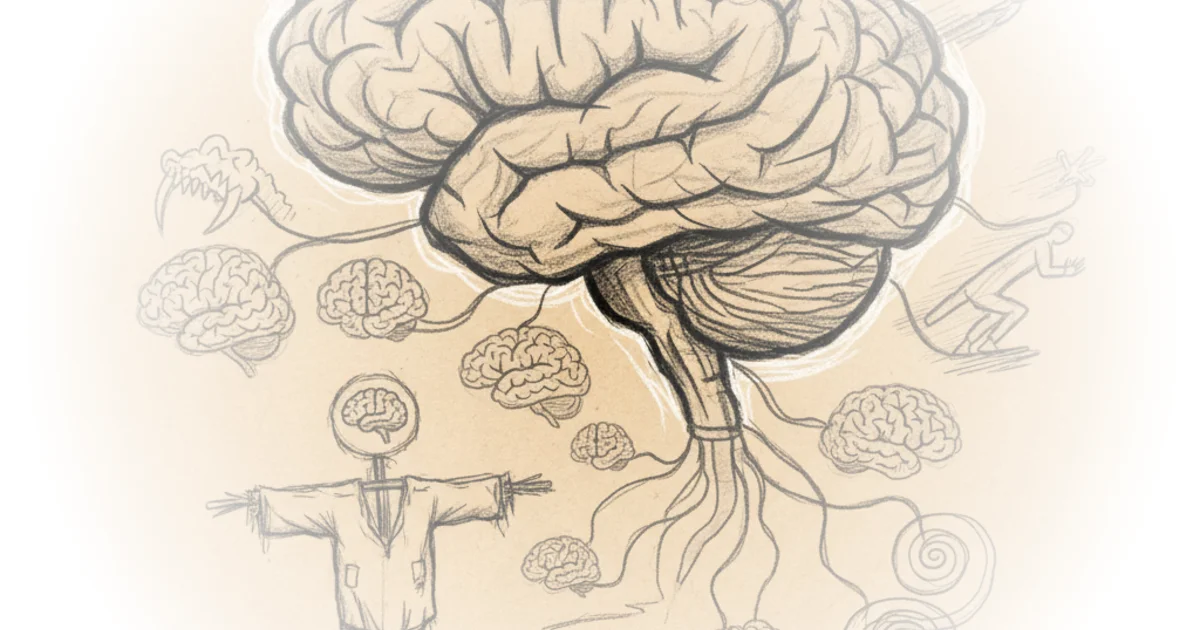
This distinction is the article's intellectual core. DeLong argues that we did not evolve to be smart and then decide to work together; rather, the pressure to cooperate forced the evolution of our intelligence. "These are not the same thing, and the distinction matters enormously," he insists. The implication is profound: if we isolate ourselves, we don't just lose our community; we lose the very cognitive advantages that define us.
The Bridge of Collective Memory
To ground this in deep time, DeLong traces the slow, uneven march of human evolution, noting that for millions of years, our ancestors were physically inferior to other species. He details the progression from the 350cc brain cases of ardipitheci to the 1350cc cases of modern humans, pointing out that even our immediate ancestors, the Homo heidelbergenses, lacked the full suite of cultural tools we take for granted. They had fire and spears, but not the "sustained and cumulative symbolic culture" that allows knowledge to compound.
DeLong draws a powerful parallel between this biological history and the strategic importance of the Bridge of the Daughters of Jacob, a critical crossing point on the Jordan River used for millennia. Just as that bridge allowed for the movement of goods, people, and ideas that no single traveler could manage alone, human cognition relies on a similar "bridge" of shared knowledge. "Humanity's unique superpower is its twin abilities to collaborate in the creation and development of knowledge on the one hand, and of production via specialization and the division of labor on the other," he writes. This connection between a specific geographic choke point and the abstract concept of cumulative culture is a brilliant rhetorical move, making the invisible machinery of society feel tangible.
The author suggests that our current moment requires a renewed appreciation for this interdependence. In an era where technology often promises to make us more self-sufficient, DeLong warns that the illusion of independence is dangerous. He notes that even the "Broccoli family"—a reference to the biotechnological manipulation of our food supply—has been "pre-chewed" for us by generations of collective labor. "We spend two, not six, hours a day chowing down," he observes, highlighting the efficiency of a system no single individual could build from scratch.
The Fragility of the Individual
The piece concludes by returning to the psychological toll of isolation. DeLong describes how hunger rewires the brain, turning a rational expert into a desperate creature. "Long-term hunger plays with your psyche," he quotes Miller's partner, who admitted to gaining 70 pounds immediately after rescue because he "didn't want to be hungry" ever again. This biological imperative to hoard energy reveals the fragility of the individual mind when cut off from the collective safety net.
DeLong's argument is that the "anthology super-intelligence" is not just a nice idea; it is a survival mechanism. Without it, we are just another species struggling to stay warm and fed. "The principal thing Melissa Miller wished she had done differently before entering the Amazon? Have gotten fatter," he writes, noting that she had to carry her own "survival rations" in her body because she could not rely on the environment. This is a poignant metaphor for the limits of individual preparation in a complex world. We can prepare, but we cannot prepare enough to replace the collective.
Bottom Line
Brad DeLong's most compelling contribution is the redefinition of human intelligence not as an individual trait but as a distributed, emergent property of our social networks. The argument is strongest when it uses the visceral failure of the "Naked & Afraid" contestants to prove that biology alone cannot sustain us. However, the piece risks underestimating the resilience of individual adaptability in the face of sudden systemic collapse. The takeaway for the busy reader is clear: our greatest vulnerability is not a lack of knowledge, but the belief that we can ever truly stand alone.
We are a cooperative organism that acquired intelligence as an emergent property of our cooperation. These are not the same thing, and the distinction matters enormously.