Crash Course makes a startling claim: the physical geography of Latin America didn't just shape its politics; it actively bred the tyrants who would dominate the continent's history. By weaving together the concept of the "dictator novel" with the brutal realities of the 19th-century pampas and 20th-century juntas, the author argues that fiction is not merely a reflection of history, but a vital tool for dismantling the "singular story" that dictators try to impose on their people.
The Landscape of Tyranny
The episode opens by establishing that authoritarianism is not an anomaly in Latin America but a recurring structural feature. Crash Course writes, "Stories have power and they can be wielded for good or for evil," immediately framing the subsequent historical analysis as a battle over narrative control. The author traces the roots of this struggle back to the 19th century, where vast, undeveloped landscapes like the jungle and plains created a power vacuum. As Crash Course puts it, "These novels explore the relationship between Latin America's physical landscape and its political and cultural landscapes."
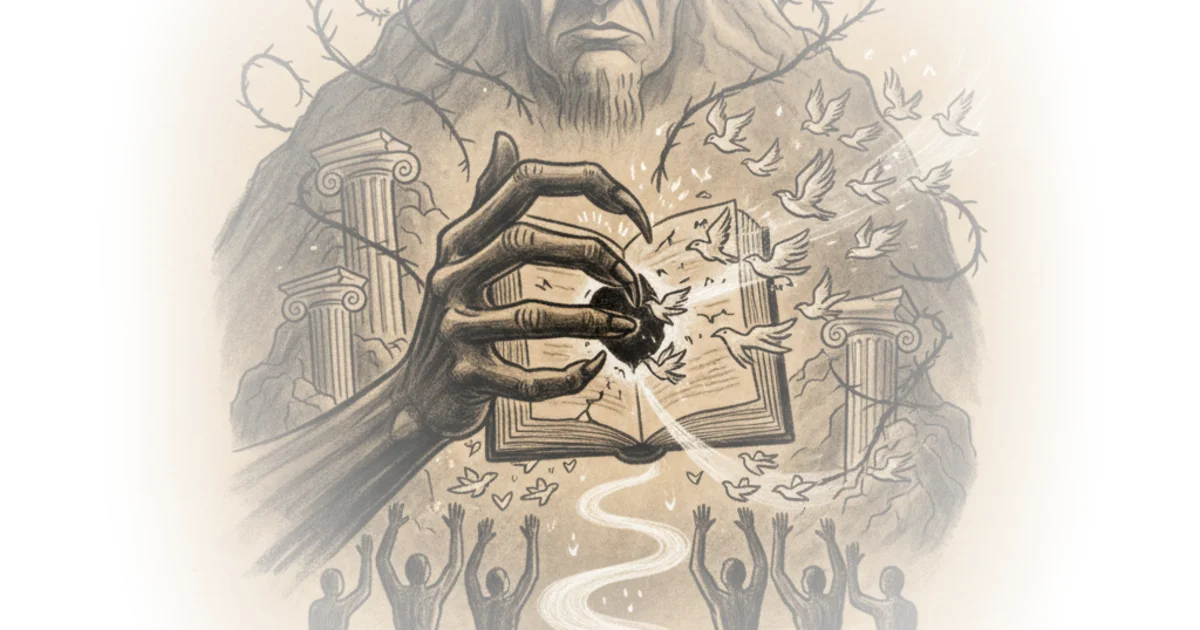
This geographical determinism is a bold move. The author suggests that the isolation of the pampas made orderly democratic control impossible, paving the way for the caudillos—charismatic strongmen who ruled by brute force. The commentary highlights Domingo Faustino Sarmiento's 1845 work Facundo, which posits that the untamed land inevitably produces dangerous leaders. Crash Course notes that Sarmiento argued, "From these characteristics arises in the life of the Argentine people, the reign of brute force, the supremacy of the strongest, the absolute and irresponsible authority of rulers." This framing is effective because it connects the abstract idea of tyranny to the concrete reality of the environment, making the rise of dictators feel almost inevitable rather than purely accidental.
"Sarmiento called for economic development and improving the country's education system to finally rid the region of tyrants... But he also propped up a false binary of barbarism and civilization."
However, this perspective has a significant blind spot. While the author acknowledges that Sarmiento's view was controversial, the analysis could go deeper into how this "civilization vs. barbarism" narrative was used to justify the genocide of indigenous groups like the Mapuche. The episode mentions that Sarmiento aimed to erase these communities, but the connection between his literary theory and his violent policies as president is only briefly sketched. Critics might note that treating the landscape as the primary culprit risks absolving the specific political choices of the elite who exploited that geography for personal gain.
The Psychological Architecture of the Dictator Novel
Moving into the 20th century, the coverage shifts from the physical landscape to the psychological one. The author explains that the violence of the Mexican Revolution, the Cuban Revolution, and the Chilean coup gave rise to a specific genre: la novela del dictador. These works, often part of the Latin American Boom, used magical realism to capture the surreal horror of living under a regime where truth was fluid. Crash Course writes, "Many of these novels were part of the boom... that saw Latin American novels in translation popping off around the world."
The analysis of Miguel Ángel Asturias's El Señor Presidente is particularly strong. The author describes the dictator not as a character, but as an omnipresent force: "Known only as the president, he rarely appears in the text and yet he hangs over every character in action like a cloud of tyrant scented freze." This description perfectly captures the paranoia of the genre. The commentary explains how Asturias blends dream sequences with reality to mirror the disorientation of life under a dictatorship, where fact and fiction become indistinguishable.
As Crash Course puts it, "The novel is less interested in recounting the story of one historical figure and more interested in exploring the effects that a dictatorship has on a society." This is the piece's most valuable insight. By refusing to name the dictator or the country, the novel transcends specific history to offer a universal warning. The author argues that this technique allows readers to understand the systemic nature of oppression rather than just the idiosyncrasies of one bad leader. This approach holds up well against the backdrop of modern authoritarianism, where the specific name of the dictator matters less than the mechanisms of control they employ.
Reclaiming the Human Story
The final section of the episode tackles the most recent wave of dictator novels, written decades after the regimes fell. Here, the focus shifts from the dictator's perspective to the victims', specifically through Julia Álvarez's In the Time of the Butterflies. The author details how the novel humanizes the Mirabal sisters, who were murdered for resisting Rafael Trujillo's regime in the Dominican Republic. Crash Course writes, "Fiction provides a window into history that's different from textbooks and official documents."
The commentary highlights a crucial distinction: while history books record the dates of the murders, fiction records the lives that were cut short. The author notes that Álvarez wanted to show the sisters as complex individuals, not just martyrs. "A novel is not after all a historical document, but a way to travel through the human heart," Crash Course quotes Álvarez, emphasizing the emotional truth that data cannot convey. This is a powerful counter-narrative to the dictator's attempt to control the story. By focusing on the sisters' dreams, loves, and fears, the novel restores their humanity in a way that political documents never could.
"Tyrants like want their victims to buy into a single story. But when we step into the hearts and minds of others through fiction, we learn to see the world and ourselves more complexely."
The author concludes by reminding us that this is not just history; over 50 countries today live under authoritarian regimes. The argument that fiction offers a necessary complexity to combat the "singular story" of tyranny is compelling. However, one might argue that the piece slightly romanticizes the power of literature to effect political change, given that the Mirabal sisters were killed despite their resistance and the eventual assassination of Trujillo was a political act, not a literary one. Still, the core message remains: stories are the battleground where freedom is either lost or reclaimed.
Bottom Line
Crash Course delivers a sophisticated argument that the "dictator novel" is essential not just for understanding Latin American history, but for understanding the mechanics of authoritarianism everywhere. Its strongest asset is the seamless integration of geographical determinism, psychological horror, and human resilience to show how fiction can dismantle a dictator's narrative. The only vulnerability lies in the brief treatment of how the "civilization vs. barbarism" rhetoric was weaponized against indigenous populations, a nuance that deserves more than a passing mention. Readers should watch for the next episode on memory, as the question of how societies remember (or forget) these tyrannies is the logical next step in this vital conversation.