This piece from Stark Realities cuts through the noise of the recent university resignations by asking a question few others are willing to pose: is the "antisemitism crisis" on campus actually a manufactured cover for censoring political dissent? While the headlines focus on viral congressional hearings and administrative fallout, the editors argue that a forensic look at the actual lawsuit filed against the University of Pennsylvania reveals a pattern of conflating standard political criticism with hate speech. For the busy listener, this is a crucial distinction that reframes the entire debate from one of safety to one of free expression.
The Lawsuit as a Censorship Tool
The article begins by dissecting the federal complaint filed by two students, Eyal Yakoby and Jordan Davis, who allege the university has become an "incubation lab for virulent anti-Jewish hatred." Stark Realities reports, "Unlike the sloppy court of public opinion, real courts demand a detailed presentation of specific allegations." The editors suggest that when you strip away the sensationalism, the complaint's true purpose is to install a "new censorship regime" to shield students from rhetoric critical of the State of Israel.
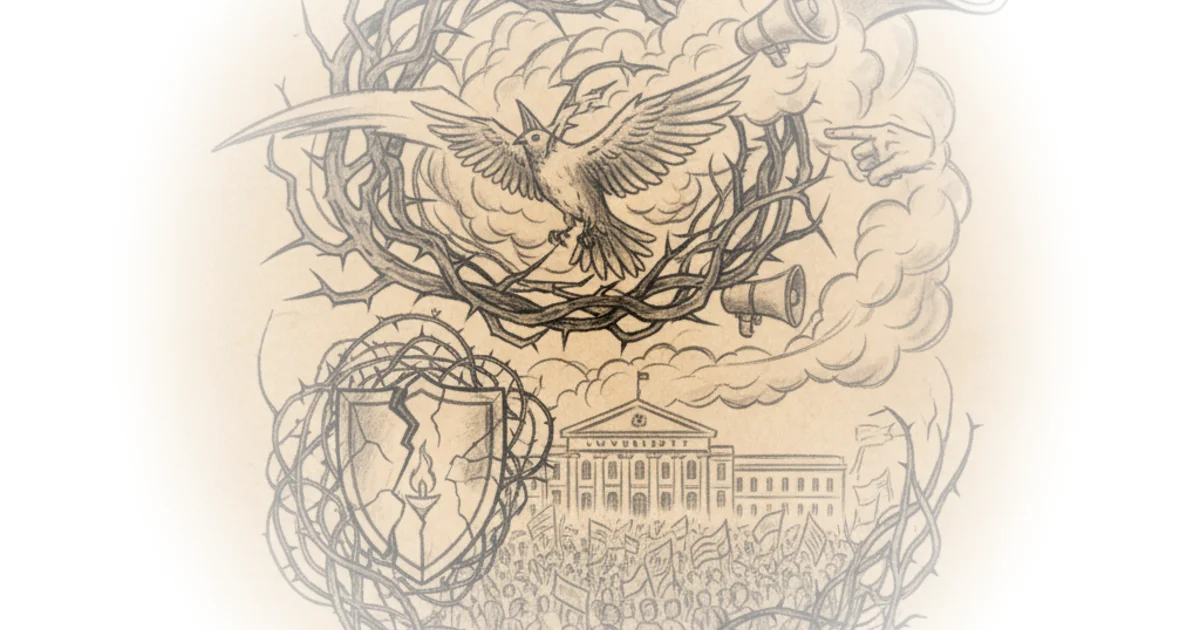
This framing is provocative because it flips the script on the usual narrative of campus safety. The piece argues that the lawsuit relies on a "repeated assumption that various political concepts, views and slogans promoted by critics of Israel are inherently antisemitic or genocidal." By treating political disagreement as a form of bigotry, the plaintiffs are effectively seeking to ban ideas rather than address actual harassment.
"It's only by first wrongly defining this assortment of Israel-critical views as inherently antisemitic that one can declare antisemitism is rampant at the University of Pennsylvania or anywhere else in American academia."
Critics might argue that this approach risks minimizing the genuine fear and isolation Jewish students feel when their safety is questioned. However, the editors counter that the complaint itself displays prejudice by assuming all Jewish students must embrace Zionist ideology, thereby victimizing them for holding contrary views. This is a bold claim that challenges the very foundation of the current campus climate debate.
Deconstructing the "Forbidden" Ideas
The commentary then systematically breaks down the specific slogans and concepts the lawsuit targets, treating them as political arguments rather than hate speech. The editors note that "anti-Zionism" is a philosophy embraced by many Jews and that opposing a Jewish nation-state is no more inherently bigoted than opposing a white or Christian state. They point out that the Chavurah, a progressive Jewish group at Penn, recently rejected the conflation of anti-Zionism with antisemitism, noting it "undermines any chance for productive dialogue."
The piece also tackles the slogan "From the river to the sea, Palestine will be free." Stark Realities argues, "For most, it's a call for the State of Israel to be replaced by a new governing arrangement." While acknowledging that some may find the implications of such a change troubling, the editors insist the idea is not inherently genocidal. They draw a parallel to the historical context of the First Intifada, noting that while it involved violence, it was fundamentally an uprising against occupation, not a call for the extermination of a people.
"Just like you're allowed to say 'I think we should bomb Iran' or go to war in Iraq or 'flatten Gaza,' people are allowed to opine... in the United States of America, that the repression by the Israeli government has become sufficiently severe that an uprising or even violence against the State of Israel is warranted."
This comparison to domestic debates on war and foreign policy is a powerful rhetorical move. It places the campus protests within the broader American tradition of contentious political speech. However, the article does acknowledge that some specific remarks, such as a speaker praising the 1972 Lod Airport Massacre, are objectively objectionable. The editors concede that while a few outliers exist, the "great majority" of the cited incidents are merely instances of political expression that proponents of Israel strongly disagree with.
The "Hate-Fest" and the Power of Narrative
The final section of the piece examines the "Palestine Writes Literature Festival," which the lawsuit describes as an "anti-Jewish hate-fest." Stark Realities reports that the festival was supported by Penn's progressive Jewish group, the Chavurah, who saw the backlash as an attempt to "silence Palestinian voices on campus." The editors highlight that the complaint struggled to find controversial content within the actual event, instead relying on pre-existing, sharp-tongued criticisms made by speakers outside the university.
The article notes that the lawsuit accuses the festival of creating a hostile environment even for students who do not attend, a claim the editors find legally and logically tenuous. They point out that the university's response, which included President Liz Magill distancing the school from the speakers, implicitly asserted that "every Jew on campus must be aligned with Israel."
"The most controversial term, 'intifada,' has been chanted by pro-Palestinian protesters at Penn and around the world. Roughly translating to English as 'shaking off,' intifada refers to an uprising against Israeli control of the West Bank and Gaza."
The piece concludes by linking the campus controversy to the broader political dynamic, where the term "intifada" was weaponized in congressional hearings to imply a call for genocide. The editors argue that this "mythology" was used to justify the resignation of university leaders, effectively punishing them for failing to police speech that falls within the bounds of First Amendment protection.
Bottom Line
Stark Realities offers a compelling, if contentious, defense of political speech on campus, arguing that the "antisemitism crisis" is largely a rhetorical construct used to silence critics of Israeli policy. The strongest part of the argument is its rigorous dissection of the lawsuit's logic, exposing how political slogans are being reclassified as hate speech. Its biggest vulnerability lies in potentially underestimating the visceral impact of such rhetoric on Jewish students who feel targeted. As the legal battles unfold, the real test will be whether the courts can distinguish between genuine harassment and the messy, often offensive, nature of political debate.