Asianometry cuts through the noise of housing affordability debates by identifying a silent, artificial force distorting global real estate markets: the systematic laundering of illicit funds through luxury property. While most analysis focuses on supply constraints or domestic investment, this piece reveals how the mechanics of money laundering itself—specifically the need to convert "dirty money into clean money"—creates a price floor that has nothing to do with housing fundamentals.
The Anatomy of the "Naked Official"
The core of the argument rests on a specific profile of the launderer: the "naked official." Asianometry explains that these are senior politicians or officials who "resettle their kids and family outside of China ostensibly for university education" while they remain in power, effectively insulating their families from domestic legal repercussions. The author illustrates this with the case of Luo Changming, a bank executive who "fled the country in 2007" after orchestrating billions in fraudulent loans, leaving his family behind in the U.S. with a portfolio valued at over $10 million.
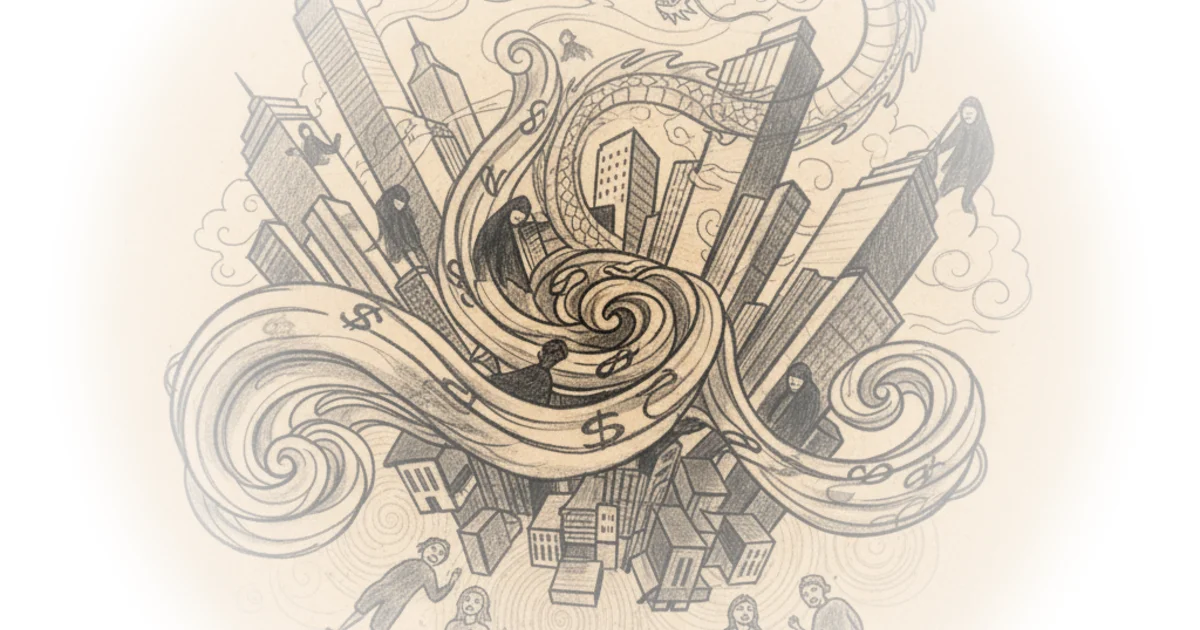
This framing is crucial because it shifts the narrative from generic "foreign investment" to a targeted flight of capital by those with something to hide. Asianometry writes, "The style of these officials is to first resettle their kids and family outside of China... a concept called a naked official." This detail transforms the housing crisis from a simple economic equation into a geopolitical security issue. However, critics might note that focusing heavily on individual corruption cases can sometimes obscure the broader, systemic nature of capital flight that includes legitimate but aggressive tax avoidance strategies by non-official elites.
The Real Estate Loophole
Why real estate? Asianometry argues that the sector is uniquely vulnerable because "transactions in that space absorb huge amounts of money yet at the same time remain extremely informal." The decentralization of markets in the U.S., U.K., and Canada means that critical anti-money laundering features, such as strict ownership reporting, are often missing. The author points out that in 2014, "half of all... real estate transactions over 5 million dollars were purchased with shell companies" in the United States.
"When clients are offering and paying twice the listed price in cash the market is not free it's being artificially distorted and thus is not built on top of fundamentals."
This observation is the piece's most potent insight. It explains why housing prices in cities like San Francisco and London have decoupled from local income levels. The launderer's goal is not to live in the home or earn a rental yield; it is to wash the asset. Consequently, they are willing to overpay, creating an artificial ceiling that pushes out local buyers. The author notes that this dynamic "causes home builders to focus on constructing luxury homes and apartment complexes rather than affordable housing," leading to cities dotted with "empty luxury high rises... traded on paper but never lived in."
The Regulatory Disconnect
The commentary then pivots to the regulatory failure that enables this. Asianometry highlights a stark contrast in enforcement efficiency: in 2012, Chinese banks filed 29 million suspicious transaction reports but secured only eight arrests, whereas the U.S. saw 1,110 arrests from 1.5 million reports. The author attributes this to China's reliance on a "rules basis" system—reporting any transaction over a specific threshold—versus the Western shift toward a "risk-based system" that evaluates the person and their business context.
"China has not yet moved to the style yet and you know the result is there," Asianometry notes, pointing out that once criminals know the rule, they simply evade it. The piece also acknowledges the domestic political friction in the West, where real estate agents and industry professionals are "loath to accept this more complicated regulation." This creates a stalemate where the very people who facilitate these transactions resist the oversight needed to stop them.
The Political Danger
Perhaps the most unsettling implication is how this economic distortion fuels xenophobia. Asianometry warns that "politicians can easily turn these trends into racial and citizenship issues with the goal of acquiring political power." Citing a survey in Sydney where 70% of respondents believe or are unsure that Chinese investments involve illegalities, the author argues that the opacity of shell companies creates a vacuum filled by suspicion.
"Money laundering is a crime that happens when different bodies don't communicate with each other."
The author correctly identifies that the solution requires international cooperation, yet admits that "China's recent tensions with the west have made this much harder." This is a critical vulnerability in the proposed solution; without diplomatic channels to share intelligence on shell companies and beneficial owners, the regulatory gaps will remain open regardless of domestic policy changes in either country.
Bottom Line
Asianometry's strongest contribution is exposing the mechanism by which illicit capital actively inflates housing prices, moving beyond the tired debate of "supply vs. demand" to reveal a market being rigged by criminal enterprise. Its biggest vulnerability lies in the geopolitical reality: the very international cooperation required to fix the problem is currently the most fractured area of global relations. Readers should watch for whether Western regulators can finally close the shell company loophole, or if the housing market will remain a primary vehicle for global corruption.