In an era where political discourse feels increasingly volatile, this piece from Stark Realities offers a provocative thesis: the root of America's deepening division isn't just cultural friction, but a federal government that has long operated beyond its constitutional leash. The editors argue that the intensity of our current conflicts stems from a national struggle to control powers that were never intended to exist at the federal level, suggesting that if the government were confined to its original scope, federal elections would be largely irrelevant to daily life.
The Architecture of Overreach
The article begins by grounding its argument in the fears of the nation's founders, who deliberately designed a system of limited federal authority. Stark Realities reports, "The powers delegated by the proposed Constitution to the federal government are few and defined. Those which are to remain in the State governments are numerous and indefinite." This distinction is crucial to the piece's logic; it posits that the Founders viewed federal power as external—focused on war and foreign commerce—while reserving the "lives, liberties and properties of the people" for state governance.
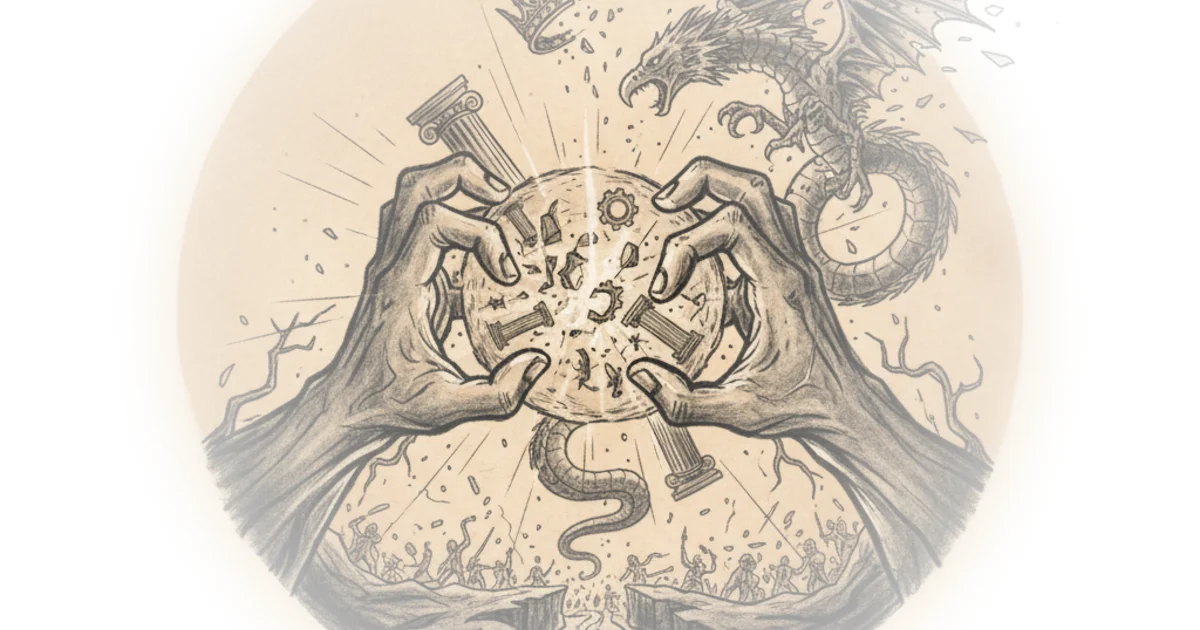
The editors take a hard line on the modern state, listing a vast array of federal entities they claim lack constitutional authority. "Today's sprawling federal government, which involves itself in almost every aspect of daily American life, is almost entirely unconstitutional," the piece argues. It catalogues everything from the Social Security Administration to the Department of Education as unauthorized undertakings. This framing is aggressive, forcing the reader to confront the idea that even beloved programs may rest on shaky legal ground. Critics might note that this strict constructionist view ignores the practical necessity of a national safety net in a complex, industrialized economy, but the editors insist that "even if you view some of those enterprises as benign, that doesn't render them constitutional."
"If the federal government were confined to its actual granted authorities, federal elections would be of little interest to the general public, because the outcome would be largely irrelevant to their everyday lives."
The Judicial Pivot
The commentary then shifts to the mechanism that allowed this expansion: the Supreme Court's reinterpretation of the Constitution's General Welfare and Commerce clauses. The piece traces a specific historical turning point, noting that in 1937, the Court faced intense pressure following President Roosevelt's landslide reelection and his threat to expand the judiciary. Stark Realities reports that the Court, in Helvering v. Davis, essentially surrendered to this pressure, declaring, "Congress may spend money in aid of the 'general welfare.' There have been great statesmen in our history who have stood for other views. We will not resurrect the contest. It is now settled by decision."
This moment is presented as the death knell for limited government. The editors highlight how the Court moved the discretion of what constitutes "general welfare" from the judiciary to Congress, effectively removing a key check on power. The argument gains historical weight by referencing the 1937 Judicial Procedures Reform Bill, often called the "court-packing" plan, suggesting the Court's shift was a political capitulation rather than a legal evolution. The piece notes that James Madison had warned against such an interpretation, writing, "If not only the means, but the objects [purposes] are unlimited, the parchment had better be thrown into the fire at once."
The Commerce Clause and the Farmer
Perhaps the most striking historical deep dive in the article concerns the Commerce Clause and the 1942 case Wickard v. Filburn. The editors explain that the clause was originally intended to prevent states from taxing each other, creating a free trade zone, not to regulate internal economic activity. However, the Supreme Court's ruling in Wickard expanded this definition to include any activity that, in the aggregate, affects interstate commerce. The piece describes the absurdity of the case: an Ohio farmer, Roscoe Filburn, was fined for growing wheat for his own family and animals, not for sale. "Wickard stands for the sad proposition that Congress can prevent a man from feeding his family in his own home with food he grew himself," the article quotes from a 2012 amicus filing by Rand Paul.
This example serves as the article's emotional core, illustrating how a theoretical legal link can justify federal intrusion into the most private aspects of life. The editors argue that this precedent allows the federal government to regulate "nearly every aspect of our existence," turning the Constitution's protections into a hollow shell. A counterargument worth considering is that without such broad interpretations, the federal government would lack the tools to address national economic crises or environmental challenges that transcend state borders. Yet, the editors maintain that this centralization has locked the nation into a "winner-take-all steel-cage match" over a single set of rules for 332 million people.
The Path Forward
The piece concludes by acknowledging the difficulty of reversing these precedents, noting that the Supreme Court is unlikely to overturn its own history. Instead, the editors point to Article V of the Constitution, which allows for a convention if two-thirds of state legislatures call for one. Stark Realities reports that 19 states have already requested such a convention, with the goal of limiting federal jurisdiction. The editors warn that without this structural correction, the pressure of concentrated power will lead to further fracture. "If we don't bend the union back into proper shape, it will surely break under the pressure of intensifying discontent with concentrated power and one-size-fits-all governance," they write.
Bottom Line
The strongest part of this argument is its historical rigor in tracing the specific judicial moments that dismantled the original federal-state balance, particularly the pivot in 1937 and the Wickard decision. Its biggest vulnerability is the assumption that the modern complexities of a global economy can be managed by a government restricted to the 18 powers listed in Article I, Section 8. Readers should watch for the momentum of the Article V movement, as it represents the only viable constitutional path the article identifies to reverse the centralization of power without a constitutional crisis.