Devin Stone delivers a rare and urgent legal dispatch: federal judges are not merely frustrated with immigration enforcement—they are actively threatening to jail government officials for ignoring court orders. What makes this coverage distinctive is its granular focus on the mechanics of judicial contempt in Minnesota, where the rule of law is being tested by a systematic refusal to return seized property and honor release mandates. This is not abstract constitutional theory; it is a breakdown of the justice system in real-time, documented through specific orders, dates, and the names of the officials involved.
The Unprecedented Threat of Contempt
Stone opens with a stark assessment of the current judicial climate. "Federal judges are sounding a five alarm firebell unlike anything I've ever seen in my legal career," he writes. This is not hyperbole; the author points to a historical anomaly where courts are repeatedly forced to threaten contempt proceedings against the executive branch just to achieve basic compliance. The core of the argument is that the administration's approach to immigration enforcement has moved beyond policy disagreement into outright defiance of judicial authority.
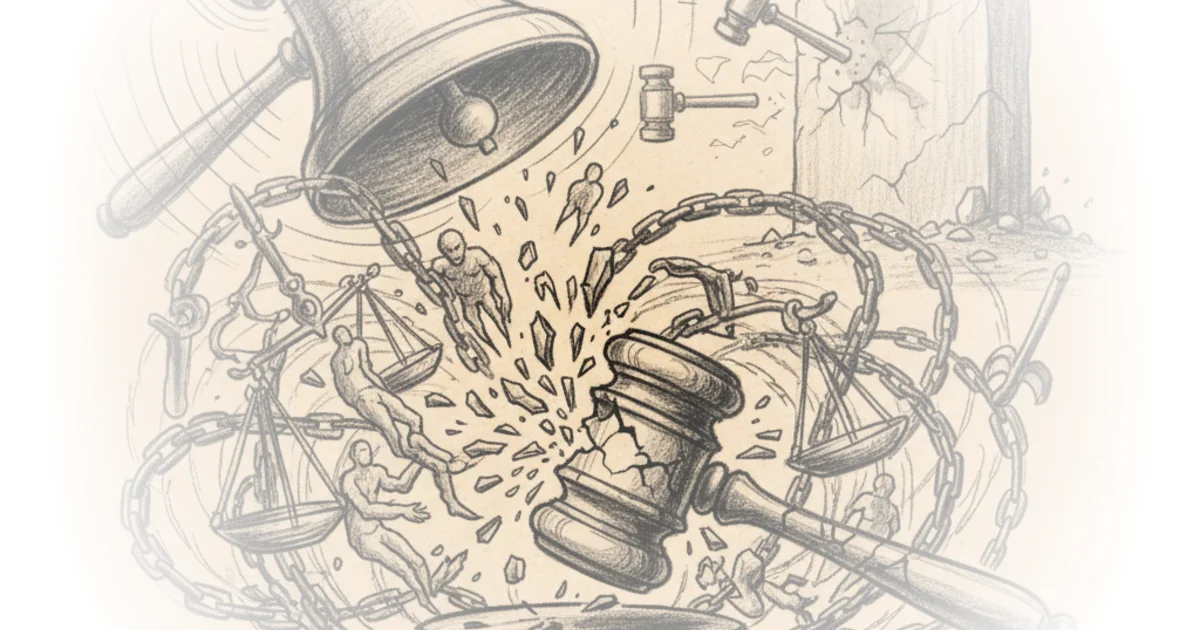
Stone highlights a specific case in the District of Minnesota where Judge Jeffrey Bryant ordered the government to return everything seized from unlawfully detained individuals—cash, phones, passports, and identification. When the government responded with vague declarations claiming they were "currently not aware of any property return issues," the judge saw through the evasion. Stone notes that the judge set a show-cause hearing, ordering officials to appear in person to explain why they should not be held in civil or criminal contempt. This escalation is significant because contempt is the judiciary's ultimate enforcement tool, reserved for deliberate disobedience. The author argues that the administration's reliance on "capacity issues" and understaffing is a poor defense for what the courts view as flagrant violations of the law.
The laws of decency condemn such villain. The undersign will not sit idly by and allow this intentional misconduct to go on.
Critics might argue that the sheer volume of cases created by aggressive enforcement sweeps makes perfect compliance logistically impossible, suggesting the failures are bureaucratic rather than malicious. However, Stone counters this by citing Judge Laura Provenino, who rejected the "enormous volume" excuse, stating that the government's understaffing is a "problem of its own making" that does not justify disobeying court orders. The judge imposed a $500 daily fine on a federal prosecutor until documents were returned, a move that underscores the court's refusal to accept administrative chaos as a valid legal defense.
The Systematic Nature of Non-Compliance
The piece moves beyond isolated incidents to paint a picture of a coordinated campaign of non-compliance. Stone details how Judge Patrick Schultz, a Bush appointee, compiled an appendix listing 96 prior court orders allegedly violated by Immigration and Customs Enforcement (ICE) in a single month. When the government's attorney challenged the accuracy of this list, claiming the judge's assessment was "beyond the pale," the court did not back down. Instead, Schultz ordered every judge in the district to independently verify the cases.
The verification process confirmed the judge's initial findings and actually expanded them. Stone writes, "ICE had violated 97 orders in 66 cases from the initial list and then 113 additional orders and 77 more cases beyond that." This independent audit is a crucial piece of evidence in Stone's narrative, transforming the issue from a dispute over numbers to a confirmed pattern of institutional defiance. The author emphasizes that this level of non-compliance is historically unprecedented, noting that the court is "not aware of another occasion in the history of the United States in which a federal court has had to threaten contempt again and again and again to force the United States government to comply."
The stakes are raised further when Stone discusses the shift from civil to criminal contempt. While civil contempt is meant to coerce compliance, criminal contempt is punitive, designed to vindicate the court's authority. Stone explains that when judges raise the possibility of criminal contempt, they are signaling that the conduct may be outright defiance of the judiciary itself. This distinction matters because it moves the conflict from a procedural dispute to a potential constitutional crisis involving the imprisonment of executive branch officials.
One way or another, ICE will comply with this court's orders.
The Broader Context of Enforcement Sweeps
Stone contextualizes these legal battles within the broader scope of enforcement operations, specifically referencing "Operation Metro Search" in Minnesota and "Operation Country Roads" in West Virginia. He describes the latter as a scenario where agents stop cars and seize people based on appearance, operating without warrants. Stone quotes Judge Goodwin, who described the situation as a "deliberate elimination of every structural feature that distinguishes constitutional authority from raw force."
The author connects these enforcement tactics to the Supreme Court's decision in Trump v. CASA, warning that the ruling's logic has made it difficult for federal courts to stop illegal government action nationwide. Stone argues that this legal landscape has encouraged the administration to challenge orders repeatedly, clogging the courts until the system strains. He notes that the same abusive policies are being challenged over and over, creating a backlog that the administration exploits to delay compliance. This historical reference adds depth to the argument, suggesting that the current crisis is not an accident but a consequence of a specific judicial strategy that has backfired.
Critics might suggest that the focus on legal technicalities distracts from the broader policy goals of the administration, arguing that the courts are being used to obstruct legitimate law enforcement. Stone, however, frames the issue as a fundamental breakdown of the rule of law, where the executive branch is effectively operating as a "law unto itself." The author's reliance on direct quotes from judges across the political spectrum—including those appointed by Republican presidents—strengthens the argument that this is a systemic issue, not a partisan one.
Bottom Line
Stone's most compelling contribution is his detailed documentation of the judicial verification process, which transforms allegations of non-compliance into a confirmed historical record of defiance. The piece's greatest vulnerability lies in its reliance on the assumption that the threat of criminal contempt will be sufficient to change executive behavior, a move that could trigger a constitutional standoff. Readers should watch closely for whether the administration's refusal to comply escalates to actual criminal charges against officials, a scenario that would mark a definitive shift in the balance of power between the branches of government.