Andrew Henry challenges a deeply held boundary between humans and the rest of the animal kingdom by asking a question that sounds almost heretical to traditional theology: Are animals religious? The piece doesn't just speculate; it marshals neuroscience, primatology, and behavioral biology to suggest that the roots of ritual, awe, and grief are not unique to our species. For busy minds grappling with the definition of faith in a secular age, this is a provocative pivot that forces a re-evaluation of what it means to be spiritual.
The Science of Awe and Grief
Henry begins by dismantling the assumption that spirituality requires language or complex theology. He anchors the discussion in the work of the late Jane Goodall, who observed chimpanzees performing a "waterfall dance"—a rhythmic swaying and stamping that Goodall interpreted as an expression of awe. "I think chimpanzees are as spiritual as we are, but they can't analyze it," Goodall is quoted as saying. "You get the feeling that it's all locked up inside them and the only way they can express it is through this fantastic rhythmic dance."
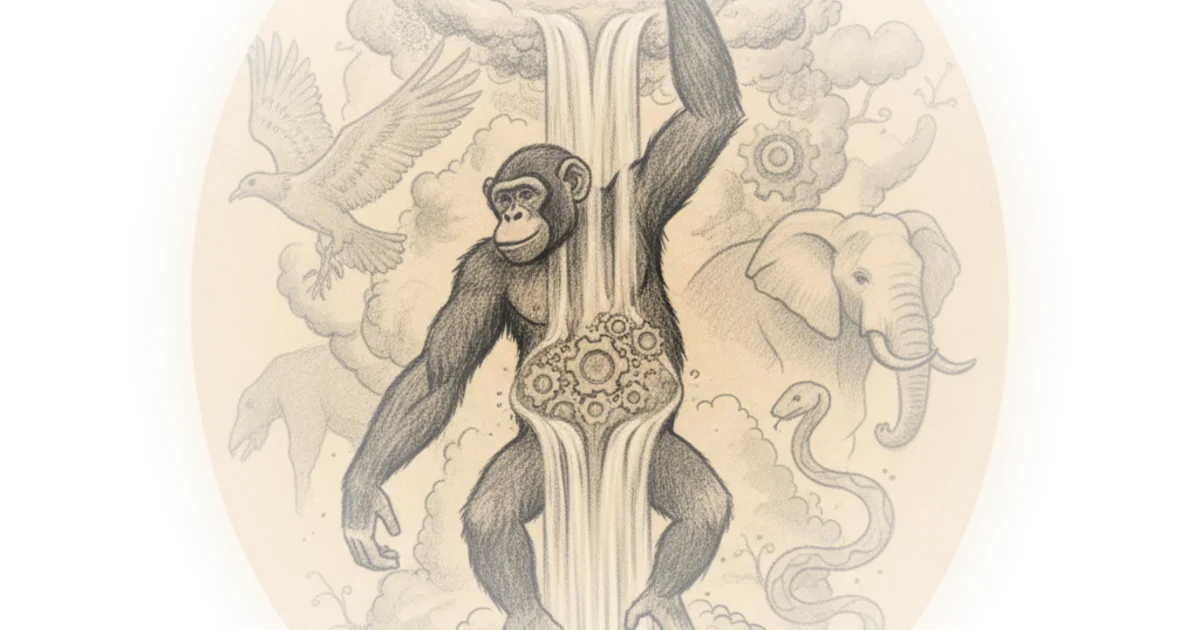
This anecdote sets the stage for a broader investigation into animal emotions. Henry notes that ethologists have documented behaviors resembling wakes and funerals across species, from elephants caressing corpses to gorillas grooming the dead. The author leans heavily on the neurological evidence to support these observations, citing brain imaging studies that show shared subcortical regions in mammals responsible for primary emotions. "Rejecting the possibility of animal emotions amounts to bad biology," Henry asserts, quoting biologist Mark Beckov. This is a crucial move; by grounding the argument in hard science rather than sentimentality, Henry shields the piece from accusations of mere anthropomorphism. Critics might argue that equating a mammal's grief response with human mourning is a category error, but the neurological data Henry presents makes that dismissal increasingly difficult to sustain.
"If you believe J35 was displaying evidence of mourning or grief, you are making a case that rests on faith, not on scientific endeavor."
The article wisely navigates the skepticism surrounding the famous orca Tlequa (or J35), who carried her dead calf for 1,000 miles. While zoologist Jules Howard warns against projecting human narratives onto the whale, Henry counters that the burden of proof has shifted. The evidence of shared brain chemistry suggests that the emotional substrate for grief is not a human invention but a biological inheritance. This reframing is effective because it treats animal behavior not as a mimicry of humans, but as a parallel evolution of similar emotional depths.
Redefining Religion for a Trans-Species World
The core of Henry's argument lies in his rejection of "essentialism"—the idea that religion must be defined by specific human traits like belief in the supernatural, sacred texts, or complex doctrines. He argues that this definition is inherently biased toward Protestant Christianity. "Essentialist definitions of religion are based on the idea that there is something inherently different about religion than any other cultural phenomenon which makes religion a uniquely human experience," he explains. By stripping away the human-centric requirements, Henry introduces scholar James Herod's "transspecies definition" of religion.
Herod's framework reduces religion to five dimensions: reverence, careful observance, dread, wonder, and intimacy. Henry applies this to the chimpanzee behaviors previously discussed, arguing that the waterfall dance and the silent vigil over a dead companion fit these criteria perfectly. "Chimpanzees are repurposing everyday behaviors like grooming and screaming in fear of a leopard for an extraordinary event, a period of observation of their dead companion," Henry writes. This is the piece's most innovative contribution: viewing ritual not as a set of actions, but as a process where ordinary behaviors are transformed for extraordinary emotional contexts.
The author acknowledges the inherent difficulty in this approach. "We can't exactly interview a chimpanzee about what it feels or what it's doing," Henry admits. He notes that scholars like Herod use phrases like "as if" to describe these behaviors, walking a fine line between observation and projection. "Some might argue that interpreting these behaviors as final farewells or feeling vulnerable is again simple projection," he concedes. However, the article pivots to scholar Donovan Schaefer, who argues that we fail to see animal religion because we are looking for it in the wrong places. Schaefer suggests we should view religion through the lens of "what bodies do and how things feel."
This shift from cognitive belief to bodily sensation is the article's strongest philosophical move. It suggests that religion might be less about what we think and more about how our bodies react to the sublime or the tragic. By focusing on the physical experience of awe and the somatic reality of grief, Henry makes a compelling case that the seeds of religion are biological, not just cultural.
Bottom Line
Andrew Henry's coverage succeeds by replacing theological dogma with biological evidence, forcing the reader to confront the possibility that the sacred is a shared mammalian experience rather than a human monopoly. The argument's greatest strength is its rigorous application of neuroscience to debunk the idea that emotion requires language, while its vulnerability lies in the inevitable ambiguity of interpreting non-verbal behavior. Readers should watch for how this "transspecies" framework might reshape not only our understanding of animals but also the very definition of human spirituality in the future.