Dan Snow dismantles the Victorian fantasy of the prudish Middle Ages, revealing a era where sexual activity was rampant, pragmatic, and often hilariously regulated by a church that knew its rules were being ignored. This piece is notable not just for its saucy details, but for its sharp critique of how later eras projected their own anxieties onto the past, turning history into a moral fable rather than a record of human behavior.
The Myth of the Chastity Belt
Snow begins by confronting the most persistent misconception: the idea that medieval society was defined by repression and devices like the chastity belt. He attributes this myth squarely to the Victorians, who, he argues, "invented most of what we think about medieval sex." The author's framing is effective because it immediately shifts the blame for our misconceptions from the medieval people to the 19th-century moralists who romanticized the past. Snow notes that the chastity belt is a "Victorian invention" and that if one hears of a gruesome torture device from the era, it is likely a "fever dream" created by later generations who found the idea "sexy."
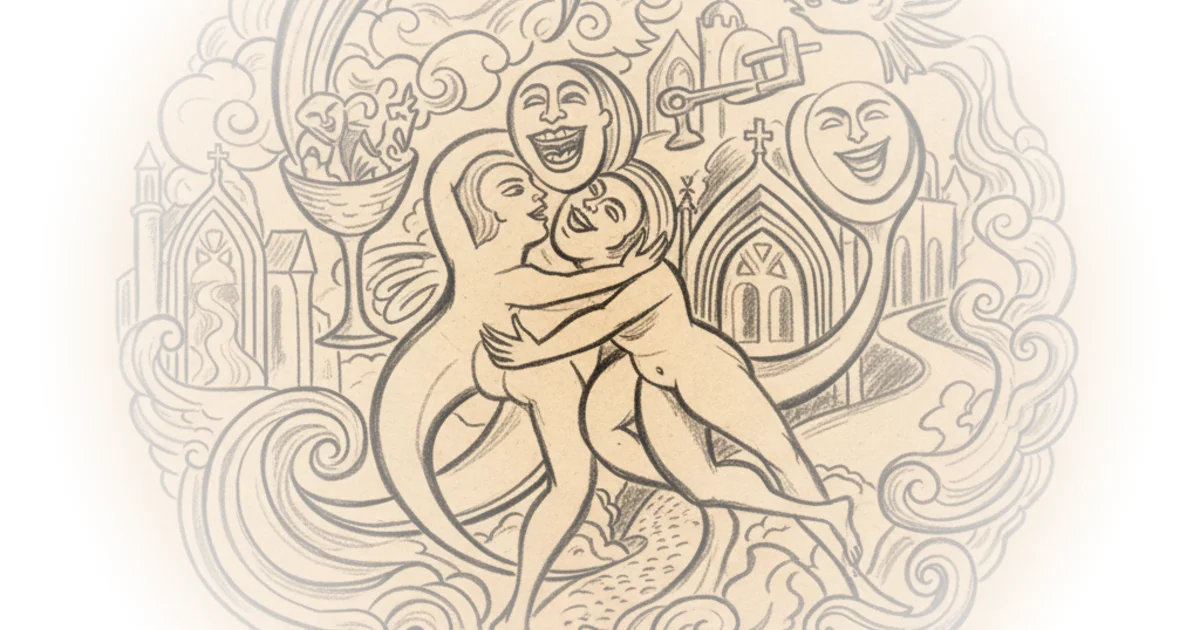
This is a crucial distinction. By identifying the source of the myth, Snow clears the ground to discuss the reality: a society where people were "rampant" and had sex in public, in church, and on pilgrimages. The author suggests that the medieval approach was far more pragmatic than the modern imagination allows, treating sex as a biological necessity rather than a moral failing to be suppressed by iron hardware.
The Moral Tightrope of the Church
The core of Snow's argument lies in the complex relationship between the medieval church and sexual activity. He describes the church's stance as a "moral tightrope," where the ideal was celibacy, but the reality required procreation. Snow explains that while figures like St. Augustine and St. Jerome championed virginity, the church also had to accommodate the command to "go forth and multiply." The solution was marriage, which Snow calls a "legal workaround" for the inevitable human drive for sex.
"In their opinion, the ideal Christian isn't going to have sex... but everybody knows that it's going to happen. So there's got to be a legal workaround for that. That's marriage."
Snow's analysis of the church's enforcement mechanisms is particularly insightful. He notes that while the church preached against premarital sex, the penalty was often light penance followed by a recommendation to marry the partner. This suggests a system that was more about social order than spiritual purity. The author points out that the "sex cops" were not lurking under beds; rather, the church operated on a system of confession and repentance that acknowledged human weakness. This framing humanizes the medieval religious experience, showing it as a negotiation rather than a dictatorship.
The Paradox of Pleasure and Procreation
Perhaps the most surprising section of Snow's commentary is his exploration of the medieval understanding of female sexuality. Contrary to the Victorian view of women as passive or asexual, medieval medical theory held that women were "hot and wet" and possessed a high libido. Snow explains that the "two seed theory" required both men and women to reach orgasm for conception to occur, meaning that female pleasure was not just permitted but biologically necessary.
"Women are just like out for it. Women, you cannot stop them. They're horny as all get out."
Snow cites the writer Boccaccio, who claimed that "one rooster is able to service 10 hens but 10 men would scarcely be able to service one woman." This quote highlights the medieval belief in female insatiability, a stark contrast to later eras that would silence female desire. However, Snow also notes the irony: while women were thought to be driven by lust, the church imposed strict rules on when and how sex could occur. Sex was forbidden on Sundays, Wednesdays, Fridays, Saturdays, and during Lent and Advent, creating a calendar where "nobody's following them."
Snow's observation that "if people really were following them, then there would be no one born in September" is a witty and effective way to illustrate the gap between doctrine and practice. The author argues that the church's rules were so restrictive that they were essentially impossible to follow, leading to a culture of discreet transgression.
Class Divides and the Courtly Love Illusion
Snow draws a sharp distinction between the lives of the peasantry and the aristocracy. He notes that while the "0.00001%" of society were bound by arranged marriages and the literature of courtly love, the 70% who were peasants lived with far more sexual freedom. The author points out that the "courtly love" trope was largely a literary construct of the wealthy, who were often trapped in political unions and sought outlets through poetry and secret affairs.
"Most of these people hate each other... You write each other love poetry. A lot of it takes place pretty from afar where you sit around and pine."
Snow's commentary on the class divide is compelling because it challenges the romanticized view of medieval romance. He suggests that the "love match" was a rare exception, often dangerous for young women like Eleanor of Castile, who was separated from her husband after becoming pregnant at 14. The author argues that the literature of the time, written by and for the elite, skews our understanding of the period, making it seem more repressed and romantic than it actually was for the majority.
Critics might note that relying on the "two seed theory" to explain medieval views on female pleasure risks oversimplifying a complex medical and philosophical landscape. While Snow accurately reflects the prevailing humoral theory, he does not fully explore the dissenting voices or the variations in regional practices. However, his central point—that medieval sexuality was more fluid and less repressed than we assume—remains robust.
Bottom Line
Dan Snow's commentary succeeds in stripping away the Victorian veneer that has long obscured the reality of medieval life, replacing it with a picture of a society that was pragmatic, prolific, and surprisingly open about its desires. The piece's greatest strength is its ability to connect historical medical theories and religious doctrines to the lived experiences of ordinary people, revealing a gap between law and life that feels remarkably modern. The biggest vulnerability lies in its reliance on the assumption that the "rampant" behavior of the peasantry was the norm, potentially underestimating the power of religious surveillance in rural communities. For the busy reader, this piece offers a refreshing reminder that history is often less about the rules we think existed and more about the messy, human ways we actually lived.