Chris Chappell flips the script on conventional naval wisdom, arguing that the US Navy's recent one-sided dismantling of Iran's fleet isn't just a victory over Tehran, but a grim preview of a potential clash with Beijing. The piece stands out not for predicting a new war, but for using the Iran conflict as a forensic audit of American readiness, revealing that while the US can crush a regional power, its industrial base is crumbling just as a far more formidable adversary ramps up production. This is a stark warning for busy strategists: the gap between tactical dominance and strategic sustainability is widening faster than Washington admits.
The Iran Litmus Test
Chappell opens by contrasting the US military's overwhelming success against Iran with the looming threat of a Chinese confrontation. He notes that the US has "decimated the Iranian military," sinking dozens of vessels including prized drone carriers, yet warns that this ease of victory is deceptive. The core of his argument is that Iran's defeat exposes a dangerous complacency. "Iran thought it was prepared to take on the US after its humiliating defeat in the 1980s during Operation Praying Mantis," Chappell writes, highlighting how war games suggested Iran could compete, only to be crushed instantly by superior US range and technology. This historical parallel to Operation Praying Mantis, where the US Navy sank Iranian frigates and mine layers in a single day in 1988, serves as a grim benchmark; Chappell suggests the current conflict was even more lopsided, proving that "the US hasn't even had to jog for its money."
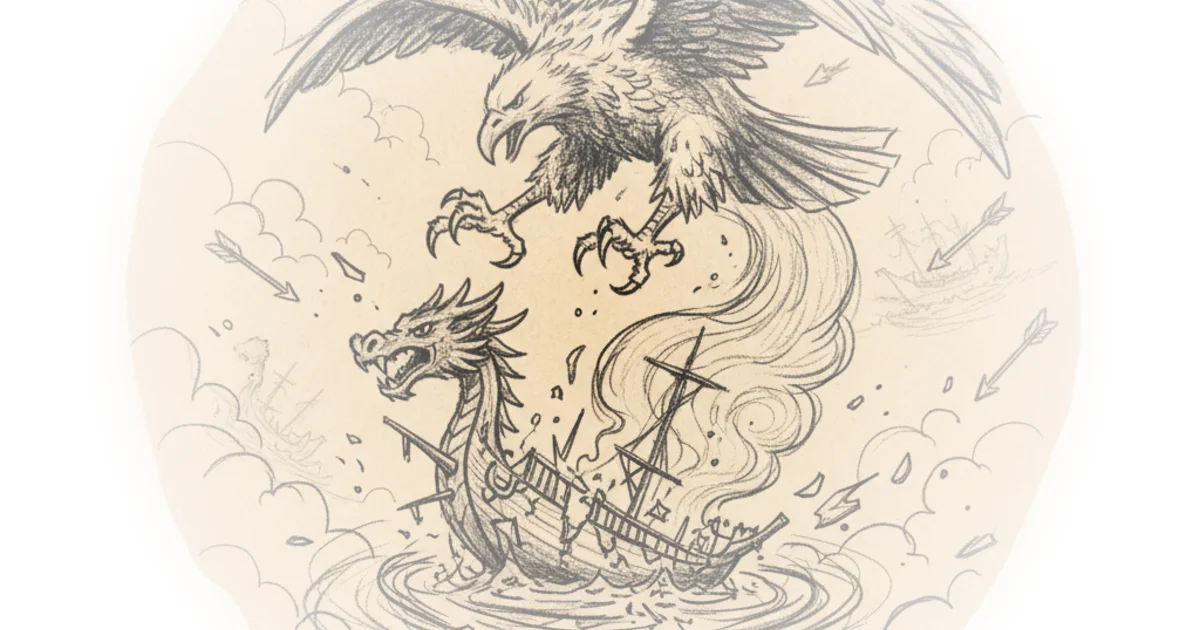
However, the author pivots quickly to the real concern: China. He argues that the strikes on Iran were a strategic move to sever ties between Tehran and Beijing, noting that "Iran was already rebuilding everything that the US and Israel destroyed last year" with Chinese help. The commentary here is sharp, suggesting that the US is fighting a proxy war against Chinese influence. Chappell points out that even advanced Chinese systems like the HQ-9B missile defense failed to shield Iran, yet he cautions against underestimation. "China is far deadlier than Iran with the world's largest navy and missiles galore," he asserts, framing the Iranian conflict as a mere warm-up that highlights the scale of the coming challenge. Critics might note that comparing a regional power with asymmetric tactics to a near-peer superpower with a global footprint risks oversimplifying the complexities of naval warfare in the Pacific.
"China is far deadlier than Iran with the world's largest navy and missiles galore. That should be raising alarm bells in Washington."
The Submarine Shadow
The piece deepens its analysis by shifting focus to the undersea domain, where Chappell identifies the most critical vulnerability for the US. He details China's aggressive expansion of its submarine fleet, moving from diesel-electric to nuclear-powered vessels at an unprecedented pace. "China currently has over 60 submarines, including six nuclear-powered attack submarines," Chappell writes, contrasting this with the US fleet of 71, all nuclear-powered but facing production delays. The author uses the metaphor of Chinese electric vehicles to question the reliability of China's hybrid fleet, joking that they might just be "kamikaze units," but the underlying data is serious. He cites Rear Admiral Mike Brooks, who warns that China has accelerated production from less than one nuclear submarine per year to significantly higher rates, with projections of 70 subs by 2027 and 80 by 2035.
Chappell emphasizes the strategic implications of the new Type 096 nuclear-powered ballistic missile submarine, which will carry JL-4 missiles capable of striking the US from protected waters. "It's like sniping but underwater," he quips, illustrating the shift from defensive patrols to offensive reach. The author argues that China is not just building numbers but quality, with vessels designed to operate in the Arctic and Atlantic, effectively bringing the fight to America's "backyard." This section effectively leverages the concept of "quantity over quality," suggesting that sheer volume can overwhelm even superior individual units. A counterargument worth considering is that while China is building faster, the US retains a significant advantage in nuclear propulsion technology and crew experience, which Chappell acknowledges but feels is being eroded by industrial neglect.
The Industrial Rot
Perhaps the most damning part of Chappell's coverage is his diagnosis of the US shipbuilding crisis. He argues that the US has allowed its infrastructure to rot, making it impossible to replace losses or expand fleets in a timely manner. "The US has allowed decades of neglect to rot out its ship building infrastructure," he writes, pointing to the Columbia-class submarine program, which is years behind schedule. The first of its class was only 65% complete as of February, with delivery pushed to 2029. Chappell highlights the irony that while China is accelerating, the US is struggling to maintain a production rate of even two Virginia-class attack submarines per year. "Ironically, that's a boatload of unfinished boats," he observes, underscoring the backlog that threatens to leave the US Navy outnumbered.
The author connects this industrial failure to broader geopolitical risks, suggesting that without a revived merchant marine and a robust defense industrial base, the US cannot sustain a prolonged conflict. He critiques the reliance on foreign supply chains, noting that "what good is fighting wars if you can't get vital supplies from one place to another." Chappell concludes that the US must stop letting American universities conduct Pentagon-funded research that inadvertently aids the Chinese military, likening it to giving a bully lunch money. "Betting the future of the free world on the hope that China has timu quality military gear is a dangerous gamble," he warns, using a play on words to emphasize the risk of assuming Chinese equipment is inferior. This framing is effective because it moves beyond tactical comparisons to the fundamental economic and industrial realities of modern warfare.
"Betting the future of the free world on the hope that China has timu quality military gear is a dangerous gamble."
Bottom Line
Chappell's strongest argument lies in his use of the Iran conflict as a mirror to reveal the US Navy's fragile industrial foundation, effectively arguing that tactical superiority means little without the capacity to sustain it. The piece's biggest vulnerability is its reliance on a binary view of US-China naval competition, potentially underestimating the resilience of the US alliance network and the operational challenges China faces in projecting power globally. Readers should watch for whether the administration's proposed maritime action plan can actually reverse the decades of neglect Chappell so vividly describes, or if the "boatload of unfinished boats" becomes a permanent fixture of American defense policy.