Michael Ruhlman delivers a rare, unvarnished meditation on why food journalism matters, not as a lifestyle accessory, but as a critical lens for understanding power, ethics, and community. While the piece weaves together a tribute to Ruth Reichl, a family reunion, and a New Orleans cocktail, its most striking claim is that the act of eating is inextricably political and that the current media landscape desperately needs writers who can expose the broken machinery behind our plates. In an era where food coverage often retreats into elite escapism, Ruhlman argues that the most vital stories are those that connect a dinner table to the global forces of labor, cost, and morality.
The Political Plate
The essay anchors itself in a classroom setting where Ruhlman brings in legendary critic Ruth Reichl to inspire a new generation of writers. He frames Reichl not just as a celebrity, but as a necessary counterweight to the gloomy narrative that journalism is dying. Ruhlman writes, "There's never been a better time, a more necessary time, a more important time to be a food journalist." This assertion is bold, especially given the economic realities of the industry, but it is backed by Reichl's own history of transforming Gourmet magazine from a publication of "fluff stories and recipes for affluent middle-aged white ladies" into a vehicle for hard-hitting inquiry.
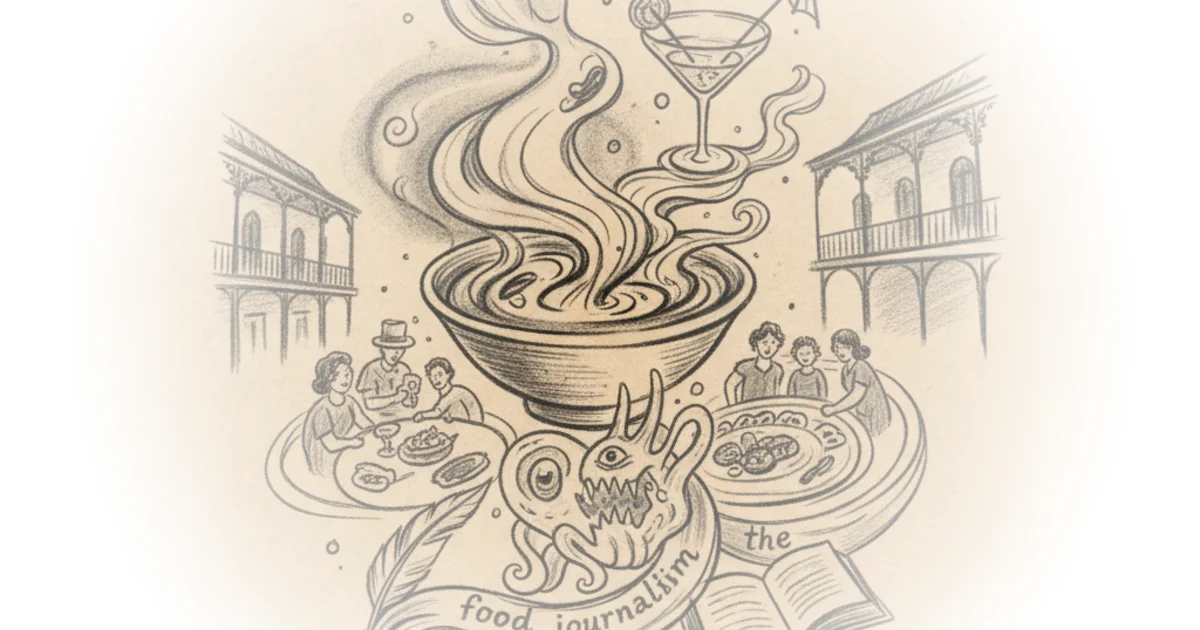
Ruhlman highlights how Reichl's tenure was defined by her willingness to tackle uncomfortable truths, a move that required significant courage. He notes that it was David Foster Wallace's essay "Consider the Lobster" that gave her the license to push boundaries further. That 10,000-word piece, which Ruhlman describes as "a hilarious travel story, scientific inquiry into the biology of the lobster, and an extraordinary philosophical inquiry," forced the publication to confront the ethics of eating live creatures. This historical pivot is crucial; it mirrors the shift seen in Wallace's broader work, where the mundane becomes a portal to profound moral questioning. By citing this, Ruhlman suggests that the best food writing doesn't just describe a meal; it interrogates the system that produced it.
"Thirty-three years ago I was convinced that food journalists were absolutely necessary. It has never been more true."
The argument gains traction when Ruhlman details how Reichl expanded the scope of coverage to include "the slave labor in Florida that produces our grocery-store tomatoes." This is the core of his thesis: food journalism is the only genre that can seamlessly bridge the gap between the consumer's plate and the systemic injustices of the supply chain. Critics might argue that focusing on food distracts from direct political action, but Ruhlman counters that consumers "still have very little understanding of the forces that drive those costs." Without this understanding, policy changes remain abstract; with it, they become personal and urgent.
The Architecture of Connection
Beyond the political, Ruhlman explores the intimate, grounding power of shared meals, using a reunion with his cousins as a case study. He contrasts the isolation of modern life—where family members are "spread out and scarcely see each other"—with the profound warmth of a collaborative kitchen. The description of the meal is not merely a recipe list but a testament to the labor of love involved in gathering. He writes, "The best part, the BEST part, of the day was naturally all the cousins cooking together in Matt's ample kitchen, music playing, Matt's young daughters adding some young life to the gathering."
This section serves as a quiet rebuttal to the cynicism of the news cycle. While the world fractures, the act of preparing a spatchcocked turkey or caramelizing a skillet of onions creates a temporary, tangible community. Ruhlman observes that the gathering was "anchored by great food and the shared work of its preparation." He suggests that in a fragmented society, the kitchen remains one of the few spaces where cooperation is not just encouraged but required for survival and joy. The inclusion of specific details, like the "crazy Lone Star tick" preventing one cousin from eating bacon, adds a layer of authentic, lived experience that elevates the narrative beyond a generic family portrait.
The Weirdest Things We Eat
The piece concludes with a journey to New Orleans, where Ruhlman and his companions encounter "Fried oysters with brie at Clancy's." He admits, "Why the brie, I don't know, but the dish has been a mainstay on the menu for ages." This moment of culinary confusion is juxtaposed with the ritual of the Carousel Bar's bourbon milk punch, a drink described as a "splendid way to begin the day." These anecdotes serve a larger purpose: they remind the reader that food culture is often illogical, deeply traditional, and resistant to rational explanation. It is a space where the weird and the wonderful coexist, much like the complex human relationships that sustain us.
Ruhlman also touches on the recent loss of director Rob Reiner, framing it as a lament for a "great, great storyteller." He notes that Reiner "probably made more of my favorite movies than any single director," connecting the loss of a cultural icon to the broader theme of storytelling's importance. Just as Reichl used food to tell stories of power, Reiner used film to tell stories of humanity. The parallel suggests that whether through a magazine article, a movie, or a family dinner, the act of storytelling is the primary mechanism we have for making sense of a chaotic world.
"Food touches everything we do. And that it is definitely a political issue."
Bottom Line
Ruhlman's commentary succeeds by refusing to separate the aesthetic pleasure of food from the moral weight of its production, offering a compelling argument that food journalism is a vital tool for civic engagement. Its greatest strength lies in its ability to move seamlessly from the macro-political to the micro-personal, proving that the personal is indeed political. However, the piece's reliance on the legacy of past icons like Reichl and Wallace risks implying that the current generation of writers must replicate their specific battles rather than forging new paths for a digital, fragmented media landscape. Readers should watch for how emerging voices will adapt these ethical frameworks to the realities of social media and algorithmic distribution.