"The social costs of China's education system are often dismissed as a temporary byproduct of rapid modernization, but this piece from Sinification argues they represent a fundamental fracture in the nation's social fabric. It moves beyond the familiar narrative of 'involution' to diagnose a generation that is either silently withdrawn or psychologically brittle, stripped of the emotional resources needed to navigate adulthood.
The Myth of Fragility
The article opens by challenging the common adult perception that today's youth are simply 'snowflakes' who cannot handle hardship. Sinification reports that while older generations recall a childhood defined by physical deprivation or strict corporal punishment, the current crisis stems from a different source entirely: 'it is not that children [today] have experienced fewer setbacks, but that their ability to accept them has weakened.' The piece argues this fragility is not innate but manufactured by an environment that has removed the natural friction of childhood.
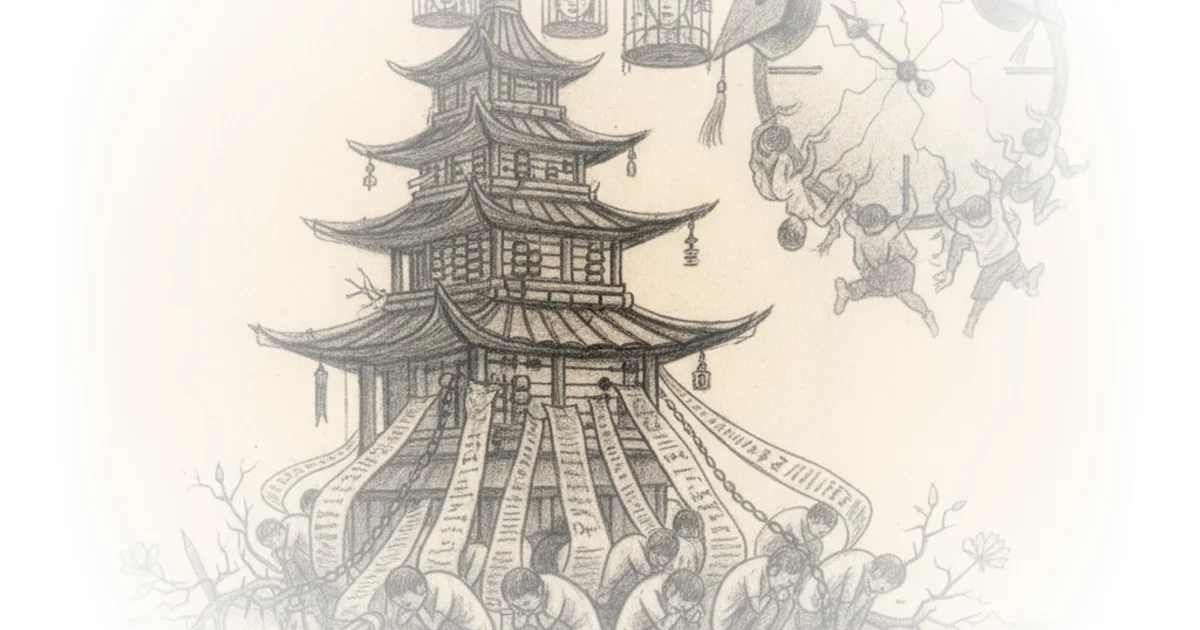
This analysis gains depth when viewed through the lens of 'agricultural involution'—a historical concept describing a system where increased labor input yields diminishing returns. Just as farmers once worked harder for the same yield, today's students are trapped in a high-effort, low-resilience cycle. The editors note that the current generation lacks the 'emotional and social resources needed to absorb setbacks and recover from them effectively.' Instead of building resilience, the system has created a binary of 'good kids' and 'bad kids,' where the former internalize discipline until they collapse, and the latter retreat into digital silence.
'Both groups develop similarly narrow inner lives, easily dominated by grades, adult approval, online distractions or other single sources of emotional meaning.'
Critics might argue that the state's recent 'Double Reduction' policy, which banned for-profit tutoring and capped homework, was a genuine attempt to address these pressures. However, the piece suggests these measures are superficial, failing to tackle the root cause: a society where 'parents have ample reason to justify themselves' by claiming, 'If we refuse to join the rat race, we'll be harming our children.' The policy intervenes in symptoms, not the disease of hyper-competition.
The Silent and the Pitiful
The commentary distinguishes sharply between two emerging archetypes of youth: the 'silent ones' and the 'pitiful ones.' The silent group, predominantly boys, has withdrawn entirely from adult supervision, creating a 'transparent wall' between themselves and the world. A headteacher quoted in the piece describes the situation with palpable helplessness: 'What makes us teachers feel most powerless nowadays is not that they [the students] are naughty and difficult to discipline. Naughty children are actually easier to discipline. It is the silence [that is the hardest to deal with].'
In contrast, the 'pitiful ones' are often girls who have internalized the system's demands to a heartbreaking degree. They are described as 'so obedient that it hurts to see,' having surrendered their autonomy to a schedule managed down to the minute. Sinification highlights the gendered nature of this crisis, noting that while girls suppress their exhaustion to succeed, boys disengage. This dynamic creates a future where 'withdrawal and over-compliance are the contrasting responses to this same narrowness,' leading to a society where mutual understanding between classes and genders is eroding.
The piece draws a sobering parallel to the phenomenon of 'left-behind children' in rural China, where migrant parents have left their offspring in the care of grandparents or alone. The editors quote sociologist Zhou Juan, who observes that these caregivers often 'have no concept of what a childhood ought to look like.' This historical disconnect is now spreading to urban centers, where the 'incomplete socialisation' of children is producing a cohort that is 'selfish' not because they have too much self, but because their self is 'underdeveloped, deprived of the play, freedom and social interaction needed to cultivate judgement and empathy.'
'These problems are likely to persist into adulthood, contributing to mental-health problems, hypersensitivity and intolerance among university students and in wider society.'
The administration's reaction to this malaise has been telling. Rather than addressing the structural pressures of the Gaokao or the economic anxiety driving the competition, the state has framed the resulting 'lying flat' movement as a security threat. As the piece notes, officials in 2026 claimed that 'hostile foreign forces systematically orchestrate the "lying flat narrative" to "brainwash" young people.' This deflection ignores the reality that the 'lying flat' movement is a rational response to a system where effort no longer guarantees mobility.
Bottom Line
The most compelling aspect of this argument is its rejection of the 'resilience training' narrative, correctly identifying that you cannot teach resilience to children who have never been allowed to fail or play. The piece's greatest vulnerability lies in its limited discussion of economic alternatives; without a broader shift in how success is defined in China, the pressure will likely remain. Readers should watch for whether the next generation of policy moves beyond censorship and tutoring bans to address the fundamental disconnect between childhood and the natural world.