Chris Chappell delivers a provocative thesis that cuts through the noise of current events: the most effective weapon in the Chinese Communist Party's arsenal isn't a missile, but the American desire to avoid conflict. By framing the current surge in anti-war sentiment not as a moral awakening but as a calculated cognitive warfare campaign, Chappell forces a uncomfortable re-evaluation of why the United States hesitates to confront authoritarian aggression. He argues that the very arguments used to question military intervention in Iran are merely a dress rehearsal for the isolationist rhetoric that will inevitably surround a potential invasion of Taiwan.
The Architecture of Manipulation
Chappell opens by dismantling the assumption that skepticism of US military power is inherently virtuous. He points out a historical irony, noting that while many mock US interventions, "the people who mock the US government for bombing brown people also wouldn't be able to tell you the difference between an Arab and a Persian." This observation serves to highlight a superficial understanding of the geopolitical landscape, suggesting that the anti-war movement often lacks the nuance to distinguish between distinct regional threats. The author draws a direct line from Cold War tactics to the present day, asserting that "the CCP stealing someone else's ideas" is actually a return to a Soviet playbook where Moscow funded anti-war groups to demoralize the American public.
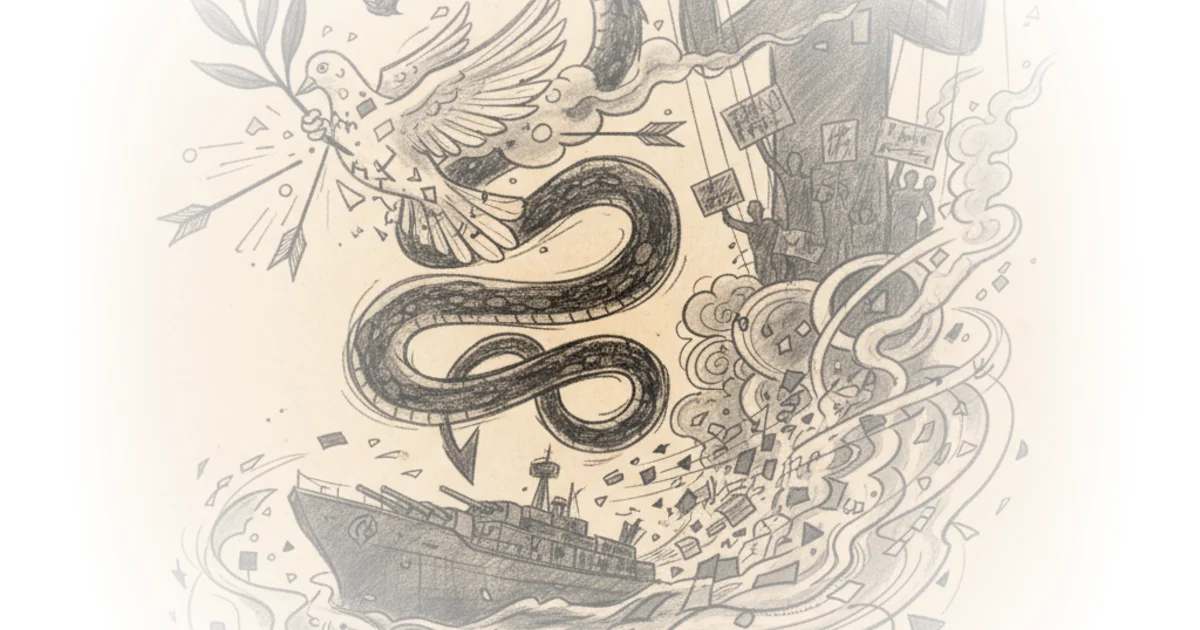
The core of Chappell's argument rests on a controversial reinterpretation of the Vietnam War. He challenges the prevailing narrative that the conflict was a catastrophic failure, claiming instead that "the US won almost every major battle." He argues that the ultimate loss of South Vietnam was not a military defeat but a political one, driven by domestic pressure. "Anti-war Democrats being at least tangentially influenced by the Soviet anti-war movement got into power in Congress," Chappell writes, leading to a cutoff of funding that allowed the North to overrun the South. This perspective is designed to reframe the lesson of Vietnam from "war is bad" to "abandoning allies is fatal." Critics might note that this view overlooks the immense human cost of the war and the complex geopolitical realities that made a long-term US presence unsustainable, regardless of funding. However, Chappell uses this historical lens to argue that "when the US backs down from its duty, authoritarians win."
The CCP loves people who are anti-war because they can hide behind them. While China prepares for war, the most anti-war thing the US can do is prepare for war.
The Failure of Engagement
Moving from history to current policy, Chappell attacks the concept of diplomatic engagement with authoritarian regimes. He posits that the belief that trade and negotiation will reform China is a dangerous delusion. "Authoritarians don't play by the rules," he states, citing a litany of broken promises from North Korea to Iran. He specifically targets the Iran nuclear deal, noting that "despite Biden's efforts to revive the Iran deal after Trump pulled out of it, Iran continued its nuclear weapons program and reportedly bragged that they had enough enriched uranium to make 11 nuclear bombs." This evidence is used to support the claim that concessions only buy time for adversaries to strengthen their capabilities.
Chappell extends this logic to the South China Sea and the Taiwan Strait. He argues that the CCP has already engaged in "unrestricted warfare," which encompasses economic, legal, and cyber domains, not just kinetic military action. He highlights the severity of this threat by pointing out that "more Americans die every year from Chinese fentanyl than the entire Vietnam War." This statistic is intended to shock the reader into realizing that the war is already happening, just not in the traditional sense. He warns that the current isolationist arguments regarding Taiwan are a direct result of this cognitive warfare. "Some argue that US military support might actually trigger Chinese aggression," Chappell paraphrases, before dismissing the idea as a paradox: "In order to protect Taiwan, we shouldn't prepare to defend it."
The Taiwan Precipice
The commentary culminates in a stark warning about the future of US-Taiwan relations. Chappell suggests that the arguments being made today to ignore the Taiwan issue are a test run for the propaganda that will flood the zone when an invasion occurs. He notes that some voices claim "the Taiwan issue does not directly affect US national security," a position he rejects by emphasizing the strategic importance of the island for global trade and technology. He draws a parallel to the Soviet era, suggesting that just as the USSR used anti-war movements to weaken the US, the CCP is now using similar tactics to erode American resolve. "The sing for China will go a hundred times harder than Tucker Carlson singing for Russia," he predicts, indicating that the volume of disinformation will be unprecedented.
Chappell concludes by asserting that the only language bullies understand is strength. He argues that the CCP's strategy relies on the US appearing weak and divided. "Bullies leave no other choice but to show strength," he writes, framing military preparedness not as a path to war, but as the only viable path to peace. The piece ends with a surreal, satirical vision of a future where the fight against communism has become so all-consuming that it transforms the narrator into a Dune-like sandworm, a metaphor for the total assimilation required to survive the threat. While the humor is dark, the underlying message is serious: the cost of inaction is the loss of American sovereignty and global stability.
Bottom Line
Chappell's most compelling contribution is the reframing of anti-war sentiment as a strategic asset for the CCP rather than a moral stance of the American public. His historical revisionism of the Vietnam War is his most polarizing move, yet it effectively serves his broader argument that political will is as critical as military capability. The piece's greatest vulnerability lies in its dismissal of the legitimate costs of perpetual conflict and the complexity of diplomatic engagement, but it succeeds in forcing the reader to confront the possibility that the enemy is actively manipulating the domestic debate to ensure American inaction.