Erik Hoel arrives at a hospital bedside with a newborn in his arms to make a counterintuitive claim: we should stop trying to prove artificial intelligence is conscious and instead embrace its lack of consciousness as a liberation for humanity. While the Pope and secular critics like Ted Chiang argue that AI lacks a soul because it cannot feel, Hoel flips the script, suggesting that acknowledging machines are "mutely dumb" despite their brilliance frees us from the burden of cognitive mastery to focus on being human experiencers.
The Shift from Master to Experiencer
Hoel begins by dissecting Pope Leo XIV's encyclical Magnifica Humanitas, which draws a hard line between biological life and algorithmic output. The author notes that while AI can mimic empathy, "they do not understand what they produce, for they lack the affective, relational and spiritual perspective through which human beings grow in wisdom." Hoel finds it fascinating that both religious authority and secular philosophy arrive at the same conclusion via different paths, yet he argues this consensus is built on a flawed premise: that intelligence and consciousness must be linked.
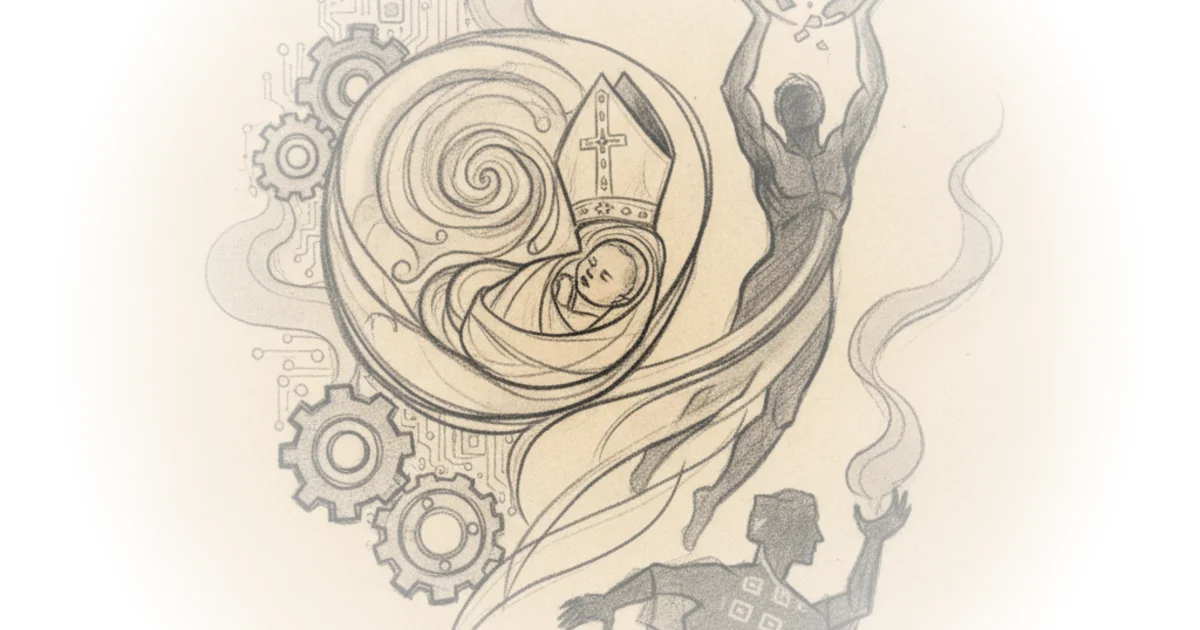
The core of Hoel's argument is a redefinition of human value. He suggests we are moving from Homo sapiens (the wise man) to Homo experiens (the experiencing man). "If machines do ever more of our cognitive work, perhaps spiritually this abnegation is not some horror, but frees us to focus on experiencing the world, living in the world, rather than constantly mastering it." This framing is compelling because it reframes the potential obsolescence of human intellect not as a crisis, but as a return to childhood—a state where being "blessed" has nothing to do with productivity.
Critics might argue that this romanticization of "experience" over "intelligence" ignores the very real economic displacement and loss of agency that comes when machines outperform humans in cognitive tasks. However, Hoel's point is not about economics but about spiritual orientation: "It is a hard thing to cede, unpleasant for our generation, but eventually—if not now, then in a decade, or a century—we will have to cede away much of our cognitive mastery."
It is perhaps the most interesting move—maybe one day an inevitable one—to accept their intelligent capabilities while still rejecting their consciousness.
The Mystery of Consciousness in an Intelligent Machine
Hoel then pivots to the scientific absurdity of the current moment: AI systems are solving problems at a superhuman level without any apparent need for consciousness. He invokes Thomas H. Huxley's 19th-century comparison of consciousness to a steam whistle—a "collateral product" that does nothing but exist alongside the mechanism. The author points out the strangeness of this dissociation: "All while happily ignoring consciousness, the ability to complete long programming tasks by state-of-the-art AI models like ChatGPT is supposedly doubling roughly every handful of months."
This section highlights a critical gap in our understanding. If intelligence can scale exponentially without consciousness, then what is consciousness actually for? Hoel suggests that current theories are failing us. He references his own background with Integrated Information Theory (IIT), noting that while it allows for "conscious dust" in simple systems, most theories of consciousness are currently "more like pre-paradigmatic metaphors or sketches of theories."
The author warns against the "toy system" problem, where applying theories like Global Workspace Theory to a computer game character or even the United States government might technically classify them as conscious. This suggests that our definitions are too loose to be useful. As Hoel puts it, "Claims of consciousness in LLMs therefore come with a significant question mark: Consciousness of which persona? The AI assistant? Or the base model?"
No one has been able to convincingly articulate how conscious states could be uniquely grounded in the assistant persona, and the problem seems quite difficult.
Player-Shaped vs. Task-Shaped
The most vivid evidence Hoel offers for the lack of machine consciousness comes from the failures of Large Language Models (LLMs) in unstructured environments. He describes a scenario where an AI, tasked with fine-tuning a new leader, spends an hour waiting for that leader to arrive, only to realize it is the leader reading its own thoughts. "Out-of-distribution tasks remain almost as hard as they ever were," Hoel writes, noting that while models can recite physics equations, they "suck" at playing text-based adventure games like Zork because they lack meta-cognition—they don't know what they know.
Hoel draws a parallel to the history of philosophy of mind, referencing the "Chinese Room" argument (a companion topic in his series) to illustrate that syntax is not semantics. He argues that LLMs are "masters of the Gish gallop," throwing together semi-connected nonsense that looks cohesive but collapses under scrutiny. The distinction he draws is between being a task-doer and being a "player."
"Is not life the ultimate game and all we consciousnesses the players, wandering around?" Hoel asks. He suggests that video games are the best simulacrum of consciousness because they require navigating an uncertain world with agency. LLMs fail here because they are not "player-shaped." They can win a math olympiad but cannot navigate the social and logical traps of a simple game without getting stuck in loops.
Critics might counter that these failures are merely engineering hurdles, not proof of a fundamental lack of consciousness; as models scale, their ability to maintain state and meta-cognition may improve. Yet Hoel insists that even if they do, it would be an accident: "It would be as if consciousness is something we find growing by accident, like mushrooms in the dark corner of a basement."
Bottom Line
Hoel's strongest move is decoupling intelligence from consciousness to argue for a new human identity rooted in experience rather than utility. His biggest vulnerability lies in assuming that "experience" alone can sustain human dignity in an economy where machines do everything better. Readers should watch how this philosophical shift plays out as the gap between AI capability and AI awareness widens, forcing society to decide if being "conscious" is a requirement for value or just a biological accident.