Yascha Mounk offers a startling diagnosis for the current chaos in global governance: we are not witnessing a temporary political anomaly, but the full flowering of a "postmodern presidency" where truth is no longer a standard to be met, but a tool to be wielded. By reframing the administration's erratic behavior through the lens of 1990s French philosophy rather than simple personality quirks, Mounk provides a framework that explains why traditional political analysis fails to make sense of today's headlines.
## The Collapse of Shared Reality Mounk begins by tracing the intellectual lineage from academic skepticism to raw political power. He notes that while postmodern theorists like Jean Baudrillard and Michel Foucault originally sought to liberate individuals from oppressive narratives, their ideas have been hijacked. "Whatever its sources, the world of the present is permeated with deep skepticism about the grand narratives and universalistic hopes that often prevailed in the past," Mounk writes. This observation lands with force because it connects abstract philosophical debates to the concrete reality of a government that seems incapable of stating a consistent position.
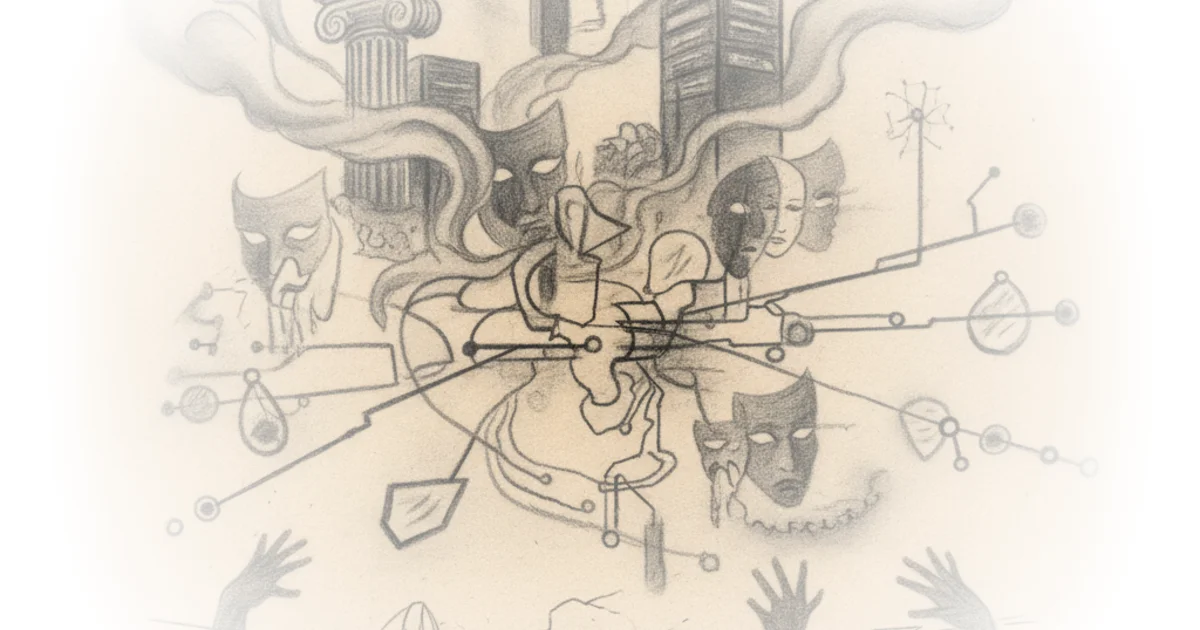
The author argues that this skepticism has created a vacuum filled by nationalism, which no longer claims to be part of a universal human project but rather a defensive reaction against one. "Today's nationalists... agree entirely with this zero-sum outlook on international affairs," he explains, noting that the administration treats global cooperation not as a moral good, but as a loss for domestic interests. This reframing is crucial; it suggests that the abandonment of international norms isn't just bad policy, but a fundamental shift in how reality is constructed by those in power.
There is no such thing as disinterested reason, just various forms of self-interested rationalization. The claim that one possesses truth or knowledge is nothing but a power move.
Critics might argue that this philosophical lens over-intellectualizes what is simply opportunistic populism, yet the consistency of the behavior suggests something deeper than mere calculation. When the administration treats facts as malleable to fit desired outcomes, it validates Mounk's claim that "truth is a tool for manipulation." This approach effectively dismantles the possibility of accountability, as there is no objective baseline against which to measure failure.
## Governance as Spectacle The article moves from theory to practice by examining recent military engagements, specifically the administration's conduct regarding Iran. Mounk points out that despite campaign promises to end conflicts, the executive branch has engaged in aggressive action without coherent justification. "He made no effort to build support in public opinion or Congress. He merely acted, as if reasoning about going to war was irrelevant and persuasion both futile and unnecessary," Mounk observes.
This section is particularly sobering because it highlights the human cost of treating war as a media event rather than a grave state decision. The administration's shifting rationales, delivered through social media and contradictory statements from officials like Secretary of War Pete Hegseth, have made it impossible to judge success or failure. Mounk draws a parallel to Baudrillard's controversial claim that the Gulf War "did not take place," arguing that we have now entered an era where war is indistinguishable from propaganda.
We have entered the age of fully postmodern propaganda in which the powers that be don't even bother to construct a coherent narrative to generate support for what they do.
The implication here is terrifying: if the public is entertained by "explosions and infliction of pain," they may become indifferent to the actual strategic reality. This detachment from consequence is the ultimate danger of postmodern governance. It prioritizes the spectacle over the substance, leaving civilians and soldiers alike as pawns in a game where the rules are invented on the fly.
## Reclaiming Universalism In his conclusion, Mounk pivots to a solution, arguing that the only way out of this cognitive chaos is to re-embrace some form of universal truth. He suggests we view universalism not as an arrogant imposition, but as a necessary "cognitive heuristic" or a "regulative principle." "Think of it as a flashlight emanating from the human mind that can illuminate the darkness of the surrounding world," he writes, urging readers to find a balance between particular interests and shared humanity.
This appeal to reason feels like a desperate plea in the face of overwhelming evidence to the contrary. The author acknowledges that traditional justifications for universalism may seem outdated, but insists that without them, politics collapses into "raw and ruthless assertions of power." While this is a noble sentiment, it faces the steep challenge of convincing an electorate that has already been radicalized against the very idea of shared truth.
A world in which universal truths and goods is widely denied will also be a world in which politics has been reduced to raw and ruthless assertions of power.
## Bottom Line Mounk's strongest contribution is his ability to link high-level philosophical deconstruction to the gritty reality of modern executive overreach, proving that the erosion of truth has real-world consequences for war and peace. However, the piece's greatest vulnerability lies in its optimism about reviving universalism; it offers a diagnosis but struggles to prescribe a cure that can penetrate the very tribalistic mindset it describes. Readers should watch for whether this intellectual framework gains traction among liberal institutions or remains an academic observation of a sinking ship.