South Korea's housing market operates on a financial logic that seems to defy basic economics: paying nothing in monthly rent while handing over nearly a million dollars in cash upfront. PolyMatter dissects this counterintuitive system, revealing how a post-war survival mechanism evolved into a fragile, high-stakes pyramid scheme that now underpins the lives of millions. For the busy observer of global markets, this is not just a cultural curiosity; it is a stark warning about what happens when capital is diverted from individuals to corporations, leaving the population to invent their own risky financial instruments.
The Architecture of Zero Rent
The piece opens by dismantling the assumption that "free rent" implies a government subsidy or a marketing gimmick. PolyMatter describes a 36-story gold-plated complex in Seoul where a tenant can live for two years without paying a dime, provided they front a massive lump sum. "About 40% of all renters in Korea are currently paying exactly $0 a month," the author notes, a statistic that immediately signals a systemic anomaly rather than an outlier. This is the Jeonse system, a private agreement where the tenant loans the landlord a deposit—typically 60% to 90% of the property's value—in exchange for rent-free occupancy.
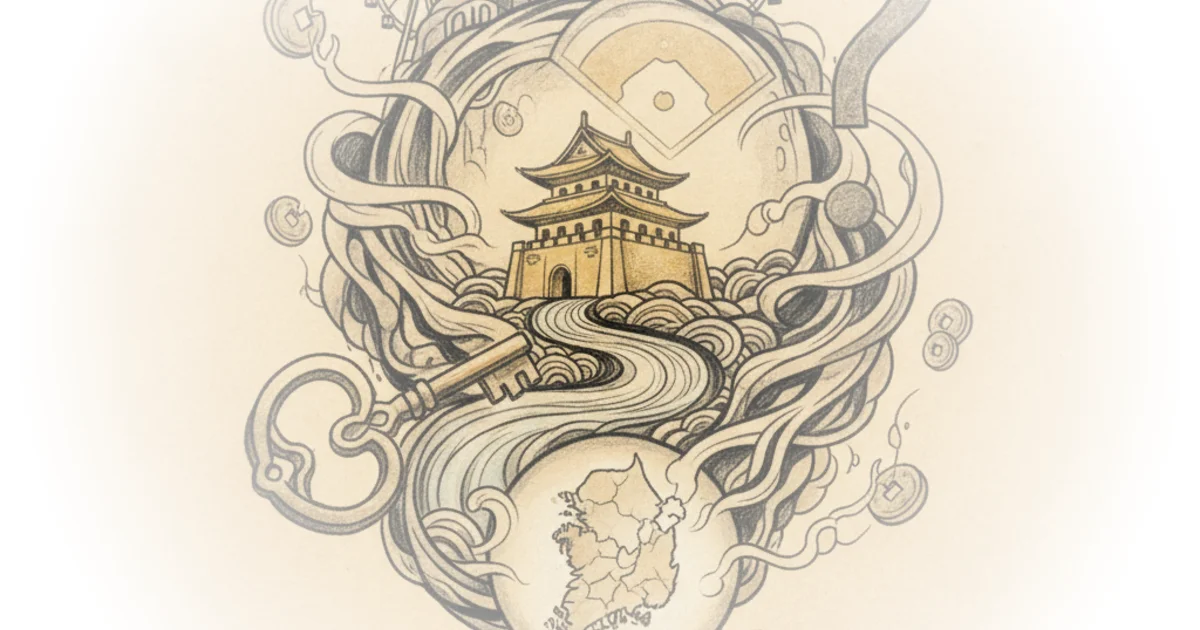
The commentary here is sharp: the author reframes the deposit not as a security bond, but as the primary engine of the transaction. "If these deposits were treated as loans, South Korea would have the largest household debt of any country on Earth," PolyMatter writes, highlighting a hidden leverage ratio that dwarfs even property-obsessed China. This framing is crucial because it forces the reader to see the deposit not as savings, but as a high-risk investment in the landlord's liquidity.
"The 0.001% probability of losing everything is the price Koreans must pay for what is effectively free rent."
This single sentence captures the existential gamble of the system. It is a rational calculation for a population priced out of traditional mortgages, yet it relies on a perpetual motion machine of housing appreciation. The author effectively argues that this arrangement is a direct consequence of historical policy choices that prioritized corporate growth over individual wealth accumulation.
The Historical Pivot
To understand why this system exists, PolyMatter traces the lineage back to the aftermath of the Korean War. The narrative is clear: the military government, seized by the need for rapid industrialization, deliberately starved individuals of capital to feed massive conglomerates. "Loans were so cheaply handed out to Korean companies and their success so heavily prioritized that they grew inconceivably huge," the author explains. This created a vacuum where families could not access bank mortgages, forcing them to rely on each other for housing finance.
The argument here is compelling because it connects macroeconomic policy to micro-level household survival. The government imposed rent control to protect tenants, but homeowners, desperate for capital, creatively bypassed these rules. "What if they thought instead of paying them money, tenants loaned them money?" PolyMatter asks, illustrating how a regulatory constraint birthed a parallel financial system. This historical context is vital; it shows that the current crisis is not an accident, but a structural feature of a development model that treated housing as a secondary concern to export-led growth.
Critics might note that the author slightly downplays the role of cultural trust in this system. While the financial mechanics are explained, the sheer scale of the practice relies on a level of social cohesion that is increasingly fraying in a modern, hyper-competitive society. The piece acknowledges this but focuses more on the economic inevitability than the social erosion.
The House of Cards
The most terrifying section of the commentary is the breakdown of what happens when the music stops. The system functions on a simple premise: as long as housing prices rise, a new tenant can pay a deposit large enough to cover the outgoing one's refund. But this creates a "house of cards" where the entire economy is leveraged against continuous appreciation. "Imagine the whole of debt you could dig for yourself if you bought two or three, never mind 2 or 300," PolyMatter warns, describing landlords who have accumulated thousands of units.
The risk is not theoretical. The author points to recent events where a landlord owning a thousand units died, leaving thousands of tenants in limbo. "When a thousand people are waiting in line, there is no guarantee everyone will be made whole," the text states. This is the systemic fragility at the heart of the story. The author argues that the system is sustained only because the alternative—paying high monthly rent while saving nothing—is perceived as worse.
"The beauty of this arrangement, one you might struggle to distinguish from a pyramid scheme, is that when one tenant moves out, a new one moves in providing the funds to repay the first."
This comparison to a pyramid scheme is the piece's most provocative claim. It is not hyperbole; the mechanics are identical. The author's analysis holds up under scrutiny: the system requires constant inflow to remain solvent. When the market corrected slightly, the fragility was exposed, leaving many landlords unable to return the deposits they had gambled away on new properties or failed businesses.
The Bottom Line
PolyMatter's analysis succeeds in demystifying a system that looks like a scam but functions as a desperate survival strategy for a generation locked out of traditional wealth-building. The strongest part of the argument is the historical linkage between state-directed corporate growth and the emergence of this high-risk household debt. The biggest vulnerability, however, is the assumption that the system can be reformed without causing a massive economic shock. If the government cracks down, millions of young Koreans lose their only path to housing; if they don't, the next market correction could be catastrophic. The reader must watch for how the administration navigates this impossible choice between stability and solvency.
"The 0.001% probability of losing everything is the price Koreans must pay for what is effectively free rent."
Bottom Line
The most powerful insight in this piece is the revelation that South Korea's "free rent" is actually a massive, unregulated transfer of household wealth to landlords, sustained only by the belief that housing prices will never fall. The argument's greatest strength is its historical grounding, showing how this system is a direct legacy of state policy that favored conglomerates over citizens. The critical vulnerability lies in the future: as the population ages and the market corrects, the question is no longer if the system will break, but how many lives will be ruined in the process.