In a cultural moment defined by moral fragmentation, Dennis Prager offers a stark, unyielding thesis: the collapse of Western civilization is not a failure of economics or policy, but a catastrophic substitution of feelings for objective values. Written from a hospital bed after a paralyzing fall, this excerpt from his upcoming book serves as a desperate, last-ditch defense of the idea that right and wrong exist independently of human emotion. It is a provocative claim that demands attention, not because it is new, but because it refuses to soften its edges for a modern audience accustomed to moral relativism.
The Shadow of History
Bari Weiss introduces Prager not merely as a conservative commentator, but as a thinker whose worldview was forged in the immediate aftermath of the Holocaust. Prager, born in 1948, carries the weight of that history as a personal preoccupation. He writes, "I was born in 1948, only three years after the Holocaust... when I was about 10, I watched a program on television, and I saw an image of Adolf Hitler." This anecdote is not just biographical filler; it is the foundational evidence for his entire argument. He asks a question that haunts the 20th century: "How did the country that gave us Beethoven, Bach, Schiller, Thomas Mann, and other unique figures in the sciences and arts also give us Auschwitz?"
The answer Prager provides is that high culture and advanced civilization are no safeguards against evil. He argues that the American tendency to dismiss such atrocities as the work of the "sick" is a dangerous naivety. "Did a massive number of Germans all of a sudden become psychologically ill?" he asks. "Were all the sadists who worked in the concentration camps sick?" This framing forces the reader to confront the banality of evil, suggesting that ordinary people, guided by the wrong values, can orchestrate genocide. The historical context here is potent; Prager implies that the moral vacuum left by the rejection of divine authority allowed the machinery of the death camps to function not as a glitch, but as a logical outcome of a society that prioritized the will of the state over the sanctity of life.
The Dog and the Stranger
The core of Prager's argument rests on a thought experiment that strips away social niceties to reveal the conflict between instinct and principle. He describes a scenario where a person must choose between saving their drowning dog or a drowning stranger. "If your inclination is to save your dog, that means you were animated by feelings," he asserts. "But the whole point of values is to hold that something is more important than your feelings."
This is where Prager's logic becomes most rigorous, and perhaps most contentious. He posits that human life is sacred because humans are created in God's image, whereas animal life is not. "You should save the stranger," he concludes, citing the Bible as the source of this hierarchy. The argument is effective in its clarity: it exposes the flaw in a morality based solely on affection. If we act only on what we love, we abandon those we do not know. However, critics might note that this binary ignores the complexity of human attachment and the psychological reality that empathy often drives moral action more effectively than abstract duty. Yet, Prager's point stands: without an external standard, our deepest affections can lead us to neglect the greater good.
Feelings measure your actions against nothing at all. Values measure your actions against an ultimate authority.
Prager extends this critique to the modern classroom, recounting a visit to high schools in Cleveland where students admitted they would shoplift if they could get away with it. When pressed on why this was wrong, they replied that "everything is a matter of opinion." Prager identifies this as the "great moral tragedy of our time." He argues that when morality is reduced to personal opinion, society loses its ability to condemn clear evils. He draws a parallel to history, noting that "Hitler felt that Jews should be destroyed" and that white supremacists in South Africa "felt that apartheid was right." The lesson is brutal: feelings cannot determine right and wrong because feelings are often the very engine of atrocity.
The Fragility of Secular Ethics
The most controversial section of the piece is Prager's assertion that secular ethics are doomed to fail. He uses the metaphor of cut flowers: "Ethics cut off from their biblical roots are like flowers cut off from their roots in the soil." He argues that while secular institutions like universities may produce the appearance of morality, they lack the deep roots necessary for long-term survival. "Goodness without God isn't as strong as goodness with God," he states plainly.
This is a direct challenge to the Enlightenment project, which sought to ground morality in reason rather than revelation. Prager contends that attempts to teach values without reference to God have been a "moral and intellectual failure." He points to the rise of "multiculturalism, moral relativism, opposition to capitalism, virulent anti-Americanism" in universities as evidence of this decay. While this framing resonates with those who feel alienated by modern academic trends, it overlooks the robust ethical frameworks developed by secular humanists throughout history. A counterargument worth considering is that many of the world's most enduring moral advancements, such as the abolition of slavery and the civil rights movement, were driven by a mix of religious conviction and secular philosophical reasoning, not solely by biblical mandates.
Nevertheless, Prager's warning is urgent. He suggests that without an "ultimate authority," the only remaining guide is the self. "If you feel like shoplifting and act on your feelings, you'll shoplift," he writes. "If a man is sexually aroused by a woman, he will rape her." The implication is that the only thing stopping such behavior is the internalization of a code that transcends the individual. He illustrates this with a story of a mother who, after her son pushes another child, comforts her own child rather than correcting the behavior, effectively teaching him that "Your feelings are more important than right and wrong."
Bottom Line
Prager's argument is a powerful, if polarizing, defense of objective morality in an age of subjective truth. Its greatest strength lies in its refusal to compromise: it forces the reader to acknowledge that feelings, while human, are an unreliable compass for ethical behavior. However, its biggest vulnerability is the assumption that only a divine authority can sustain a moral society, a claim that ignores the resilience of secular ethical traditions. As the West grapples with rising polarization and a crisis of meaning, Prager's call to return to a higher standard of right and wrong offers a clear, albeit demanding, path forward.
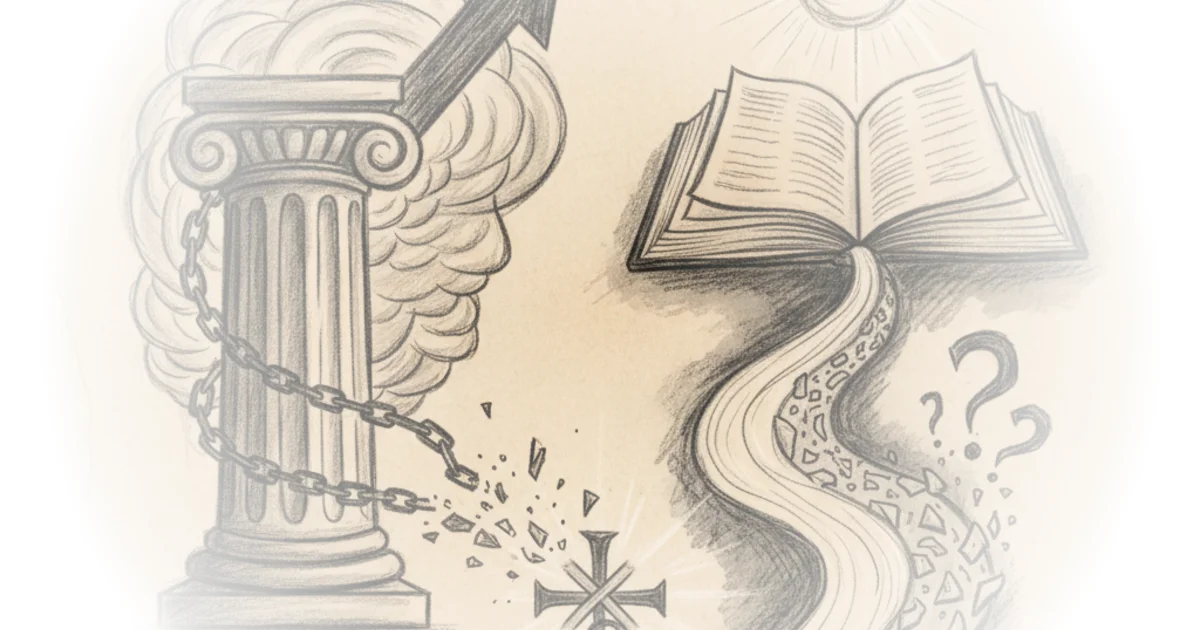
The battle in America and the rest of the Western world today is between the Bible and the heart.