In a landscape dominated by protectionist rhetoric, Noah Smith makes a startlingly counterintuitive claim: the United States should immediately lower barriers to allow Chinese electric vehicles into its market. This is not a plea for open borders, but a strategic argument that shielding domestic industry from competition is actually accelerating its decline. Smith brings a rare synthesis of industrial policy and consumer reality to the table, arguing that the current U.S. stance risks creating a technological orphanage for American manufacturing.
The Strategic Paradox
Smith begins by acknowledging his own consistency as a hawk on China, noting that he has "repeatedly praised the U.S. export controls that stop China from buying American chips and chipmaking equipment." Yet, he pivots sharply to argue that the blanket ban on Chinese cars is a mistake. The catalyst for this shift is Canada's recent decision to slash tariffs on Chinese EVs from 100% to 6.1% in exchange for investment and agricultural access. Smith observes that this move highlights a geopolitical fracture: "Trump's bullying tactics often produce unintended consequences," pushing allies like Canada to reorient toward Beijing when the U.S. becomes too unpredictable.
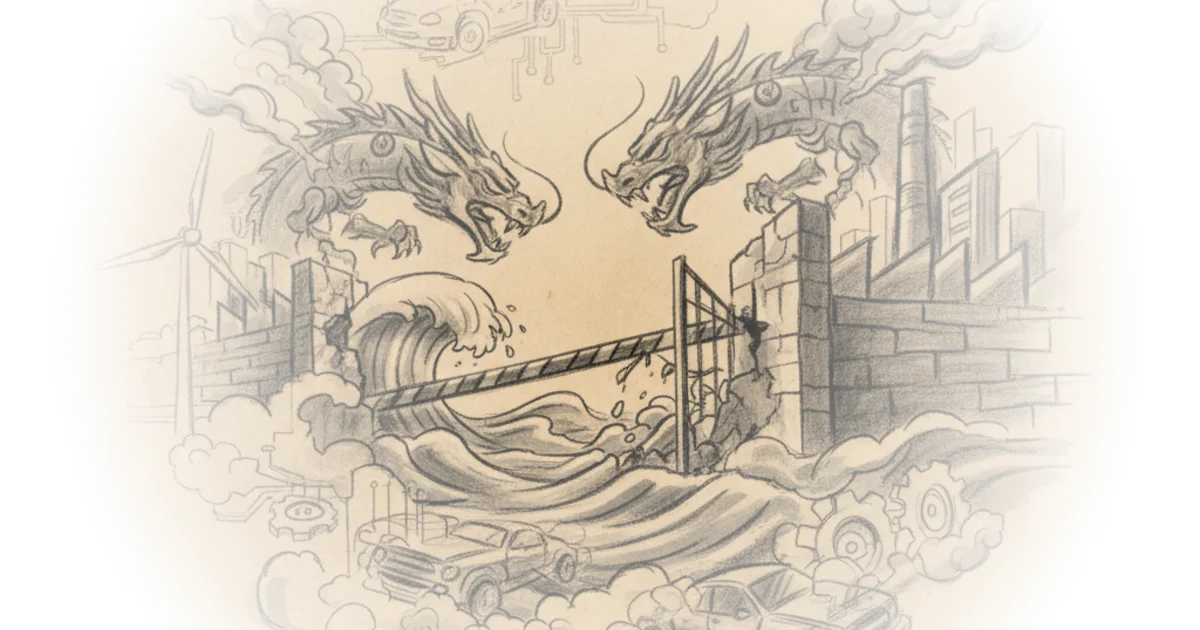
The core of Smith's argument is that the U.S. is suffering from a self-inflicted stall in the transition to electric mobility. He points out that "the transition to EVs has stalled" in America, driven by the removal of subsidies and the unpopularity of dominant players like Tesla. Meanwhile, traditional giants are retreating. "Ford Motor Co. announced $19.5 billion in charges tied to the retreat from an electric strategy," while General Motors has incurred billions in charges to pare back production. Smith warns that if the U.S. continues to drive combustion cars while the world switches, "American automotive technology will be orphaned from the rest of the world." This phenomenon, known as "Galapagos syndrome," threatens to isolate U.S. automakers to a shrinking domestic market.
"A country that has no electric supply chain will lose an increasing number of manufacturing industries as more and more devices switch to the Electric Tech Stack."
Critics might argue that allowing cheap, subsidized foreign goods undermines domestic workers and national security. Smith counters that the alternative is a "long slow death" for Detroit, where companies cling to obsolete technology rather than innovating. He suggests that the U.S. should follow Canada's lead but with stricter conditions: slashing tariffs while demanding firm commitments to local sourcing and joint ventures.
The Quality and Cost Reality
The most persuasive part of Smith's coverage is his dismissal of the idea that American consumers would reject Chinese vehicles. He argues that the narrative of inferior quality is outdated. "Chinese EVs are very cheap... but partly because China has essentially the entire EV supply-chain in-country, and has attained massive scale." He cites reviews from major outlets to prove that these vehicles are not just affordable, but technologically superior in many aspects. Quoting a review of the Xiaomi SU7 Max, Smith highlights features that feel futuristic compared to American counterparts: "Navigation directions don't kill the music. They come through speakers in the driver's seat headrest, while the song or podcast keeps playing everywhere else."
Smith emphasizes that the user experience is a game-changer. The car "sails along smoothly and quietly while somehow feeling sportier than my Mustang Mach-E," and offers a range that "exceeded my expectations." He notes that even in cold weather, the battery performance was robust. This evidence challenges the assumption that American buyers are loyal to domestic brands regardless of quality. Smith argues that "people who try these cheap, high-quality cars often see the light and switch," similar to how Japanese compact cars gained a foothold in the 1970s and 80s.
The argument here is that competition is the only thing that will force U.S. automakers to wake up. Smith draws on historical data from the "First China Shock" to show that while imports hurt profits, they also "led to increases in R&D, patenting, IT and TFP within firms." He writes, "Without competition, U.S. automakers are likely to simply throw in the towel when faced with initial difficulties." The presence of Chinese EVs would make it impossible for Ford or GM to retreat to gas-powered comfort zones without losing significant market share.
Building the Ecosystem
Beyond forcing competition, Smith argues that importing these vehicles is essential for building the broader "Electric Tech Stack." Batteries and electric motors are not just for cars; they are critical for drones, robotics, and future military hardware. "Currently, the U.S. can't build many batteries or motors; if this situation continues, American military power will wither." By creating a massive demand for these components through EV sales, the U.S. can drive down costs for the entire manufacturing sector.
Smith envisions a future where the initial import of Chinese cars leads to local production. "As U.S. companies leveraged their proximity advantage to cancel out China's price advantages, BYD and Xiaomi and the other big Chinese automakers would start building factories in America." He compares this to the Japanese automakers who, after trade friction in the late 80s, "went all-in on building factories in America." The goal is to use the Chinese supply chain's efficiency to jumpstart a domestic ecosystem that is currently stagnant.
"Chinese EVs could be just the thing to save Detroit from its own short-termism, the way Japanese compact cars were in the 1980s."
A counterargument worth considering is the risk of espionage and sabotage in connected vehicles, a concern Smith acknowledges but believes can be mitigated through software firewalls and hardware isolation. However, the speed at which these vehicles integrate with digital ecosystems makes this a persistent vulnerability that requires robust, ongoing regulation.
Bottom Line
Noah Smith's strongest move is reframing the import of Chinese EVs not as a concession to a rival, but as a survival mechanism for American industry. His argument holds water because it exposes the fragility of a protectionist strategy that allows domestic giants to stagnate. The biggest vulnerability remains the political difficulty of admitting that foreign competition is necessary to save local jobs, a tension that may prove insurmountable regardless of the economic logic. Readers should watch to see if the U.S. can adopt a "Canada-style" targeted deal that balances openness with strict local content requirements before the domestic auto sector becomes truly obsolete.