Sabine Hossenfelder, a physicist known for demystifying complex science, delivers a stark pivot in her latest analysis: the scientific community may be dangerously underestimating how fast the planet will heat up. While public discourse often fixates on the existence of climate change, Hossenfelder zeroes in on a specific, technical debate about "climate sensitivity" that could render current global policy plans obsolete within two decades. She argues that the very models dismissed as outliers might actually be the most accurate predictors of a future where economic collapse and mass migration are not possibilities, but inevitabilities.
The "Hot Models" Dilemma
Hossenfelder begins by acknowledging the fatigue many feel regarding climate reporting, noting that her own videos on the topic are disproportionately disliked. "I get it and I'd rather just talk about some fun new physics stuff but I feel like I need to tell you about this because the lives of hundreds of millions of people depend on it." This admission sets a somber tone, shifting the focus from political debate to the raw mechanics of the atmosphere. The core of her argument rests on a single metric: Equilibrium Climate Sensitivity (ECS), which measures how much the Earth warms if atmospheric carbon dioxide doubles.
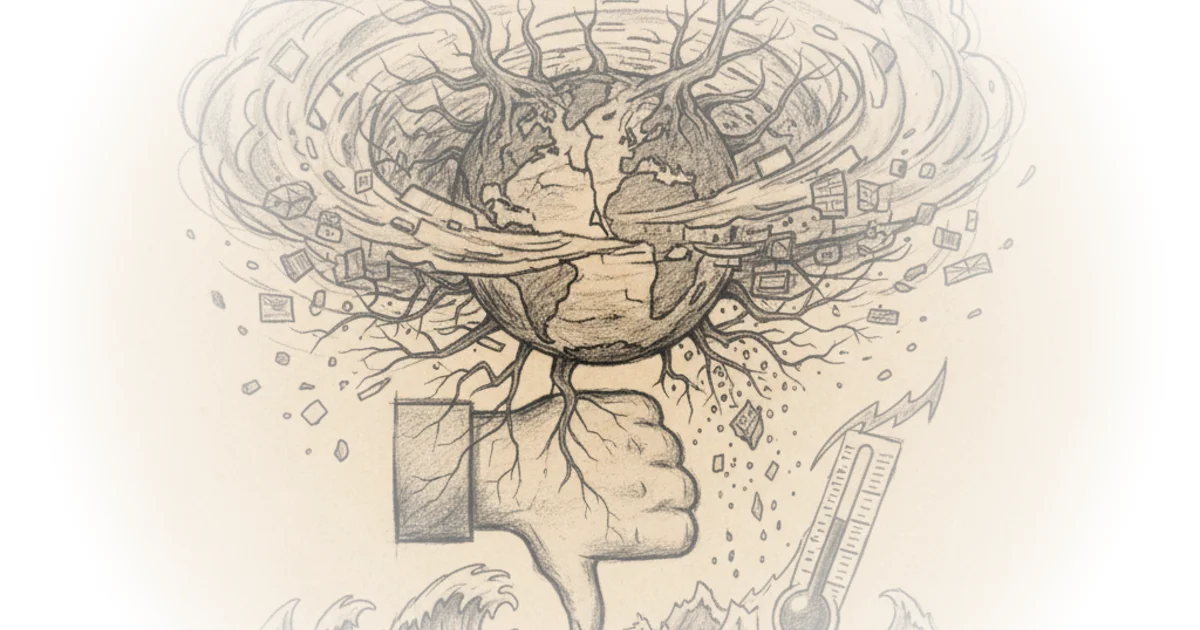
For years, the scientific consensus, as reflected in reports from the Intergovernmental Panel on Climate Change (IPCC), placed this sensitivity between 2 and 4.5 degrees Celsius. However, Hossenfelder points out a disturbing anomaly in the 2019 model assessment where ten out of fifty-five sophisticated models predicted a sensitivity exceeding 5 degrees. "If this number was correct it would basically mean that the situation on our planet would go to hell twice as fast as we expected." The scientific establishment largely rejected these "hot models," assuming they were flawed because they didn't align with historical data from millions of years ago.
The argument from historical data therefore climate scientists must assume that a model that is good for clouds in the current climate was also good for clouds back then under possibly very different circumstances without any direct data to check that seems to me a very big if.
This reliance on paleoclimate data is where Hossenfelder's critique bites hardest. She highlights a critical gap: we have no direct observations of cloud behavior from a million years ago. The assumption that cloud physics have remained constant over geological time is a massive leap of faith. When she notes that "the dinosaurs forgot to back up their satellite images," she is using dry humor to expose a fundamental weakness in the methodology used to dismiss the alarming models. Critics might argue that paleoclimate proxies, while imperfect, are the best evidence we have, and that discarding them for short-term data is risky. However, Hossenfelder suggests that ignoring the models that fit our current reality is a far greater error.
A Test of Reality
The piece gains significant traction when Hossenfelder introduces a real-world test. She describes how the UK Met Office used one of these "hot models" to generate a six-hour weather forecast. The result was unexpected: the model with the higher climate sensitivity predicted the weather more accurately than the older, cooler version. "They found that the newer model the hotter one gave the better forecast." This is a crucial distinction; it wasn't just a theoretical exercise but a demonstration that the model better captured the immediate physical processes of the atmosphere.
Hossenfelder emphasizes that this finding has been largely ignored, citing a paper by Jim Hansen that re-analyzed historical data and found it compatible with the higher sensitivity range. "I don't know who's right or wrong but for me the bottom line is that the possibility of a high climate sensitivity above 5° C can't be easily dismissed especially not seeing how fast average temperatures have been rising in recent years." The silence on this front is baffling to her, especially given the stakes. She notes that the paper detailing this potential reality has been cited only a handful of times, suggesting a collective unwillingness to confront the worst-case scenario.
The Human Cost of a Technical Error
The commentary shifts from the abstract to the visceral as Hossenfelder outlines the consequences of a high climate sensitivity. If the models are right, the window for effective action is closing rapidly. "We have maybe 20 years or so until our economies collapse." This timeline transforms the issue from a long-term environmental challenge into an immediate existential threat to global stability.
She details a cascade of failures: crop yields collapsing in equatorial regions like Central Africa and India, leading to famine. "In many countries around the equator crop yield will substantially drop this will most affect countries that are already prone to famine and at the same time some of the poorest countries in the world will be hit very hard by heat waves and drought." The solution of simply turning up the air conditioning is dismissed as a fantasy for the world's most vulnerable populations.
The lives of all people on this planet depend on an obscure discussion about the properties of super cool old water droplets in a type of cloud whose name I can't even remember.
This observation captures the absurdity of the situation: the fate of billions hinges on the physics of supercooled water droplets in clouds. The failure to resolve this technical detail has profound geopolitical implications. Hossenfelder predicts that as these regions become uninhabitable, hundreds of millions will migrate north, creating immense pressure on borders in Europe, Russia, and Mexico. The resulting tension could spark conflicts, with "someone somewhere will make a lot of money by selling weapons." Furthermore, the disruption of ecosystems and mass displacement could trigger new pandemics.
Bottom Line
Sabine Hossenfelder's most compelling contribution is her willingness to challenge the scientific consensus when the data suggests a more dire reality than the comfortable middle ground. Her argument that the "hot models" may be correct because they better predict current weather patterns is a powerful, if unsettling, piece of evidence. The biggest vulnerability in the prevailing view she critiques is the over-reliance on historical data that lacks direct cloud observations. The reader must watch for whether the scientific community will finally confront the possibility that the climate is more sensitive than previously thought, or if the "hot models" will continue to be marginalized until the consequences are undeniable.
If the climate sensitivity is indeed that high then we have maybe 20 years or so until our economies collapse and what's the point of being successful on YouTube if my pension savings will evaporate before I even retire.