Friendship as Theology
Megan Armknecht's essay for Wayfare's "Light Notes" column opens with a scene so ordinary it could belong to anyone: a lonely third-grader gets invited to play four-square at recess. From that small moment, Armknecht builds an argument that friendship is not merely a social convenience but a theological imperative -- one that the Latter-day Saint tradition takes more seriously than most Christian denominations, and one that the modern world has quietly hollowed out.
The essay's central claim rests on a bold declaration from Joseph Smith, delivered in 1843 along the Mississippi River.
Friendship is one of the grand fundamental principles of Mormonism.
Armknecht treats this not as a platitude but as a doctrinal statement with real consequences for how believers should organize their lives. The word "fundamental" does heavy lifting here -- it places friendship alongside faith, repentance, and covenant-making in the architecture of Mormon theology. Whether that placement is warranted is a question the essay raises more than it answers, but the ambition of the claim is worth taking seriously.
The Sacred and the Mundane
One of the essay's strongest moves is its insistence that holiness and ordinariness are not opposites. Armknecht draws a line from Joseph Smith's First Vision -- a farm boy encountering God -- through the founding revelations received in unremarkable upstate New York towns, to the blacktop of an elementary school playground. The implication is that friendship, like revelation, can arrive without fanfare.
Even Joseph Smith's description of friendship as "grand" and "fundamental" seems to pair these two adjectives -- which can mean opposite things -- as friends.
This is a genuinely clever observation. "Grand" suggests elevation; "fundamental" suggests a foundation, something buried and load-bearing. The two words pull in opposite directions, and Armknecht reads that tension as itself enacting the principle she is describing -- the union of unlike things through mutual regard.
The theology here is more suggestive than systematic, and that is both a strength and a limitation. Armknecht is writing a personal essay, not a treatise, and the devotional register gives her freedom to make associative leaps that a more rigorous argument would have to earn. The connection between playground four-square and divine love is emotionally persuasive but logically thin. The essay trusts the reader to feel the continuity rather than demanding proof of it.
Friendship in an Age of Algorithms
Armknecht is at her most pointed when she turns to the contemporary degradation of friendship. She identifies a cluster of forces working against deep human connection: social media reducing relationships to button clicks, algorithms mediating human contact, hypermobility disrupting the sustained proximity that friendship requires, and a culture of individualism that treats self-sufficiency as a virtue.
Friends are "added" by the click of the button, human relationships are reduced to algorithms, hypermobility disrupts emotional and physical intimacy, and individuality is prioritized over symbiotic social bonds.
This diagnosis is familiar -- it echoes concerns raised by everyone from Sherry Turkle to Robert Putnam -- but Armknecht frames it in distinctly theological terms. The desaturation of friendship is not just a sociological problem; it is a spiritual one. If friendship is truly a "grand fundamental principle," then its erosion represents a kind of apostasy, a falling away from something essential.
A counterpoint worth raising: the essay's nostalgia for a richer era of friendship may be partly illusory. Historians of emotion have argued that every generation perceives the bonds of the previous generation as deeper and more authentic. The lament "how do I make friends as an adult?" is not unique to the smartphone age; it appears in advice columns from the 1950s and personal correspondence from the 19th century. Loneliness may be a permanent feature of the human condition rather than a modern innovation, which would complicate Armknecht's implied narrative of decline.
Faith as Friendship's Engine
The essay's most theologically interesting section redefines faithfulness in the context of friendship. Armknecht distinguishes between faithfulness as loyalty -- sticking with someone through difficulty -- and faithfulness as being "filled with faith," meaning a willingness to enter relationships without knowing how they will end.
Friendship, like faith, cannot be forced. This means there will be unpredictability and risk. The riskiness of friendship means that there have been (and will be) periods of loneliness.
This is a mature and honest acknowledgment that friendship does not guarantee happiness. The essay does not promise that faithfulness will be rewarded with permanence. Friends move, relationships cool, people change. Armknecht's own life as a military or diplomatic spouse -- her husband's job takes the family "around the world" -- gives her a lived understanding of this impermanence. She cycles through friendships not because she wants to but because geography demands it.
The theological move here is to frame that impermanence not as failure but as an inherent feature of mortal friendship. The eternal dimension, in Latter-day Saint thought, is where the welding happens. Armknecht invokes Joseph Smith's metaphor of friendship as iron welded to iron -- a bond forged under heat and pressure that outlasts the circumstances of its making.
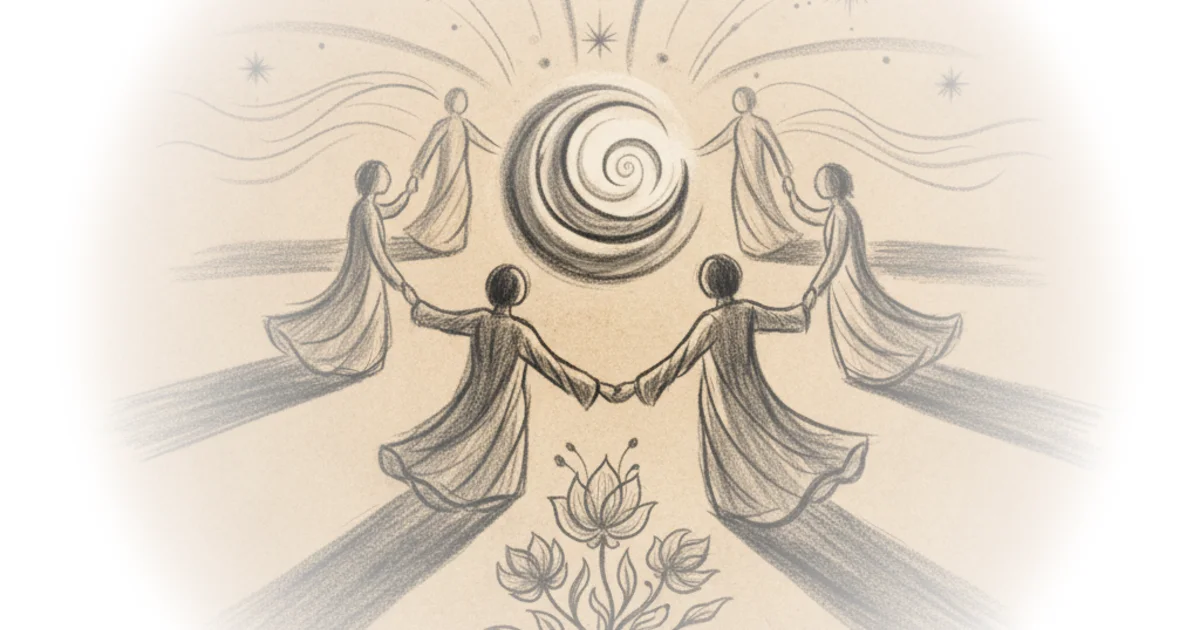
As friends, we come together as equals, as iron and iron, made of the same elements of divinity, mud, salt, and hope, as we strengthen each other and whatever communities we find ourselves within.
The phrase "divinity, mud, salt, and hope" is the essay's finest piece of prose. It captures the Latter-day Saint anthropology -- humans as literal children of God who are also thoroughly embodied, earthbound, and incomplete -- in four words.
What the Essay Leaves Unexamined
For all its warmth, the essay sidesteps some harder questions about friendship. It does not address the power dynamics that can corrupt friendships, the way shared religious community can make friendships coercive as well as sustaining, or the particular challenges faced by people whose identities put them at odds with their faith community. In a tradition that has sometimes struggled with inclusion, the claim that friendship is a "grand fundamental principle" invites scrutiny about who gets included in that circle.
The essay also leans heavily on Christ's statement that "ye are my friends, if ye do whatsoever I command you," without interrogating the conditional structure of that offer. Friendship contingent on obedience is a different thing from friendship freely given. Armknecht reads the passage as an invitation; it can also be read as a transaction. The tension between those readings is worth more attention than the essay gives it.
Finally, the essay's concluding vision -- a cascade of remembered friendships in Cambridge, Ukraine, Provo, and a medieval university town -- is lyrically beautiful but risks aestheticizing friendship in a way that obscures its difficulty. The hard work of friendship, which Armknecht acknowledges earlier, recedes behind a montage of golden moments. Real friendship is also boring Tuesday evenings and unreturned phone calls, and an essay that wants to elevate friendship to a theological principle might benefit from sitting with that ordinariness a bit longer.
Bottom Line
Armknecht's essay is a genuinely felt meditation on friendship as a spiritual discipline, grounded in Latter-day Saint theology but speaking to a universal hunger for deep human connection. Its strongest contribution is the insistence that friendship is not a secondary relationship -- not a consolation prize for those without romantic love or family -- but a primary form of sacred bond. The writing is warm without being sentimental, and the theological claims, while underdeveloped, are provocative enough to reward further thought. The essay works best as an invitation, which is fitting: like the four-square game that started it all, it asks the reader to step into the circle and see what happens.