Pitch:
In 1894, a small island nation with a population of barely thirty million people crushed the ancient civilization that had dominated Asia for millennia—and then did the same to one of Europe's great powers. What drove this reversal? And why does it matter today as China rises again?
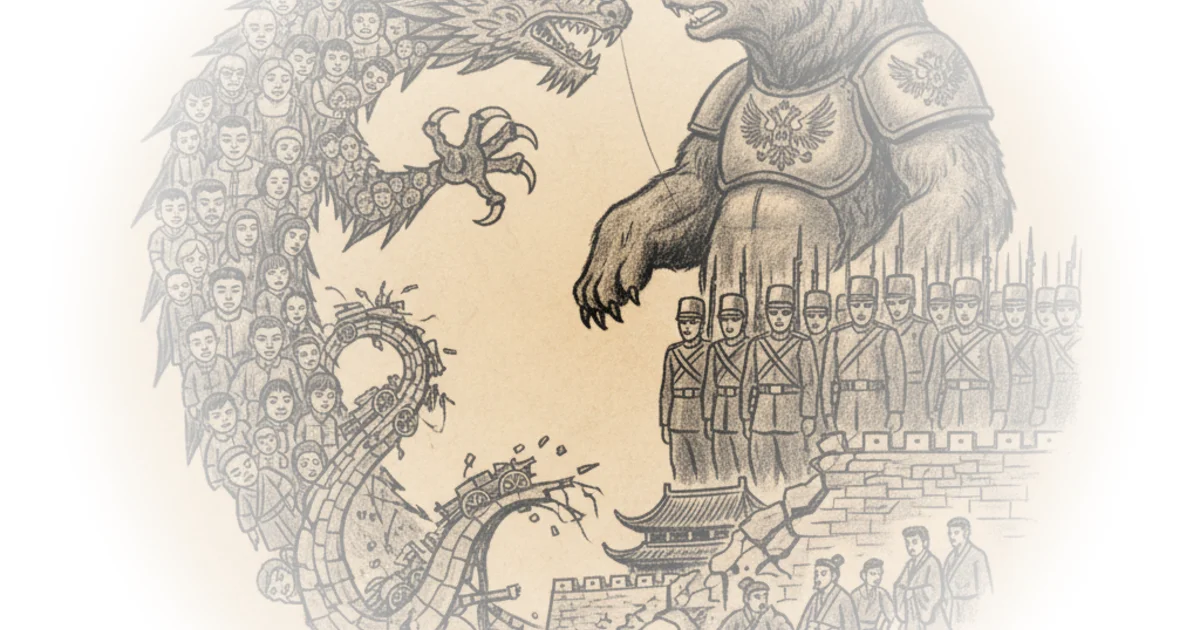
Dwarkesh Patel argues that Japan's transformation wasn't accidental—it was a deliberate strategy born from watching China's humiliations at the hands of Western powers, and executed with surgical precision.
The Meiji Transformation
By the mid-nineteenth century, the Industrial Revolution had reached Asia. It was profoundly disruptive to traditional societies whose old ways of organizing defense no longer worked against modern weaponry. Traditional economies remained stable, but compounding economic growth created stark differences between those who industrialized and those who didn't.
Japan watched neighboring China suffer defeats by Western powers—and realized they might be next.
The United States, Britain, and France did unto Japan what they had done to China: the treaty port system. Trade would occur in designated ports where Western citizens operated under their own laws, not Japanese or Chinese law. Both nations lost sovereignty. But unlike China—which continued fighting these wars with no success—Japan took a different approach.
In 1871, Japan sent the famous Wakaur mission abroad to study not just military institutions but an entire array of political, economic, legal, and social systems that underpinned Western power.
They observed Otto von Bismarck transforming Prussia from Europe's weakest great power into second only to Britain through three wars. The Japanese saw a model: unify the fragmented feudal domains into a modern nation-state.
Why Japan Won
Patel identifies three deliberate decisions by Tokyo that reversed Asia's balance of power:
First: Japan's leaders westernized their institutions—not just military technology, but everything from education to legal systems. They concluded that importing state-of-the-art technology without adopting Western institutions was impossible. The Meiji Reforms (1869-1890) dismantled the feudal domains at the top and built compulsory elementary education at the bottom. They created a central bank, a cabinet, professional civil service, a constitution, and courts modeled on Western systems.
Second: Japan integrated multiple instruments of national power—military, economic, diplomatic—into a coherent strategy. This wasn't just building warships; it was building an industrial base, a modern education system, and diplomatic leverage simultaneously.
Third: In the Russo-Japanese War (1904-1905), Japan quit at exactly the right moment: the culminating point of victory to extract maximum gains. If Russia had continued fighting, its vast reserves of troops could have overwhelmed Japan's collapsing supply lines.
The result was immediate. Britain—the precedent setter for unequal treaties—renegotiated with Japan on the basis of equality in 1894. Other powers followed. Japan achieved this a half-century before China managed to rid itself of similar treaties.
The Reversal
Before Japan defeated China in the First Sino-Japanese War, China believed it was the sole civilization—the dominant power in Asia. Its institutions were imitated throughout the East. It was the richest country on the planet for centuries.
When Japan crushed China in 1894-95, it detonated the Confucian underpinnings of Chinese civilization. The Chinese could dismiss European defeats as irrelevant to them. But when Japan did it—this island nation they had looked down upon—the psychological impact was devastating. China has been searching for a suitable replacement ever since. For a while, they thought it was communism.
"Japan defeated Qing China not through ancient samurai traditions but by deliberately adopting Western institutions—and then executing the strategy with precision timing."
Counterarguments
Critics might note that reducing complex civilizational shifts to institutional decisions underestimates cultural and psychological factors. The humiliation of losing to a smaller nation that had been a vassal state for centuries created wounds that modern scholarship suggests went far beyond institutional reform.
Another counterargument: attributing success solely to Tokyo's "clever decisions" overlooks the role of chance, timing, and the particular weaknesses of both Tsarist Russia and Qing China during these periods. Both adversaries were simultaneously declining in ways that made Japan's victories possible regardless of strategy.
Bottom Line
Patel's core argument—that Japan reversed Asia's balance of power through deliberate westernization and strategic timing—holds up well against historical evidence. The Meiji transformations really did transform Japan into the first non-Western modern power, and the Russo-Japanese War demonstrated this on the world stage.
The strongest part of this thesis is its specificity: rather than offering vague explanations about "cultural superiority," it names exact institutional choices made in Tokyo between 1869 and 1890. The biggest vulnerability is that it leans toward monocausal explanation—suggestesting institutional reform alone caused the reversal without fully accounting for the simultaneous decline of both China and Russia during this period.
What emerges from the author's analysis is a question that's become urgently relevant today: as China rises again, we should ask what lessons Japan might teach about deliberate transformation—and whether history is repeating itself.