Freddie deBoer makes a claim that cuts against the dominant tech narrative: the Singularity isn't coming — it already happened, and you missed it. The revolution you're waiting for is over. This is not a piece about AI timelines or chip speeds. It's about the gap between what we call progress and what actually keeps people alive.
The Long Boring
DeBoer opens with Katherine Dee's declaration that she typed from an iPhone while looking at 3D renderings of her unborn children. "And, you know, that's cool," he writes. Then he pivots: "But it's still clearly the case that dramatically reduced infant mortality, in the developed world, is not an achievement of the digital age; all of the heavy lifting was accomplished before most of us were born."
This is the piece's central move — reframing progress through metrics that matter rather than metrics that sell. Infant mortality fell from 100 per 1,000 in 1900 to 30 in 1950, to 20 in 1970, to less than 6 today. The entire 1995–2024 window is "the nearly flat tail-end of a transformation that was essentially complete before the 'digital revolution' began." The argument lands because it forces a comparison most tech discourse avoids: what actually saves lives versus what captures attention.
DeBoer names the magic window: 1870ish to 1970ish. "The heavy lifting, the core development and progress in sanitation, antibiotics, pasteurization, hospital births, happened far earlier." Here the piece could invoke its companion deep dives — pasteurization's impact on infant survival, Gordon Moore's transistor scaling that enabled the refinement culture he critiques. These aren't summaries; they're anchors. Pasteurization alone transformed milk from a leading cause of infant death to a safe staple by the 1920s. That's the kind of progress that doesn't get a keynote.
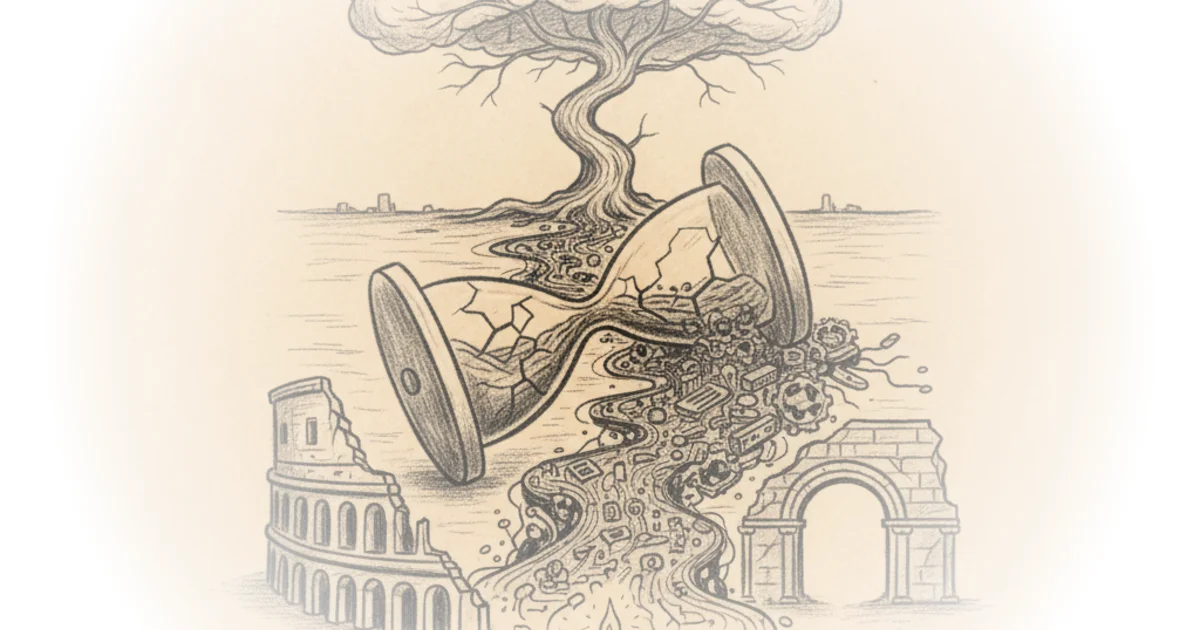
A person transported from 1926 to 1976 would find the world nearly unrecognizable. A person transported from 1976 to 2026 would find it, after some orientation, quite familiar.
This sentence carries the weight of the whole argument. Cars go to the same places. planes aren't faster. houses are built the same way. people still die of cancer. The contrast is stark, and it's effective because it's concrete.
Refinement Culture
DeBoer treats smartphones as the epitome of refinement, not invention. "Telephones were more than 130 years old when the iPhone was first released, portable telephones 35 years old. Portable televisions were first available in the 1950s. The first portable GPS (or GPS-like) product was released in the 1980s; the first portable camera a hundred years before that." The components existed; the integration improved.
This framing is useful because it separates genuine invention from iterative optimization. But critics might note that integration itself can be transformative — the smartphone didn't just combine existing technologies; it created new social and economic structures. DeBoer acknowledges this partially but doesn't fully engage with how network effects change the equation.
"What modern invention would you really take over indoor plumbing, or pain killing medication, or the airplane?" he asks. "I think any honest person would have to say, none of it. No, you would not trade food refrigeration for TikTok. No, you would not trade routine handwashing as a mass phenomenon for the OLED TV. And no, you would not trade the EKG for ChatGPT." The rhetorical force here is strong because it appeals to lived experience rather than speculative futures.
Bits Are Easy, Atoms Are Hard
The piece's sharpest section addresses LLMs directly. "The most telling thing about the LLM moment is what this technology is actually good at. LLMs write code, generate images, produce music, summarize documents, draft prose… which is to say, they have achieved mastery over the exact domains that were already, by any sane measure, overprovisioned." This is the core critique: AI creates abundance in domains where abundance already existed.
"The scarcity that these tools have abolished, in other words, was not a scarcity anyone was actually suffering from. We did not need more 'content'; we did not need to produce digital entertainments at a faster pace. We needed (and still need) cheaper energy, more housing, better cancer treatments, functional mass transit, and a replacement for the internal combustion engine people actually want to use." The list is specific and material. It's also a political statement about what kind of innovation society should prioritize.
DeBoer names the barrier explicitly: "Code cannot insulate your house; no algorithm has ever laid a water pipe; the internet has not built a single mile of high-speed rail." This is the bits-versus-atoms problem in its starkest form. The digital revolution produced real gains within its own domain, but it never breached the membrane between virtual and physical. LLMs show no signs of doing so either.
A counterargument worth considering: Claude Code has genuinely transformed how programmers write software, and software increasingly controls physical systems — from manufacturing to logistics to energy grids. The membrane may be thinner than deBoer suggests. But his point remains: the biggest technological lessons of the 21st century are about the limits of code.
The Promissory Theology
DeBoer reserves his sharpest language for the grander promises. "Curing cancer, cracking fusion, colonizing Mars, achieving material abundance through AI-directed science" function less as predictions than as "a kind of promissory theology, perpetually redeemable but never redeemed." The phrase is cutting because it names the faith-based quality of tech maximalism without mocking it.
"Your Sam Altman and Dario Amodei are circus barkers whose net worth is directly dependent on getting you to believe their spiel," he writes, then adds: "So many people talk about this stuff through the argot of the 21st century, defensive irony and jokiness, that I'm not sure if people really believe they're going to be running their own private asteroid mine in five years or not." The observation about discourse style is acute — the jokiness makes it hard to parse sincerity, which protects the claims from scrutiny.
Bottom Line
DeBoer's strongest argument is the material one: infant mortality, workplace safety, indoor plumbing, electrification — these are the achievements that transformed human life, and they happened before the digital age. The evidence is clear, and the framing forces a comparison that tech optimism usually avoids. The biggest vulnerability is strategic: deBoer doesn't fully engage with how digital tools might eventually enable atomic progress — software-driven manufacturing, AI-assisted drug discovery, grid optimization. That gap matters because it leaves the piece's critique incomplete. What readers should watch for: whether the next wave of innovation actually bridges bits and atoms, or whether the stagnation in material progress continues despite the AI boom.