Most histories of political Islam begin with theology; Shirvan Neftchi begins with geography and the stark visual of a divided city. By anchoring the rise of the Muslim Brotherhood in the physical segregation of the Suez Canal zone, Neftchi reframes a global ideological movement not as an abstract religious resurgence, but as a visceral reaction to the humiliation of colonial modernity. This is a crucial distinction for understanding why the movement resonated so deeply with the Egyptian working class, transforming a schoolhouse into a political powerhouse.
The Geography of Humiliation
Neftchi's central thesis rests on the material conditions of early 20th-century Egypt. He argues that the Brotherhood was born from the friction between two parallel worlds existing side-by-side. "From the perspective of the Europeans, their activities were not out of the ordinary... but from the point of view of the local Muslim communities, they were under siege by European civilization," Neftchi writes. This framing effectively shifts the narrative from a clash of civilizations to a clash of lived experiences. The author details how the construction of the Suez Canal created a "unique communal situation" where European towns offered luxury and theaters, while adjacent Egyptian towns drowned in poverty and unemployment.
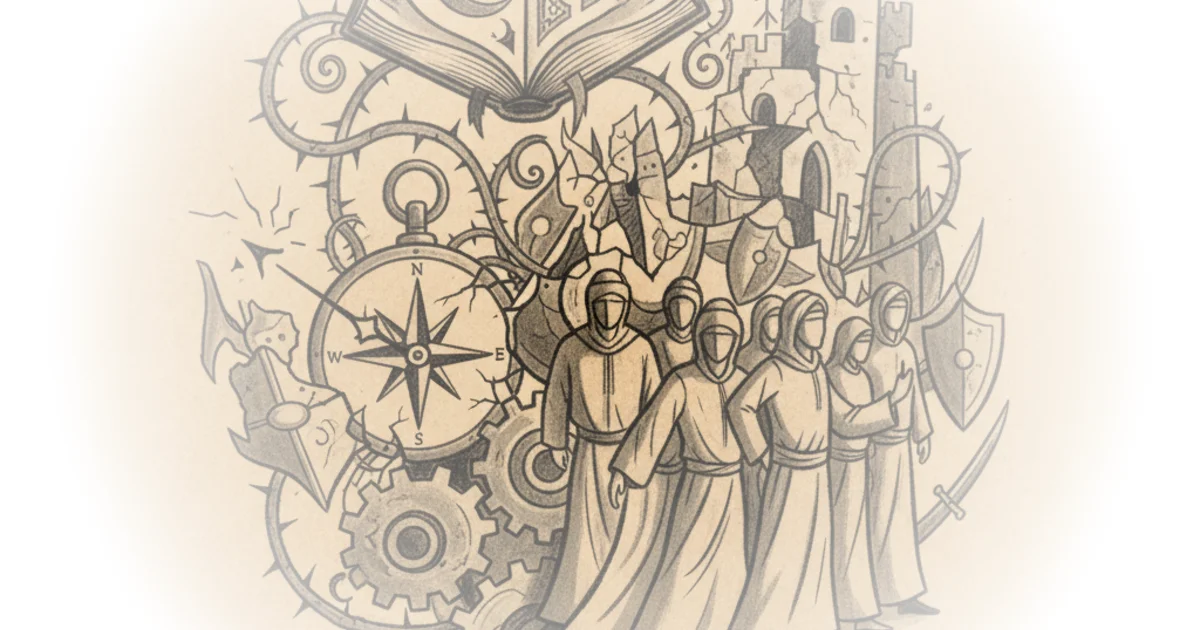
The author suggests that this spatial inequality was the catalyst for ideological radicalization. Neftchi notes that for many Egyptians, the only escape from this desolation was to "assimilate in either French or English," a process that came at the cost of cultural dignity. This observation is powerful because it explains the Brotherhood's initial appeal: it wasn't just about religious purity, but about restoring self-respect. "Hassan al-Banna lived in one such poverty-stricken Egyptian town... and witnessed firsthand how distinctly different the European and Islamic civilizations were," Neftchi explains. The movement's early focus on education was a direct response to this cultural decay, aiming to teach "self-respect and dignity" to a generation that felt second-class in their own land.
Critics might argue that Neftchi overstates the role of economic segregation, potentially downplaying the pre-existing theological currents that were already stirring in the region. However, the emphasis on the tangible, daily humiliation of the colonial experience provides a necessary grounding for understanding the movement's mass appeal.
The result was an intellectual battle for identity that quickly transformed into an armed resistance.
From Schoolhouse to Statecraft
The narrative arc presented by Neftchi traces a rapid evolution from cultural preservation to political confrontation. He highlights how the Brotherhood, under al-Banna, grew from a primary school in Ismailia into a nationwide fraternity with "roughly half a million members and sympathizers" by 1948. The author attributes this explosive growth to the organization's ability to fill the vacuum left by the state, constructing "schools, hospitals, pharmacies, [and] mosques all over Egypt."
Neftchi is careful to distinguish the Brotherhood from a purely militant group, noting that its strength lay in its social infrastructure. "The Muslim Brotherhood was by no means just a militant group; its growth represented a cultural battle for the soul of Egypt," he asserts. This distinction is vital for understanding the group's longevity. However, the author also details the inevitable collision with the state, describing how the Egyptian prime minister "officially disbanded the Brotherhood in 1948, impounded its assets, and detained many of its core members." The subsequent assassination of al-Banna, which Neftchi describes as a trap set by King Farouk, marked the end of the movement's purely non-violent phase and triggered a nationwide insurgency.
The coverage of the Brotherhood's complex relationship with the military is particularly nuanced. Neftchi describes how the group initially conspired with military officers to overthrow the monarchy in 1952, only to be betrayed by Gamal Abdul Nasser. The author recounts the dramatic 1954 assassination attempt on Nasser, which Nasser survived, leading to a massive crackdown that "nearly destroyed the Brotherhood as a functioning organization." This historical pivot point is often glossed over, but Neftchi uses it to illustrate the cyclical nature of the group's existence: oscillating between cooperation, rebellion, and suppression.
The Long Shadow of the Brotherhood
In the final section, Neftchi traces the group's metamorphosis from a revolutionary force to a political opposition umbrella and, eventually, to a banned entity again. He notes that by the 1980s, under Hosni Mubarak, the Brotherhood had "reinvented itself as an umbrella institution for political opposition," allowing it to survive authoritarian rule by adopting a policy of non-violence for political gain. "Violence was only used for defensive purposes, not to overthrow the government," Neftchi clarifies, a strategic shift that alienated hardliners who formed splinter groups like Hamas.
The author's analysis of the 2011 uprising and the subsequent election of Mohamed Morsi serves as the culmination of this historical arc. Yet, the narrative ends on a sobering note: despite Morsi's overthrow and the re-banning of the group, the "pan-Islamic message of the Muslim Brotherhood continues to resonate far beyond its indigenous base." This suggests that while the organizational structure may be suppressed, the underlying grievances and identity politics that birthed the movement remain potent.
Critics might note that Neftchi's focus on the Egyptian context risks oversimplifying the diverse manifestations of the Brotherhood across the Middle East, where local dynamics often override the central ideology. Nevertheless, the historical trajectory he outlines provides a robust framework for understanding the current political instability in the region.
Bottom Line
Shirvan Neftchi's most compelling contribution is the reframing of the Muslim Brotherhood's origins as a direct response to the material and psychological violence of colonial segregation, rather than a purely theological reaction. While the piece occasionally leans heavily on the Egyptian narrative to explain a broader regional phenomenon, its strength lies in connecting the movement's social services and educational roots to its eventual political power. The reader should watch for how this historical pattern of "cultural battle" repeats in modern conflicts, where the struggle for identity often supersedes traditional political maneuvering.