Peter Eisner's commentary on Bruce Henderson's Midnight Flyboys does more than review a new history book; it reframes the narrative of World War II from a saga of massive armies to a story of terrifying, solitary courage in the dark. While the public imagination often fixates on the daylight bombing runs over Germany, Eisner highlights a critical, shadowy campaign where the margin for error was nonexistent and the pilots were barely adults. This is not just nostalgia; it is a necessary excavation of how the liberation of Europe relied on the willingness of young civilians to fly heavy bombers at treetop level into the void.
The Children's Crusade
Eisner anchors his analysis in the stark reality of the pilots' youth, drawing a powerful parallel to Kurt Vonnegut's Slaughterhouse-Five. He notes that Vonnegut, a former prisoner of war, struggled for decades to write his story because he felt compelled to tell the truth about the absurdity of sending children to war. "You'll pretend you were men instead of babies, and you'll be played in the movies by Frank Sinatra and John Wayne," Vonnegut recalled being told, to which he replied, "I'll call it 'The Children's Crusade.'" Eisner argues that Henderson's book serves as a chronicle of this same phenomenon, describing a "children's crusade—one fought in the dark, by 'boys' flying heavy machinery and 'girls' jumping into the void."
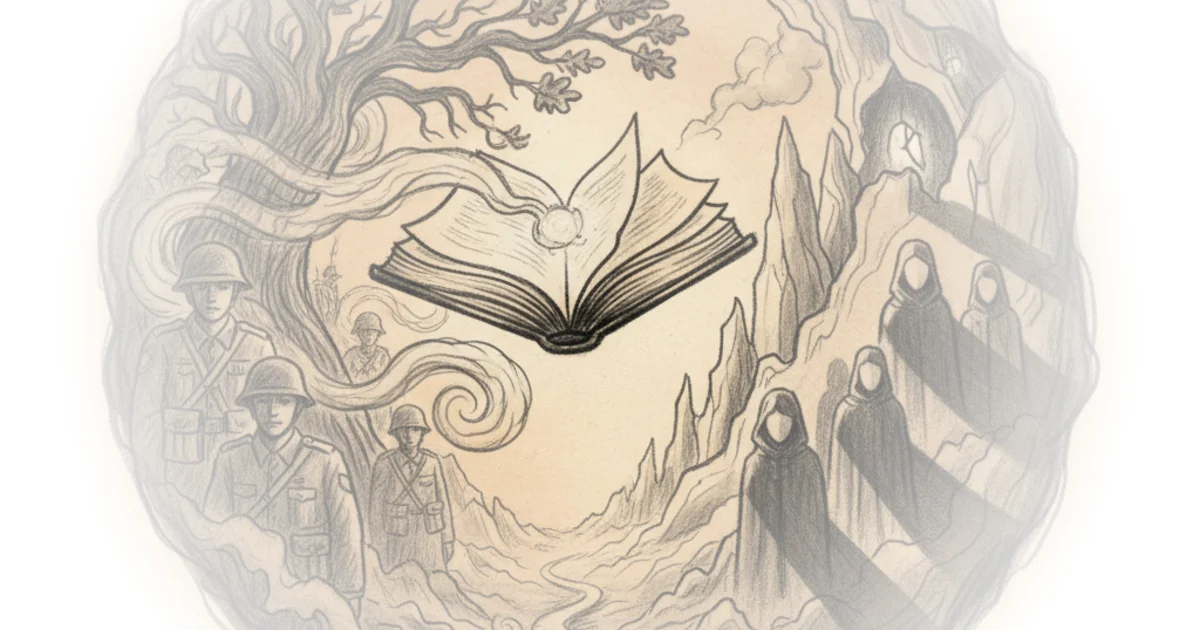
This framing is effective because it strips away the cinematic glamour often associated with the "Greatest Generation." The author emphasizes that these were not super-soldiers but ordinary people thrust into extraordinary circumstances. "Only months earlier they had been civilians—journalists, teachers, mechanics—who learned how to kill and to survive," Eisner writes. The historical weight of this is amplified by the specific context of the aircraft used. The mission relied on the Consolidated B-24 Liberator, a plane chosen for its range and speed but notorious for being physically demanding to fly, described by pilots as "like flying a truck." Unlike the B-17 Flying Fortress, which was the workhorse of daylight raids, the B-24 was stripped of its defensive turrets and painted black, becoming a stealth vehicle designed to evade searchlights rather than fight them.
"One mistake, and the aircraft could suddenly dive and the pilot might not be able to regain control before colliding with the ground."
The stakes were defined by the terrifying instructions given to the volunteers. Colonel Robert W. Fish, the operations officer, told the assembled pilots, "You'll learn to fly four hundred feet above the ground at ten miles per hour over stalling speed." The mission profile required navigating by landmarks and moonlight to find a specific field where a resistance fighter might be waving a flashlight. Eisner points out that despite the virtual suicide nature of the task, "none of them backed away." This detail underscores the moral clarity that drove the operation, a conviction that the world was broken and needed fixing, even if it meant flying into the dark without fighter escorts.
The Human Element and the Cost of Stereotypes
While the operational details are gripping, Eisner offers a sharp critique of Henderson's stylistic choices, particularly regarding the portrayal of the women involved. The book introduces the "Joes and Josephines," the agents and spies who parachuted into occupied Europe. Eisner argues that Henderson sometimes undermines their bravery by relying on superficial descriptions. "The airmen are 'big-boned,' 'cigar-chomping,' 'man's men.' The women show up as 'petite,' 'spirited,' or 'dark-eyed beauties.'" The commentator asserts that "these descriptors feel unnecessary" because the actions of these women were bold enough to stand without romanticization.
The critique is most pointed when discussing Nancy Wake, a central figure in the narrative. Wake was a New Zealand-born agent who became one of the most effective resistance leaders of the war, organizing thousands of fighters. Yet, Henderson describes her as a "hazel-eyed brunette with a sparkling smile." Eisner counters this by highlighting Wake's actual ferocity, noting she was a "force of nature who graduated from challenging the Nazis with her pen to killing them in combat." When Wake was told by a jumpmaster, "If you're afraid, ma'am, we'll take you back," her legendary response was, "I want to get out of this bloody plane!" She did not need a push; she needed to get to the fight. This contrast between the author's softening language and the historical reality of Wake's actions illustrates a broader issue in popular history: the tendency to view female agents through a lens of charm rather than capability.
Critics might note that popular history often relies on these tropes to make the narrative accessible to a general audience, but Eisner's pushback is vital. It reminds readers that the "Josephines" were warriors, not characters in a romance novel. The danger they faced was immediate and lethal; they carried cyanide pills in case of capture, knowing the Gestapo torture chambers awaited them if they failed. As Eisner puts it, "They were warriors, full stop."
The Technical and Moral Reality
Beyond the characterizations, Eisner praises Henderson's ability to explain the technical challenges of the missions. The author details the "dead reckoning" navigation, the reliance on early radar sets, and the sheer physical exhaustion of wrestling a four-engine bomber at treetop level. "He captures the claustrophobia of the aircraft and the bone-chilling cold of the unpressurized cabins," Eisner writes. This technical depth grounds the story in a reality that feels tangible to the reader, moving beyond the abstract concept of "war" to the specific, freezing, terrifying experience of the crew.
The narrative also touches on the psychological burden carried by these young people. Many of them downplayed their own bravery, a common trait among veterans. Eisner recalls his own interview with Col. Robert Z. Grimes, a former B-17 pilot, who told him, "I was too young and too dumb to know any better." However, reading Midnight Flyboys suggests that this was not just ignorance, but a profound sense of duty. "It wasn't just youth or ignorance that dulled their answers, it was a sense of purpose," Eisner argues. The moral clarity that drove them was the belief that they were fixing a broken world, a sentiment that resonates deeply in an era facing new threats of authoritarianism.
"Just below the surface of our society, in red states and blue states alike, we find men and women whose parents and grandparents and aunts and uncles fought this fight."
Eisner concludes that the book serves as a vital act of preservation. With so few World War II veterans left, the stories of the "Joes and Josephines" risk fading away. The commentary suggests that these stories are not just nostalgia but a challenge to the present: "They ask us if we, too, would have the courage to jump into the dark." The connection to the Special Operations Executive (SOE) and the Office of Strategic Services (OSS) highlights the joint enterprise that made these missions possible, a collaboration that required stripping away the heavy armament of the B-24 to prioritize speed and stealth.
Bottom Line
Eisner's review successfully elevates Midnight Flyboys from a standard war history to a meditation on the human cost of liberation, effectively using the "Children's Crusade" metaphor to strip away the myth of the invincible soldier. While the critique of Henderson's gendered stereotypes is a necessary correction, the piece's greatest strength lies in its refusal to glorify the violence, instead focusing on the terrifying vulnerability of young people flying heavy machinery into the night. The biggest vulnerability of the source material remains its occasional reliance on cinematic flourishes, but the core historical account of the Carpetbagger missions stands as a powerful reminder of the quiet, dangerous work that made the liberation of Europe possible.