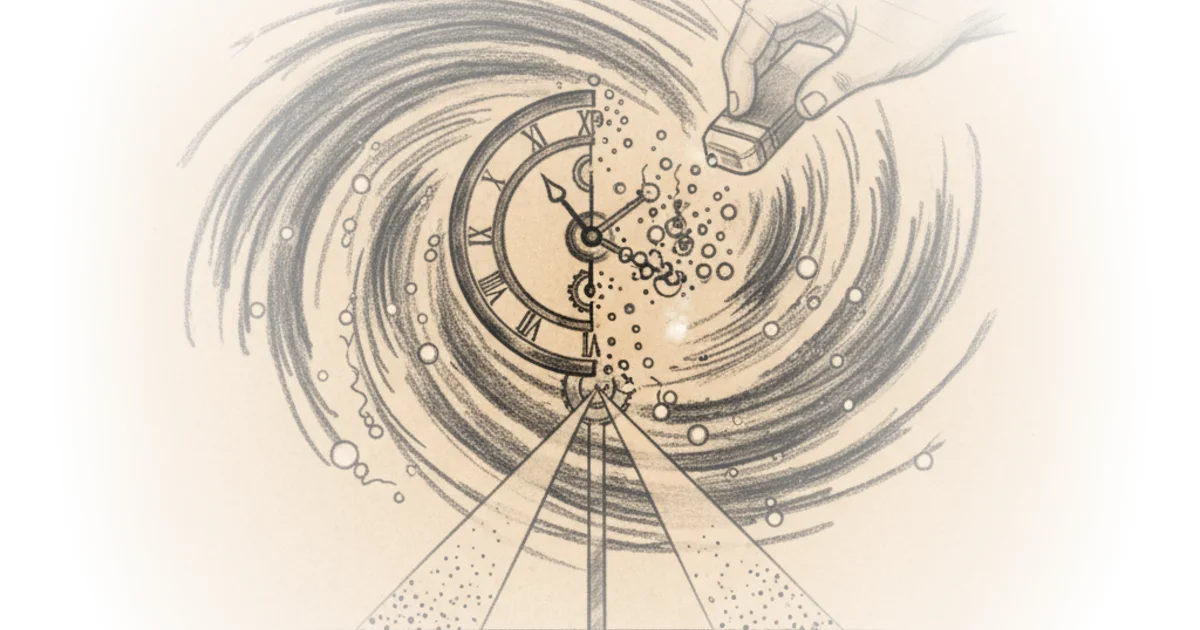
Matt O'Dowd and Mina from Looking Glass Universe dismantle a persistent myth in quantum physics: the idea that the future can rewrite the past. By recreating the infamous delayed choice quantum eraser experiment with household materials, they demonstrate that what looks like retrocausality is actually a mathematical illusion born from how we sort data. This is not just a video; it is a correction of a decade-long misunderstanding that even the hosts admit they previously propagated.
The Heart of the Mystery
O'Dowd begins by grounding the discussion in Richard Feynman's famous assertion that the double-slit experiment contains the "only mystery" of quantum mechanics. He explains that while Feynman was referring to superposition—the idea that a particle exists in all possible states simultaneously until measured—the real confusion arises when measurement is delayed. The standard narrative suggests that if you decide to measure a particle's path after it has already hit the screen, your future choice somehow forces the particle to have taken a specific path in the past.
"The most famous example is the one by Kim Yu Kulik Shei and Scully in 1999. Such experiments have been interpreted as saying that a future measurement can influence a past measurement retrocausal influence."
This framing is compelling because it taps into our intuitive sense of time as a rigid arrow. O'Dowd admits that his own channel previously failed to offer a robust alternative to this retrocausal interpretation, leaving many viewers with the impression that quantum mechanics allows for time travel. The strength of this new coverage lies in its honesty; the author is not hiding from past errors but using them as a launchpad for a clearer explanation.
"I'm really excited to show you this experiment because 12 years ago I did a video on the delayed choice quantum eraser where I got it completely wrong. And it was only doing this experiment that made it finally click for me."
The Illusion of Backward Time Travel
To explain the paradox, O'Dowd describes the classic setup where photons are cloned using a beta barium borate (BBO) crystal. One photon goes to a screen, while its entangled twin goes to a detector where the observer can choose to keep or erase "which-way" information. The bizarre result is that the pattern on the screen seems to change based on a choice made later in time. However, O'Dowd argues that this is a misinterpretation of how the data is aggregated.
"It acts as though we change photon A's behavior without actually touching it, only by measuring its twin. And if that wasn't weird enough, in the Kim experiment, the choice of whether to keep or discard the whichway information in photon B is made after its entangled partner photon A reached its detector."
The author's breakthrough comes from Mina's home experiment, which replaces expensive entanglement crystals with simple polarization filters and a calcite crystal. By marking the path of light with polarization (horizontal for one slit, vertical for the other), the interference pattern disappears, collapsing into a single-slit pattern. But when the observer uses a calcite crystal rotated at 45 degrees, the "which-way" information is scrambled, and the interference pattern reappears.
"So now just looking at the light after it goes through the calite isn't enough to tell us anything at all about which way the light went. In fact, it scramles up the light from both paths. So it basically erases all of that information that we had gotten by marking the paths."
This demonstration is powerful because it removes the mystique of "spooky action at a distance" and replaces it with a tangible mechanical process. The interference pattern was never a single, unified wave on the screen; it was two overlapping patterns that only become visible when the data is sorted correctly. Critics might note that this explanation relies heavily on the concept of post-selection, which can feel like cheating to those expecting a dynamic change in the particle's history. However, the math holds up: the total distribution of all photons always looks like a single-slit pattern, regardless of the future choice. The "retrocausality" only appears when you cherry-pick subsets of the data.
"If you look really closely at these two double slits, you'll see that they don't exactly line up. And in fact, they seem to be offset from each other the exact right amount that if you superimpose them, it looks like the single slit interference pattern. So what's going on? Well, it turns out that this is the solution to the entire paradox."
Bottom Line
O'Dowd's coverage succeeds by replacing a sensationalist narrative with a rigorous, hands-on demonstration that demystifies one of physics' most confusing experiments. The strongest part of the argument is the realization that the "future influence" is an artifact of data sorting, not a violation of causality. The biggest vulnerability remains the counter-intuitive nature of quantum mechanics itself, which will likely keep the retrocausal interpretation alive in pop culture despite this clear refutation.
"It acts as though we change photon A's behavior without actually touching it, only by measuring its twin."
The verdict is clear: the future does not change the past; our understanding of the data simply catches up to the present.