Ryan Grim and Jeremy Scahill deliver a harrowing dispatch that refuses to let the human cost of geopolitical maneuvering fade into the background. While the administration focuses on military posturing and border enforcement, the authors anchor their report in the visceral reality of a newborn dying of hypothermia and a nurse killed by federal agents, forcing a confrontation between official narratives and on-the-ground devastation.
The Human Toll of Frozen Borders
The coverage opens with a stark reminder that policy decisions have immediate, lethal consequences. Grim and Scahill write, "Another newborn dies of exposure to extreme cold on Tuesday, according to the Health Ministry, bringing the number of children who have died of hypothermia during this winter season in Gaza to 11." This is not merely a statistic; it is a direct indictment of the blockade. The authors highlight that the closure of the Rafah crossing has trapped over 20,000 patients awaiting medical evacuation, including 4,500 children.
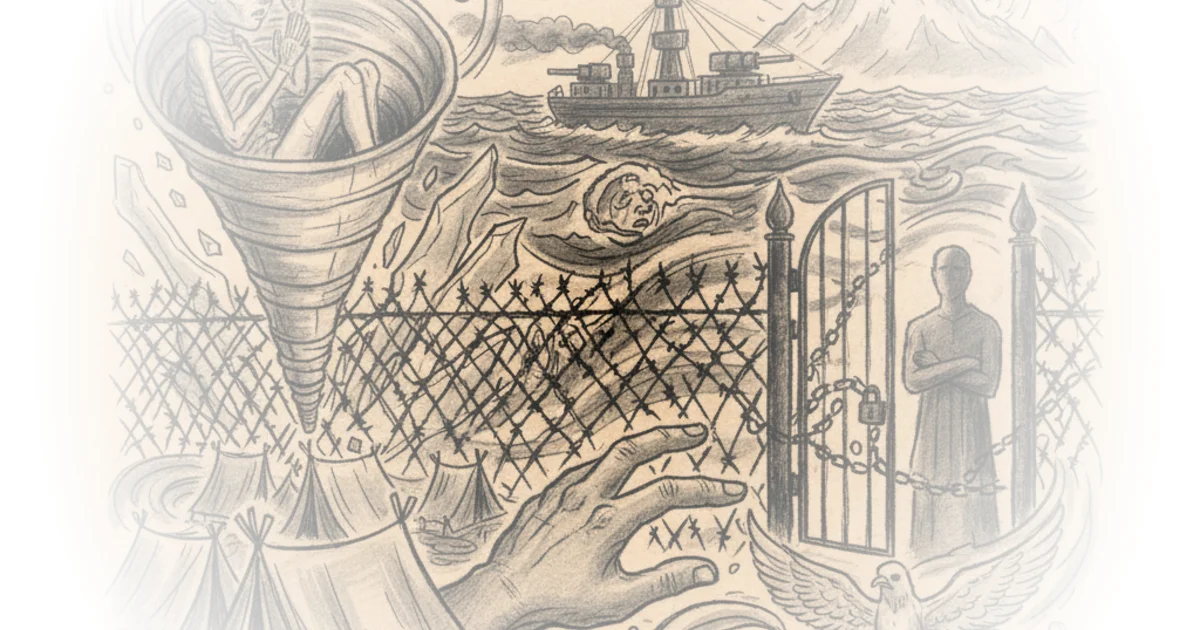
The framing here is deliberate: the authors juxtapose the bureaucratic delay of "permission to travel" with the biological urgency of dying patients. As Grim and Scahill note, "Over 1,200 patients have died while awaiting permission to travel abroad for treatment." This evidence suggests that the administrative freeze is functioning as a weapon of war, regardless of the stated intent. Critics might argue that security concerns justify border closures, yet the sheer volume of life-threatening cases awaiting evacuation undermines the notion that these restrictions are purely about safety.
"Opening the crossing and facilitating the exit of patients and the wounded, along with ensuring the smooth flow of essential medical supplies, is the last remaining hope for these patients."
The authors also expose the broader humanitarian collapse in the West Bank, where a record number of settler attacks have displaced tens of thousands. Grim and Scahill point out that "2025 saw a record number of Israeli settler attacks on Palestinians in the occupied West Bank, with more than 1,800 incidents—the highest ever recorded by the UN." This data challenges the narrative of stability often promoted by the administration, revealing a territory where displacement is accelerating rather than resolving.
The Escalation of Federal Force
Shifting to domestic enforcement, the piece scrutinizes the administration's aggressive immigration crackdown in Minnesota. The authors detail the transition of power from Gregory Bovino to Tom Homan, who is being dispatched as a "Border Czar" to report directly to the President. Grim and Scahill write, "Gregory Bovino and some of his U.S. Customs and Border Protection agents are expected to leave Minnesota immediately, following intense resistance to federal immigration enforcement operations after the fatal shooting of ICU nurse Alex Pretti by a Border Patrol agent on Saturday."
This section effectively highlights the friction between federal overreach and local resistance. The authors note that the FBI has opened an investigation into Signal group chats used by residents to track agents, a move the authors frame as a potential First Amendment violation. "Kash Patel said the move was inspired by conservative commentator Cam Higby... and drew sharp criticism from free speech advocates, who say that sharing lawfully obtained information about law enforcement is protected by the First Amendment." This framing forces the reader to question the administration's definition of "harm" versus the public's right to monitor law enforcement.
The political fallout is immediate and severe. Grim and Scahill report that "House Democrats are preparing to open an investigation into DHS Secretary Kristi Noem, laying the groundwork for a possible impeachment push, citing 'deadly and unconstitutional' conduct." The authors also capture the internal Republican split, noting that Senator Susan Collins backed the funding bill despite the violence, a move that underscores the political calculus often overriding humanitarian concerns.
Global Flashpoints and Labor Unrest
The commentary broadens to international tensions, specifically the deployment of the USS Abraham Lincoln strike group to the Middle East. Grim and Scahill describe this as a move that raises "the prospect that President Donald Trump could order airstrikes against Iran," though they focus on the strategic implications rather than the personality of the leader. The authors note that Turkey is already preparing contingency plans for a refugee wave, suggesting that the region is bracing for a catastrophic escalation.
Simultaneously, the piece highlights domestic labor unrest, with Kaiser nurses launching an "indefinite" strike. The authors connect this to broader systemic failures, quoting union complaints about "inadequate staffing levels, wages, and Kaiser's refusal to bargain in good faith." This parallel between international conflict and domestic labor strife creates a cohesive narrative about institutions failing their most vulnerable populations.
"This is not your fault—this is the Republicans' fault," said Frank Pallone Jr., the panel's senior Democrat, when addressing soaring health care costs to insurance CEOs.
The authors use this quote to illustrate the political deflection occurring in Washington. By highlighting that Pallone has accepted significant campaign cash from the insurance sector, Grim and Scahill subtly critique the integrity of the defense, suggesting that the political theater of blame-shifting masks deeper structural complicity.
Bottom Line
Ryan Grim and Jeremy Scahill succeed in stripping away the diplomatic veneer to reveal the raw, lethal mechanics of current policies. Their strongest argument is the unflinching linkage between bureaucratic decisions and preventable death, whether in Gaza or Minnesota. The piece's greatest vulnerability is its reliance on the assumption that the administration will respond to moral pressure, a hope that history suggests may be misplaced. The reader must watch for the next phase of the Iran deployment and the outcome of the Minnesota investigations, as these will determine whether the current trajectory leads to further escalation or a forced reckoning.