Anarchierkegaard challenges the modern reader to see politics not as a debate over policies, but as a totalizing machine that manufactures enemies to justify its own existence. In a landscape saturated with performative outrage, this piece offers a startlingly different lens: that the true antidote to political violence is not a better argument, but the radical, foolish act of loving one's neighbor without demanding they fit a specific ideological mold.
The Architecture of the Crowd
The piece opens with a grim diagnosis of our current moment. Anarchierkegaard writes, "Fundamentally, politics—or, at the very least, the victory of politics—comes in the imposition of a particular way of life onto a given population." The author argues that modern governance has evolved into a three-pronged system: institutional rule, propaganda that dictates respectable opinion, and violence to enforce those bounds. This is a heavy claim, suggesting that our very ability to think independently is being systematically eroded by the state's need for compliance.
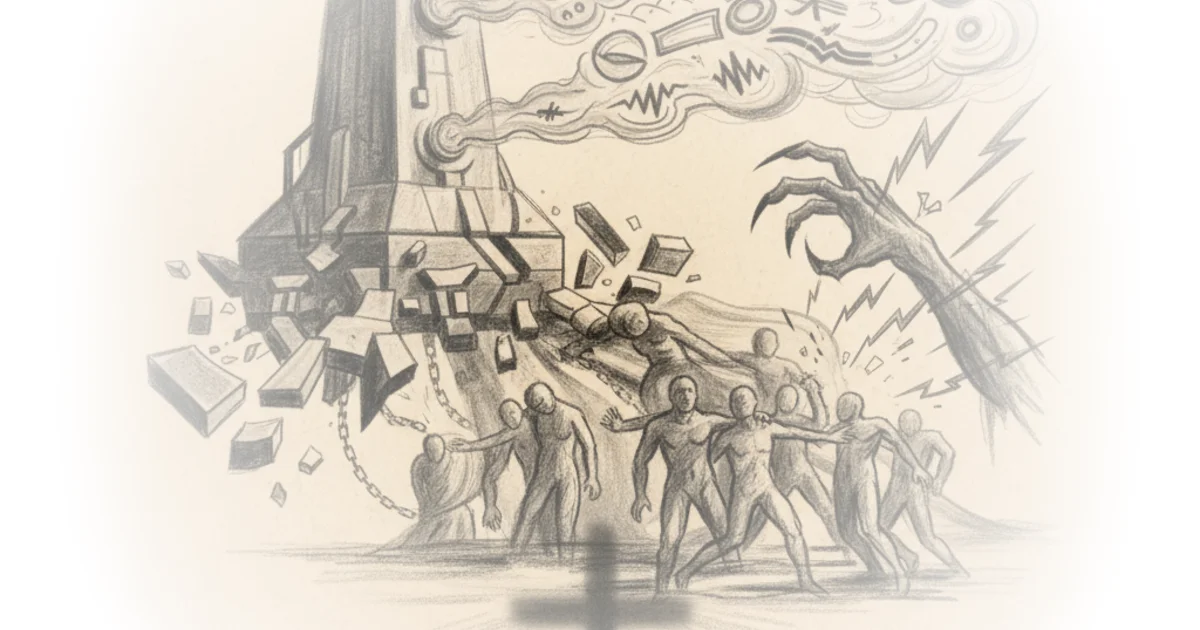
The author goes further, suggesting that even our protests are often managed to neutralize genuine dissent. "This also involves the creation and management of the counter-crowd as well—developing respectable avenues for protest that give malcontents ways to engage with the state in a way which absolves them of considered thought on their own part." This framing is provocative. It implies that the safety valve of "acceptable protest" is designed to keep people from ever questioning the system's foundations. Critics might argue this view is overly cynical, ignoring the genuine power of grassroots movements to effect change. However, the text's strength lies in its focus on the psychological cost of this dynamic: the reduction of human beings to mere roles in a script.
The soothing balm of Christ’s love, as prototype and pattern, actually a response to a state which only offers a call to arms—with Christ, there is only a call to alms in the offence of the world.
Here, Anarchierkegaard pivots from political critique to theological intervention. The author suggests that the state thrives on the binary of "friend" and "enemy," a dynamic that dehumanizes the "other." By citing the parable of the Good Samaritan, the text argues that true faith requires breaking this cycle. The author notes that figures often labeled as enemies—whether a "Russian forced conscript" or a "Palestinian Islamist extremist"—are often just neighbors turned against us by "psychopolitical structures." This is a crucial distinction. It forces the reader to confront the humanity of those the political machine demands we hate. The argument holds weight because it refuses to sanitize the reality of conflict while still insisting on the possibility of a different response.
Subverting the Wisdom of the World
The commentary then turns to the Apostle Paul, not as a religious figurehead, but as a radical disruptor of intellectual arrogance. Anarchierkegaard writes, "Where is the wise? Where is the scribe? Where is the disputer of this age? Has not God made foolish the wisdom of this world?" The author interprets this not as a rejection of reason, but as a rejection of the idea that human reason can be the ultimate ground of truth.
The piece argues that Paul's message was offensive to both the Jewish demand for signs and the Greek pursuit of wisdom because it centered on a crucified God—a symbol of weakness and failure in the eyes of the powerful. "Instead of offering us 'first things' or 'basic assumptions', he makes the grand declaration which rips apart all prior, respectable thought of the serious scholar." This is a compelling re-reading of scripture. It suggests that the very tools we use to justify our political and social orders—logic, hierarchy, strength—are the very things that blind us to the truth. The author effectively uses this to dismantle the confidence of modern ideologies, whether secular or religious, that claim to have the final answer.
No! says Paul to the Greek: only by sacrificing oneself at the altar of the self, in the quiet admission of finitude and limitedness, can we admit that there are things which may sit outside of our ability to make an assessment.
This admission of "finitude" is presented as the only path to genuine freedom. The author argues that when we stop trying to be the "ground of truth," we stop justifying the violence required to maintain our position. This section is the intellectual core of the piece, bridging ancient theology with a critique of modern authoritarianism. It suggests that the desire to control the narrative is a form of idolatry that inevitably leads to the oppression of the "other."
Against the 'Arky' of Self-Confidence
Bringing in the work of Vernard Eller, Anarchierkegaard introduces the concept of "arky"—human self-confidence that seeks to build programs and ideologies in God's name. The author writes, "Arky faith is that enthusiastic human self-confidence which is convinced that Christian piety can generate the holy causes, programs, and ideologies that will effect the social reformation of society." This is a sharp critique of those who claim to act for the greater good while inflicting harm. The text warns that this self-confidence is a trap: "No! this self-confidence, rooted in your determined grit that, above all, you are right and your neighbour shall suffer for this reason, is little more the insertion of Christ’s image into your cause in order to reach your cause’s ends."
The argument here is that true faith is not about having the right plan, but about the humility to recognize that we are often wrong. "If we are to learn anything from Kant, we might say that Eller has exposed the human willingness to take the very Lord God Himself, the One Who Weeps, and made Him a means to our ends." This is a powerful indictment of political messianism. It challenges the reader to ask whether their own convictions are driving them to love their neighbor or to crush them. The author notes that this applies to both the "Right or Left," suggesting that the danger lies in the structure of the ideology itself, not just its specific content.
Imitation, the imitation of Christ, is really the point from which the human race shrinks. The main difficulty lies here; here is where it is really decided whether or not one is willing to accept Christianity.
The piece concludes by returning to the existential challenge of imitation. Anarchierkegaard argues that Christianity has been diluted into an "intellectual doctrine" to make it palatable, stripping away the demand for radical, risky action. The author suggests that true faith is "objective uncertainty" held with "passionate inwardness." This is a difficult standard. It requires a level of commitment that many are unwilling to make. The text acknowledges this: "If there is emphasis on this point, the stronger the emphasis the fewer the Christians." This honesty about the difficulty of the path is what makes the argument so compelling. It refuses to offer a cheap solution to the deep problems of violence and division.
Housing policy was built on racist foundations, and we never tore them up. We just stopped talking about it.
Bottom Line
Anarchierkegaard's most powerful contribution is the reframing of political violence as a failure of imagination and humility, rooted in the human desire to be the ultimate authority. The argument's greatest vulnerability is its reliance on a theological framework that may feel inaccessible to secular readers, potentially limiting its reach. However, the core insight—that the machinery of the state and the crowd thrives on our refusal to see the humanity of the "other"—remains a vital and urgent warning for anyone navigating a fractured world.