Cory Doctorow delivers a chilling diagnosis of the modern labor market: the very algorithms designed to optimize efficiency are now being weaponized to extract a "desperation premium" from workers. This isn't just about dynamic pricing for consumers; it is about the systematic devaluation of human labor based on your credit card debt, your social media activity, and your inability to say "no." For busy professionals watching their own industries transform, the stakes could not be higher.
The Mechanics of Surveillance Pricing
Doctorow reframes the industry buzzword "personalized pricing" as something far more predatory. He writes, "What industry calls 'personalized pricing' is really surveillance pricing: using digital tools' flexibility to change the price for each user, and using surveillance data to guess the worst price you'll accept." The author's core insight is that this practice fundamentally alters the value of money and labor. If a company charges you more for the same product because they know you are desperate, they are effectively revaluing your currency. Conversely, when applied to wages, the logic flips: "If you get paid $1 for a job that I make $2 for, then the boss is valuing your labor at 50% of my labor."
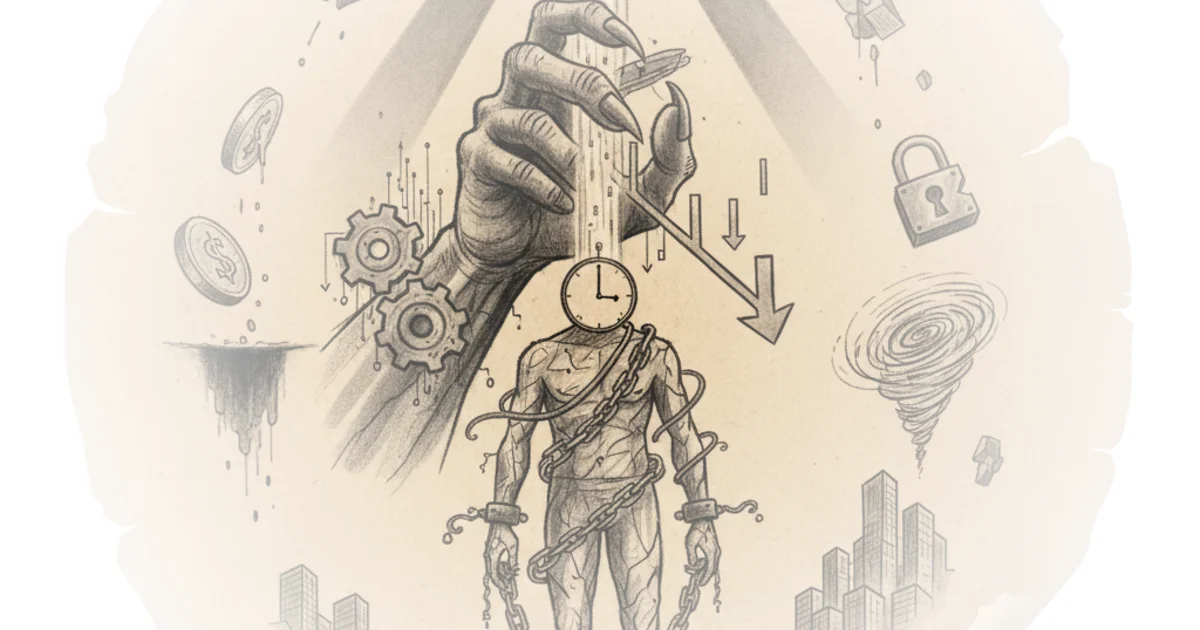
This argument is bolstered by the concept of "twiddling," a term Doctorow coined to describe how digitized businesses alter offers on a per-session basis. He notes, "Twiddling is my word for the way that digitized businesses can use computers' flexibility to alter their prices, offers, and other fundamentals on a per-user, per-session basis." The danger lies in the convergence of monopoly power, weak regulation, and this technological agility. Without effective privacy laws, companies can harvest data to predict economic precarity, creating a feedback loop where the most vulnerable workers are paid the least.
If all the garages in town set mechanics' wages using the same surveillance pricing tool, then a mechanic looking for a job will get the same lowball offer from all nearby employers.
Algorithmic Wage Discrimination
The article moves from theory to concrete examples, highlighting how this technology is already operational. Doctorow points to the gig economy, where Uber uses historic data to infer a driver's financial desperation. He explains that drivers who are pickier about rides are offered higher wages, while those who accept any ride—labeled "ants"—are offered less. "Uber uses historic data on drivers to make inferences about how economically precarious they are, and then extracts a 'desperation premium' from their wages." This is not a glitch; it is a feature designed to maximize extraction.
The scope extends far beyond ride-sharing. Doctorow details how contract nurses are now subject to wage-setting algorithms that check credit card debt and delinquency status. "The more debt you have and the more dire your indebtedness is, the lower the wage you are offered." This creates a vicious cycle where financial stress leads to lower income, which in turn increases debt. A recent report by Veena Dubal and Wilneida Negrón, cited by Doctorow, found that major firms in healthcare, logistics, and retail are adopting these tools. The definition is stark: "a system in which wages are based not on an employee's performance or seniority, but on formulas that use their personal data, often collected without employees' knowledge."
Critics might argue that these tools simply reflect market realities—if a worker is desperate, they are less valuable to a company. However, this ignores the power asymmetry. The company holds all the data; the worker holds none. The system is rigged to find the lowest possible wage a person will accept, not the fair market value of their work.
The Collusion Ruse and Historical Echoes
Perhaps the most damning aspect of Doctorow's analysis is how these tools facilitate illegal collusion under the guise of software neutrality. He argues that when multiple employers use the same surveillance wage tool, they effectively fix wages without ever speaking to each other. "If those bosses were to gather around a table and fix the wage for any (or all) mechanics, that would be wildly illegal, but the fact that this is done via a software package lets the bosses claim they're not actually colluding." This is a modern iteration of the "no-poach" agreements that led to massive antitrust fines for tech giants in the High-Tech Employee Antitrust Litigation of the 2010s. The irony is palpable: the programmers who built these systems are now the most likely to be targeted by them.
Doctorow also highlights the racial and gendered implications. Because marginalized groups statistically carry more debt due to historical discrimination, surveillance pricing acts as a proxy for race and gender discrimination. He calls this "empiricism washing": "first, move the illegal racist discrimination into an algorithm, then insist that 'numbers can't be racist.'" This allows companies to maintain a facade of compliance while systematically lowering wages for women and people of color.
This is a genuinely stupid ruse based on the absurd idea that 'it's not a crime if we do it with an app'.
The Regulatory Void
The piece concludes by examining the political landscape. Doctorow notes that while the previous administration briefly cracked down on these practices, the current executive branch has been "extraordinarily welcoming to surveillance pricing companies, dropping investigations and cases." This has left a vacuum that states are trying to fill. New York has passed a disclosure rule, and Colorado is considering the "Prohibit Surveillance Data to Set Prices and Wages Act." Yet, companies are lobbying ferociously against these measures while denying they use the technology. As Rep. Javier Mabrey asks, "if these companies don't pay surveillance wages, then 'what is the problem of codifying in law that you're not allowed to?'"
The author connects this to a broader failure of privacy law, noting that US regulations haven't been updated since the Video Privacy Protection Act of 1988, which was designed to stop video store clerks from sharing rental records. The gap between 1988 and today is the space where surveillance capitalism thrives. Without a federal privacy framework, the executive branch's inaction ensures that the most exploitative business models become the most profitable.
Bottom Line
Doctorow's strongest contribution is exposing how "surveillance wages" are not a futuristic threat but a current, scalable reality that leverages AI to automate wage suppression. The argument's vulnerability lies in its reliance on state-level legislation to solve a problem that is inherently national and global in scope. The reader must watch for the upcoming legislative battles in Colorado and similar states, as these will serve as the first real tests of whether law can catch up to the speed of algorithmic exploitation.