Paul Sagar, writing through the lens of Dan Williams, delivers a stinging critique of modern political philosophy, arguing that much of it has become an intellectual dead end. The piece's most arresting claim is that the field's most influential theories are akin to 'chmess'—a complex, rule-bound game that no one actually plays, leaving scholars brilliant at solving problems that don't exist in the real world. For busy leaders navigating actual policy crises, this is a vital warning: we cannot afford to spend our intellectual capital on perfecting systems that ignore the messy, non-compliant reality of human behavior.
The Chmess Trap
Williams introduces Sagar's central metaphor with precision, noting that Daniel Dennett once warned against pursuing 'higher-order truths' about games that don't exist. Sagar extends this to Anglophone political philosophy, asserting that 'a remarkable amount of what now passes for political philosophy is roughly the equivalent of chmess.' The argument is that by constructing idealized worlds, theorists have detached themselves from the very subject they claim to study. This framing is effective because it shifts the critique from 'this theory is wrong' to 'this theory is irrelevant,' a more damning charge for a discipline meant to guide action.
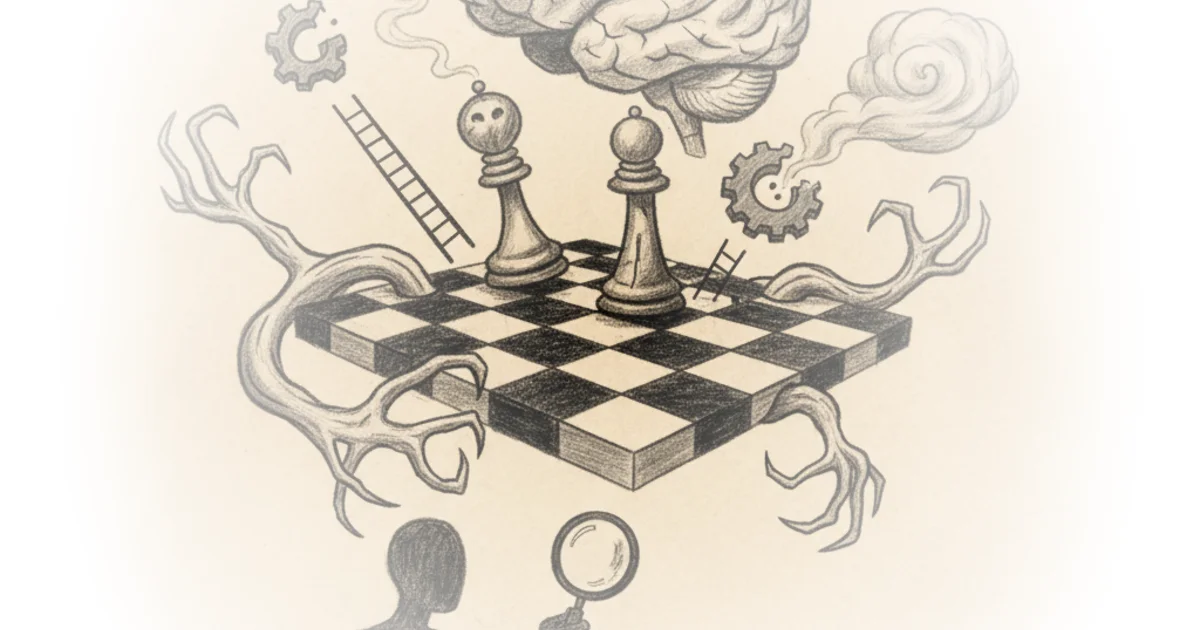
The essay targets John Rawls, the towering figure of post-war political theory, by dissecting his 'ideal theory.' Sagar points out that Rawls assumes agents are 'reasonable' in a technical sense, meaning they 'are ready to propose principles and standards as fair terms of cooperation and to abide by them willingly.' Furthermore, Rawls posits that society is 'closed' and that '(nearly) everyone strictly complies' with principles of justice. Williams notes that Sagar finds this deeply problematic, as it assumes away the 'circumstances of politics' that necessitate political theory in the first place. If everyone strictly complied with justice, we wouldn't need politics; we would just have administration.
'It is rather like turning up at the house of a chess tutor, wanting to learn more about chess, and being told that one must spend years studying the intricacies of chmess.'
This analogy lands hard because it exposes the absurdity of the current academic trajectory. Sagar argues that while Rawls's work is a 'towering intellectual achievement taken on its own terms,' it fails as a guide for the real world. The author compares Rawls's assumptions to changing the rules of chess so the king can move two spaces or knights can hover above the board. The result is a rigorous system of logic that applies to nothing. As Williams paraphrases Sagar's conclusion: 'What he gives us conspicuously leaves out crucial fixed points of politics, and as a result, offers an analysis of something else.'
Critics might argue that ideal theory serves a necessary normative function, providing a North Star for reform even if we can never reach it. However, Sagar anticipates this defense and dismantles it by asking why a theory that requires impossible conditions can ever offer a 'rational basis for continually adjusting the social process.'
The Defense of the Impossible
The piece then explores the standard defense of ideal theory: that it provides the only principled basis for critique. Sagar imagines a dialogue where an 'eminent colleague' argues that a world where everyone played chmess would be better, and therefore we should study it. But Sagar cuts through this with a pragmatic reality check. He writes, 'People have invested years in learning the rules of chess; some of them have built prestigious careers in it, and their income and status depends on it.'
The argument here is that theoretical superiority means nothing if the transition is impossible. Sagar notes that even if chmess were 'better,' the fact that 'they aren't going to, are they?' is a decisive factor. The essay highlights how theorists often retreat to the claim that change is not impossible, just difficult. Sagar rejects this, stating that 'the superiority of chmess stands independent of won't, in all its guises!' is a trap. The validity of a theory cannot be divorced from the feasibility of its application in a world of vested interests and historical inertia.
'It is not an option for us to "play" ideal theory in real life, so what is achieved by our discussing how we should play it if we could, and yet knowing full well that we can't?'
This section is the most potent for practitioners. It challenges the administration and policy makers who rely on abstract frameworks that assume a level of rationality and compliance that simply does not exist. Sagar points out that between one-fifth and one-third of American citizens hold views that Rawls would deem 'unreasonable,' yet these are the very people who must be governed. To build a theory that excludes them is to build a theory for a country that doesn't exist.
Bottom Line
The strongest part of this argument is its refusal to grant 'intellectual rigor' as a substitute for 'real-world relevance,' forcing the field to confront the gap between its models and the messy reality of human nature. Its biggest vulnerability lies in potentially discarding the normative value of ideal standards, which some argue are necessary to measure progress even if perfection is unattainable. Readers should watch for how this critique reshapes the next generation of policy frameworks, moving them away from abstract perfection and toward pragmatic, imperfect solutions.